

Quick answer
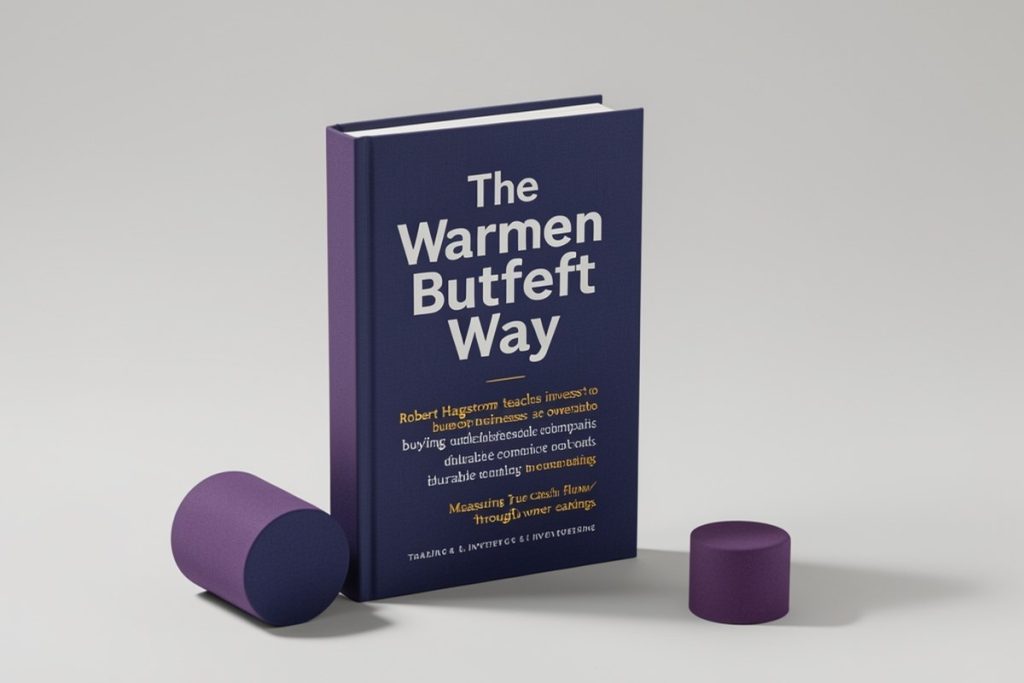
The Warren Buffett Way by Robert Hagstrom teaches investors to evaluate businesses as owners, not traders. It emphasizes buying understandable companies with durable economic moats, measuring true cash flow through owner earnings, and holding concentrated positions when the price offers a margin of safety. The framework remains a practical guide for investors who prefer rational analysis over market timing.
Key takeaways
- Focus on business quality and consistent returns on equity rather than cheap stock prices alone.
- Use owner earnings—net income plus depreciation minus maintenance capex—to estimate intrinsic value.
- Stay inside your circle of competence; avoid businesses you cannot evaluate with confidence.
- A concentrated portfolio of 8 to 15 well-understood holdings often outperforms over-diversification.
- Treat market volatility as an opportunity to buy, not a signal to panic or follow the crowd.
What The Warren Buffett Way Actually Teaches
Robert Hagstrom’s book organizes Buffett’s philosophy into four tenets: business, management, financial, and market. Instead of promoting stock tips, it teaches a filtering process. You begin by asking whether the company has a durable competitive advantage—what Buffett calls an economic moat. Then you examine whether management allocates capital rationally rather than chasing growth for its own sake. Financially, you look for high and consistent return on equity without relying on excessive debt. Finally, you compare your estimate of intrinsic value against the market price and wait patiently for a margin of safety.
This approach is materially different from mainstream advice that treats investing as a vote on next quarter’s earnings. Hagstrom shows that Buffett’s success came from treating a share of stock as a share of a business. If you cannot explain how the company makes money, how it defends its margins, and what could kill its earnings in the next ten years, it does not belong in your portfolio. In an era of algorithmic trading and social media noise, that discipline is a genuine edge.
How to Calculate Owner Earnings
One of the most useful concepts in the book is owner earnings. Buffett distrusts reported net income because accounting rules allow non-cash charges and paper gains to obscure the cash a business actually generates for its owners. The simplified formula is:
Owner Earnings = Net Income + Depreciation/Amortization − Capital Expenditures
The tricky part is separating maintenance capex from growth capex. Maintenance capex keeps the business running; growth capex expands it. You want to subtract only the maintenance portion, because that is the true cost of maintaining current earning power. This figure often requires reading the cash flow statement and management discussion in annual reports, not just screeners. Look for clues in historical asset growth: if plant and equipment barely grew but capex stayed high, most of it was likely maintenance. Once you have a normalized owner earnings figure, you can apply a discount rate that reflects the risk of those cash flows and compare the result to the company’s market capitalization.
Circle of Competence and Why It Protects Your Capital
Buffett’s outperformance is not driven by superior intelligence in every industry; it is driven by discipline. He simply refuses to invest outside his circle of competence. For most individual investors, this means starting with industries you interact with professionally or as a consumer. If you work in logistics, you likely understand trucking and warehousing economics better than semiconductor fabrication cycles.
The danger of drifting outside your circle is that you substitute brand familiarity for genuine understanding. Knowing a company’s product does not mean you understand its unit economics, regulatory risks, or capital intensity. Hagstrom repeats this warning because it is the single largest source of permanent capital loss: paying a fair price for a business you overestimated. When you find an industry opaque, the rational move is often a low-cost index fund, not a speculative stock pick.
Concentration Versus Over-Diversification
The book challenges the conventional wisdom that more diversification always equals less risk. Buffett argues that wide diversification is only necessary when an investor does not understand what they own. If you have done the work to identify a wonderful business selling below its intrinsic value, adding a twentieth mediocre holding dilutes both your returns and your attention.
That said, concentration amplifies error. A portfolio of eight to fifteen positions assumes you have analyzed balance sheets, competitive dynamics, and valuation with rigor. If your research is lazy, a concentrated bet becomes speculation. Position sizing should reflect the gap between your valuation and the market price—the larger the margin of safety, the more comfortable a larger position becomes. The framework demands deep work in exchange for the right to bet boldly.
Practical Checklist: Evaluating a Business Before You Buy
| Checklist Item | What to Verify |
|---|---|
| Return on Equity | Consistently above 15% over a decade without relying on heavy leverage |
| Owner Earnings | Positive, growing, and largely free of accounting gimmicks or unsustainable cost cuts |
| Capital Allocation | Management reinvests retained earnings at high incremental returns or returns cash to shareholders |
| Economic Moat | Evidence of pricing power, cost advantages, or network effects in gross margins and market share |
| Valuation | Current market price offers a clear margin of safety to your discounted owner earnings estimate |
Where This Book Fits in a Modern Investor’s Library
As an Amazon Associate, GetWitty may earn from qualifying purchases. While Buffett’s shareholder letters remain the primary source for his thinking, Hagstrom’s The Warren Buffett Way (30th Anniversary Edition) offers a structured synthesis that many investors find easier to navigate. It connects the philosophy to actionable filters rather than leaving the reader to reconstruct the logic from decades of correspondence. It is best used as a framework manual, not a stock-picking shortcut, and pairs well with primary financial statements and your own industry research.
Common Mistakes Readers Make
Even a sound framework fails when execution is sloppy. One frequent error is confusing a popular consumer brand with a great business. A product you enjoy may come from a company with terrible capital allocation and thin margins. Another mistake is ignoring the opportunity cost of capital. Holding a mediocre “value” stock for years because you are too proud to sell destroys wealth just as surely as overpaying for a growth darling.
Investors also misuse the “long term” label to justify poor entry prices. Buffett’s patience applies after the purchase, not before. He is willing to wait years for the right price, but once he buys, he expects the business to perform. If you pay too much, even a wonderful company can deliver subpar returns for a decade. Finally, watch debt. A business with a moat can still drown if leverage turns a temporary downturn into a solvency crisis. Owner earnings mean little if interest obligations swallow them.
Sources
Last reviewed: 2026-08-10