
Quick answer
For small repairs, choose a precision screwdriver set by matching its bit shapes and sizes to the fasteners you actually face, then check grip, magnetic retention, storage, and build quality. A compact multi-bit kit can be practical for PCs, phones, watches, and bicycles, but it is not a substitute for correct bit fit, safe power-down procedures, or specialty tools.
Key takeaways
- Identify the screw types you need before counting the number of included pieces.
- Choose a handle that gives steady pressure without forcing your wrist into an awkward position.
- Magnetic bits help manage tiny fasteners, but they do not replace correct sizing or safe handling.
- Use an organized kit only when its storage makes the right bit easy to find.
Start with the repairs you actually plan to make
The best precision screwdriver set is not necessarily the one with the largest piece count. It is the set that contains the correct bit profiles for the jobs you expect to do. A person repairing eyeglasses, a laptop, and a bicycle derailleur may need a different combination from someone opening watches or replacing a phone battery.
Make a short list of your likely projects first. Common precision fasteners include Phillips, slotted, Torx, hex, tri-point, and pentalobe designs. The correct shape should sit firmly in the screw head with minimal rocking. If a bit feels loose, stop rather than pressing harder; a near-match can damage the fastener and make the repair more difficult.
Also check whether the kit uses interchangeable bits or dedicated screwdrivers. Interchangeable bits save space and make it easier to cover more sizes, while dedicated drivers can feel simpler when you repeatedly use the same size. Neither design is automatically better; the right choice depends on whether portability or speed matters more for your work.
Look beyond the piece count
A useful kit should make small repairs easier, not create another sorting problem. Look for a handle with a comfortable, non-slip surface and enough length to apply controlled pressure. Very short handles can be convenient in tight spaces but may be tiring during longer jobs. A rotating end cap can also help when you need to turn a screw with your fingertips while keeping the shaft aligned.
Magnetic retention is useful for keeping a tiny screw attached to the bit while you position it. It can also make removal less frustrating when a fastener is recessed. However, magnetic retention is a convenience feature, not a guarantee that a screw will never fall. Work over a clear surface and keep a small tray nearby.
A ratcheting handle can reduce repeated repositioning during a repair. It is most helpful when access is limited and you need to turn the driver through short movements. For delicate electronics, use controlled pressure rather than treating the ratchet like a high-torque tool. Precision fasteners are easy to strip when the bit is misaligned or excessive force is applied.
Choose a kit that fits your workspace
Storage affects how often you will use the tools. A case with a fixed place for each bit lets you see what is missing and return pieces without mixing sizes. A compact design is useful for a home drawer, travel bag, or shared workspace, but very small compartments can be difficult to handle if the labels are unclear or the bits sit too tightly.
| What to check | Why it matters |
|---|---|
| Bit variety | Helps cover the fasteners used in your target devices or projects. |
| Handle comfort | Supports steady pressure and reduces awkward twisting. |
| Magnetic retention | Helps position and retrieve small screws. |
| Storage layout | Makes the correct bit easier to find and replace. |
| Access length | Determines whether the driver can reach recessed screws. |
Use a simple safety workflow
Before opening any device, shut it down and disconnect it from external power. If it contains a removable battery, remove it when the manufacturer’s instructions allow that step. Never use a screwdriver as a pry tool unless the repair instructions specifically identify it for that purpose; the tip can slip, damage a component, or injure you.
For electronics, work on a clean, dry surface and avoid unnecessary contact with exposed circuit components. Electrostatic discharge can damage sensitive electronic parts even when the damage is not immediately visible. The Electrostatic Discharge Association explains why controlling static is important when handling electronic devices. An appropriate anti-static setup may be worthwhile for repeated computer or device repairs.
Keep removed screws in separate groups as you work. Similar-looking screws can have different lengths, and putting a longer screw in the wrong location can damage internal parts. A small tray with separate sections, a temporary parts organizer, or a simple work map can help. If a screw will not turn with moderate pressure, reassess the bit size and alignment instead of forcing it.
Is a compact 24-piece magnetic kit a sensible choice?
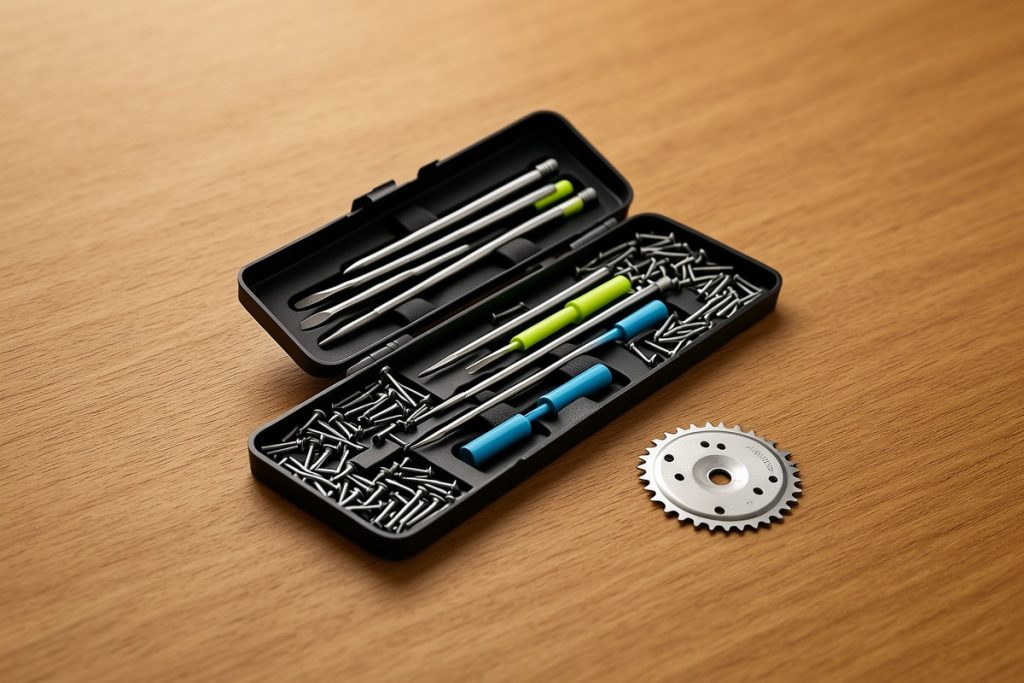
A compact multi-bit set can be a reasonable starting point for occasional repairs because it combines storage and bit variety in one tool. The DYLIFE 24 in 1 Magnetic Screwdriver Set is listed as a magnetic precision kit with a ratchet, removable design, and varied head styles for projects involving PCs, mobile devices, watches, and bicycles. Those stated features make it worth considering if your repairs span several small-device categories.
It may be less suitable if you already know you need a specialized driver, a longer shaft, unusually high torque, or a particular bit standard that is not clearly included. Before buying, compare the listed bit styles with the fasteners in your own project. Also consider whether the compact case and handle will be comfortable for you to use; a broad feature list does not automatically mean every tool will fit every repair.
A practical buying checklist
- List the devices or projects you expect to repair.
- Identify their screw shapes and approximate sizes.
- Confirm that the set includes those profiles, not just a high total count.
- Check whether the handle, shaft, and case suit your workspace.
- Plan for an anti-static setup if you regularly handle exposed electronics.
- Keep a separate tray available for removed screws.
The bottom line
Choose a precision screwdriver set by repair coverage, control, and organization. A magnetic multi-bit kit is useful when you work across small devices and want one compact solution, but the correct bit fit remains the most important factor. Start with your actual projects, follow a careful power-down and screw-sorting routine, and choose a specialty tool when the repair demands one.
Last reviewed: 2026-09-21
Sources
- Hand and Power Tools — Occupational Safety and Health Administration.
- About Electrostatic Discharge — Electrostatic Discharge Association.