
Quick answer
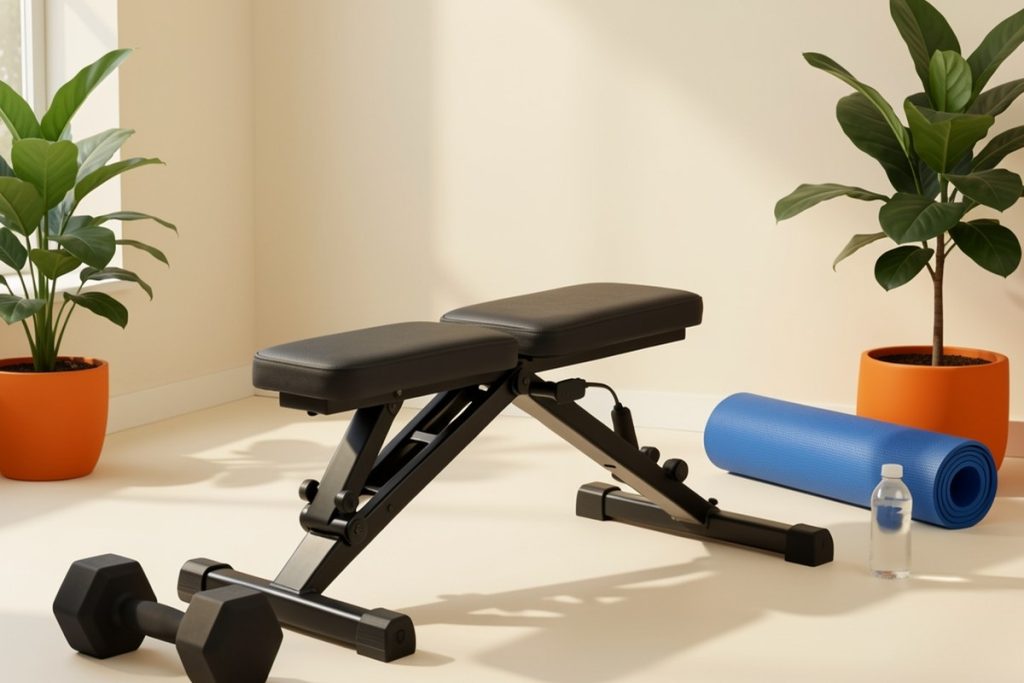
An adjustable bench can turn a pair of dumbbells into a practical full-body home workout. Use it for presses, rows, split squats, hip thrusts, shoulder work, and controlled back extensions. Train two or three days per week, begin with manageable weights, and progress by adding repetitions before load. The best bench is one you can set up safely and use consistently.
Key takeaways
- Use flat, incline, and upright positions to train your chest, shoulders, back, legs, and core.
- Start with two or three sets per exercise and stop with a few controlled repetitions still available.
- Progress gradually by adding repetitions, then small amounts of weight.
- Check the bench position, locks, floor stability, and available space before every workout.
By Jax Morrison, High-Energy Motivator
Why an adjustable bench is useful at home
A bench does not replace a complete home gym, but it gives ordinary dumbbells more options. Instead of performing every exercise from the floor, you can support your back, change your pressing angle, elevate one foot, or anchor your body for controlled movements.
That flexibility matters when your goal is a full-body routine rather than a chest-only workout. A flat bench position supports dumbbell presses and hip thrusts. A low incline can make pressing feel more comfortable for some people while changing the emphasis of the movement. A more upright position gives you a stable base for seated shoulder presses. The bench can also support single-leg exercises, rows, and carefully performed trunk work.
The biggest benefit is not novelty. It is repeatability. If your equipment lets you perform several useful movements in one space, you are more likely to follow a realistic schedule. The U.S. Department of Health and Human Services recommends muscle-strengthening activity involving all major muscle groups on at least two days each week, so a simple, repeatable setup can support that target.
A simple full-body adjustable bench workout
Perform this routine two or three nonconsecutive days per week. Begin with five minutes of easy movement, such as marching, cycling, or brisk walking, followed by a few unloaded repetitions of your first exercises. Choose a weight that allows clean technique and leaves roughly two or three good repetitions in reserve.
| Exercise | Bench setup | Starting prescription |
|---|---|---|
| Dumbbell bench press | Flat | 2–3 sets of 8–12 repetitions |
| One-arm dumbbell row | Flat, with one knee and hand supported | 2–3 sets of 8–12 per side |
| Bulgarian split squat | Rear foot supported on the bench | 2–3 sets of 8–10 per leg |
| Seated dumbbell shoulder press | Upright or comfortable incline | 2–3 sets of 8–12 repetitions |
| Dumbbell hip thrust | Upper back supported on the bench | 2–3 sets of 10–15 repetitions |
| Controlled back extension or plank | Roman-chair setup or flat floor | 2 sets of 8–12 or 20–40 seconds |
Rest about 60 to 120 seconds between most sets, and take longer if your breathing or technique has not settled. Move through the workout in the listed order: larger, more demanding movements first, then smaller or more isolated work.
How to perform the main movements safely
Dumbbell bench press: Place both feet firmly on the floor and keep your shoulder blades gently drawn back. Lower the weights under control rather than allowing them to drop quickly. Press upward without letting the dumbbells collide. If you cannot maintain a stable position, reduce the load.
One-arm row: Support one hand and knee on the bench while keeping your back long. Pull the dumbbell toward your hip, not directly toward your shoulder, and avoid twisting to create momentum. Complete both sides before increasing the weight.
Bulgarian split squat: Start with your rear foot on the bench and use bodyweight until your balance is reliable. Lower slowly, keeping the front foot planted and the knee tracking in the same general direction as the toes. The bench should support your foot, not force an extreme range of motion.
Hip thrust: Position the edge of the bench across your upper back, not your neck. Brace your midsection, drive through your feet, and finish by squeezing your glutes without over-arching your lower back. Use a lighter weight until the setup feels secure.
Back extension: Keep this movement controlled and use a range that feels comfortable. Your goal is to move from the hips while maintaining a neutral spine, not to swing or force your torso far below your legs. If the Roman-chair position does not fit your body well, substitute a plank or another core exercise.
Choosing the right bench angle
More adjustment is not automatically better. The useful setting is the one that gives you support without creating pressure, sliding, or awkward joint positions.
- Flat: Use for dumbbell presses, hip thrusts, supported rows, and some core variations.
- Low incline: Try this for pressing when a slight change in torso position feels more comfortable.
- Upright: Use for seated shoulder presses and other exercises where you want more back support.
- Decline: Treat it as optional. It is not necessary for an effective full-body program, and you should use it only when the bench feels completely stable.
Before adding weight, adjust the bench and sit or lie on it with no equipment. Check that the backrest and seat are fully locked, the frame does not rock, and your feet can reach the floor where needed. If you are training in a shared room, leave enough clearance to lift dumbbells into position and place them down safely.
How to progress without chasing maximum weights
Progress does not require testing your one-repetition maximum. A safer, more useful approach is double progression: keep the weight the same while you gradually add repetitions within a chosen range. For example, if your target is two sets of 8–12, begin with 8 and 8. Over several sessions, work toward 12 and 12 with steady form. Then increase the weight by the smallest practical amount and return to the lower end of the range.
Keep a simple record of the exercise, bench position, weight, repetitions, and how the set felt. If your technique becomes inconsistent, the load is too heavy or the bench angle is not helping. You can also progress by improving control, pausing briefly at the hardest point, or using a single-leg or single-arm variation. Change only one variable at a time so you know what actually improved.
For most beginners, consistency beats complicated programming. Repeat the same routine for four to six weeks, make small adjustments, and assess whether your movements feel stronger and more controlled. Muscle soreness is not the scorecard; steady training and recoverable effort are more useful measures.
When a multi-function bench makes sense
A multi-function adjustable bench may solve a practical problem if you want one piece of equipment to support pressing, rows, split squats, hip thrusts, and additional trunk work. One example is the Finer Form Multi-Functional Adjustable FID Weight Bench and Roman Chair | 1,000 Lb Capacity, 23 Settings, Flat Incline Decline for Total Body Workouts, Transport Wheels, Exercise Chart Included.
According to the listed product specifications, this model offers flat, incline, and decline configurations, 23 adjustment settings, a Roman-chair function, transport wheels, and a stated 1,000-pound capacity. Those features make it worth considering for someone who wants exercise variety from a single bench. They do not guarantee that the bench will fit every room, body type, or training style.
Before buying, check the current dimensions, user-height compatibility, assembly requirements, floor clearance, return terms, and manufacturer instructions. A stated capacity should not be interpreted as an invitation to load the bench to its maximum or as a substitute for correct setup. Your usable limit also includes your body weight and any equipment you are holding.
Pre-workout bench safety checklist
- Place the bench on a firm, level surface with clear space around it.
- Confirm every adjustment point is fully engaged before sitting or lying down.
- Test the bench with bodyweight before using dumbbells.
- Use a spotter or a safer alternative for challenging presses if you train alone.
- Stop for sharp pain, unusual dizziness, chest pain, or symptoms that do not feel like normal effort.
Keep the energy high, but let your technique set the pace. A bench workout should feel challenging without becoming chaotic. If you have an injury, a medical condition, or uncertainty about a movement, get individualized guidance from a qualified health professional before progressing.
Last reviewed: 2026-08-14
Sources
- Physical Activity Guidelines for Americans, 2nd edition — U.S. Department of Health and Human Services.
- Progression Models in Resistance Training for Healthy Adults — American College of Sports Medicine position stand, published in Medicine & Science in Sports & Exercise.