
Quick answer
Choose an adjustable weight bench by matching its adjustment range, stability, padding, footprint, and storage features to the exercises you actually plan to do. For a small home gym, a bench that supports flat, incline, and decline positions can replace several specialized pieces of equipment, but only if it fits your available space and remains stable under your intended load.
Key takeaways
- Prioritize stability and adjustment quality before chasing a high weight-capacity number.
- Measure both the bench’s working footprint and its storage footprint before buying.
- Flat, incline, and decline positions offer more exercise options, but more settings do not automatically mean better construction.
- Check whether the listed capacity includes your body weight, external weights, or both.
Why an adjustable bench can solve a small-space problem
A weight bench is useful when your main limitation is not motivation but equipment overlap. A stable bench can support pressing, rowing, split squats, hip thrusts, step-ups, core work, and many dumbbell exercises without requiring a full rack of machines. An adjustable design adds incline and decline positions, allowing you to change your body angle rather than buying separate benches for different movements.
That flexibility matters in a spare bedroom, apartment, or garage where every square foot has to earn its place. However, an adjustable bench is not automatically the right purchase for every home gym. If you mainly perform standing exercises, bodyweight training, or mobility work, a folding mat and a few resistance bands may solve your problem more simply.
The best choice depends on your actual training pattern. Adults are generally advised to perform muscle-strengthening activity on at least two days each week, covering all major muscle groups. A bench can make that training more comfortable and varied, but it is only one tool within a broader plan.
Match the bench design to your training goals
Start with the movements you expect to perform most often. Do not begin with a feature list and try to invent a use for every adjustment.
| Your priority | Bench features to look for | What to watch out for |
|---|---|---|
| Dumbbell pressing | Stable back support, firm padding, several incline positions | A narrow or flexible back pad that shifts during setup |
| Full-body home training | Flat, incline, and decline positions with a supportive seat | Adjustment mechanisms that are difficult to lock securely |
| Small-room storage | Transport wheels, manageable weight, and a compact folded or upright footprint | Measuring only the bench and forgetting clearance around it |
| Heavier strength work | A stable frame, clear capacity information, and minimal movement under load | Assuming a large capacity figure guarantees stability in every position |
If you are unsure, flat and incline positions are usually the most broadly useful starting points. Decline capability can expand your exercise choices, but it may require more floor clearance and can be less important than a solid flat position.
Five checks to make before buying
1. Measure the complete operating space
Measure the room where you will exercise, then add space for dumbbells, a barbell, or your body to move safely around the bench. A bench may fit against a wall when stored but need substantially more room when you lie down, adjust the back pad, or perform a movement beside it.
Also check ceiling height if you plan to use the bench with overhead presses or a rack. In a shared room, consider whether the bench can be moved without scraping flooring or blocking a doorway.
2. Examine the adjustment system
Look for clearly defined positions and a locking mechanism that is easy to engage before each set. A back pad should not wobble noticeably when you shift from the seat to the working position. Pin, ladder, and lever systems can all work well; the important factors are secure engagement, accessible controls, and a design that does not force you to place fingers beneath a heavy pad.
More settings can be useful, but only when they are practical to adjust. A bench with fewer positions may be the better choice if those positions are sturdy, easy to reach, and suited to your routine.
3. Interpret weight capacity carefully
Manufacturers do not always present capacity figures in the same way. One figure may include your body weight and the weights you lift, while another may describe only the external load. Read the product specifications and, when necessary, contact the manufacturer for clarification.
Choose a margin above your current needs rather than buying for a theoretical maximum. Your body weight, dumbbells, barbell, and any added resistance all contribute to the force placed on the bench. Stability also depends on how that load is distributed and whether the bench is flat or inclined.
4. Assess comfort without confusing softness for support
Padding should be firm enough to support you without creating pressure points. Excessively soft upholstery can make it harder to stay stable, while very thin padding may become uncomfortable during longer sessions. Check the width of the back pad and seat, the gap between them, and whether the edges feel supportive rather than intrusive.
Comfort is especially relevant if the bench will be used for several exercises in one session. A bench that feels acceptable for a quick press may be frustrating during supported rows, hip thrusts, or core work.
5. Consider storage and maintenance
Transport wheels can make a heavy bench easier to move, but they do not eliminate the need for a safe storage location. Keep the bench on a level surface, inspect adjustment points periodically, and follow the manufacturer’s instructions for tightening hardware and cleaning upholstery.
Where the Finer Form adjustable bench fits
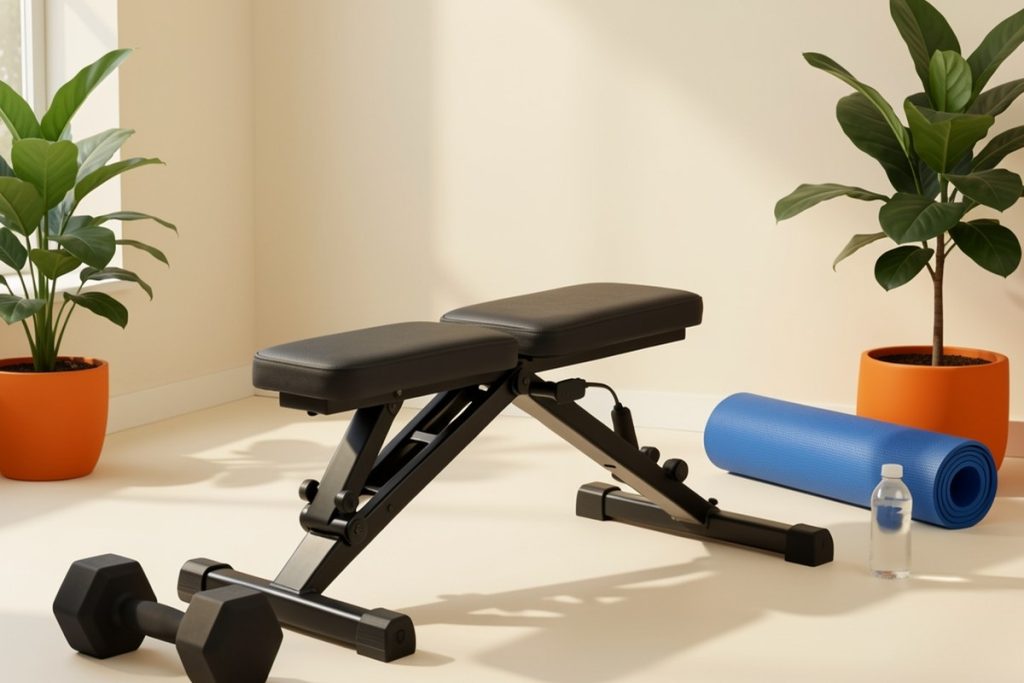
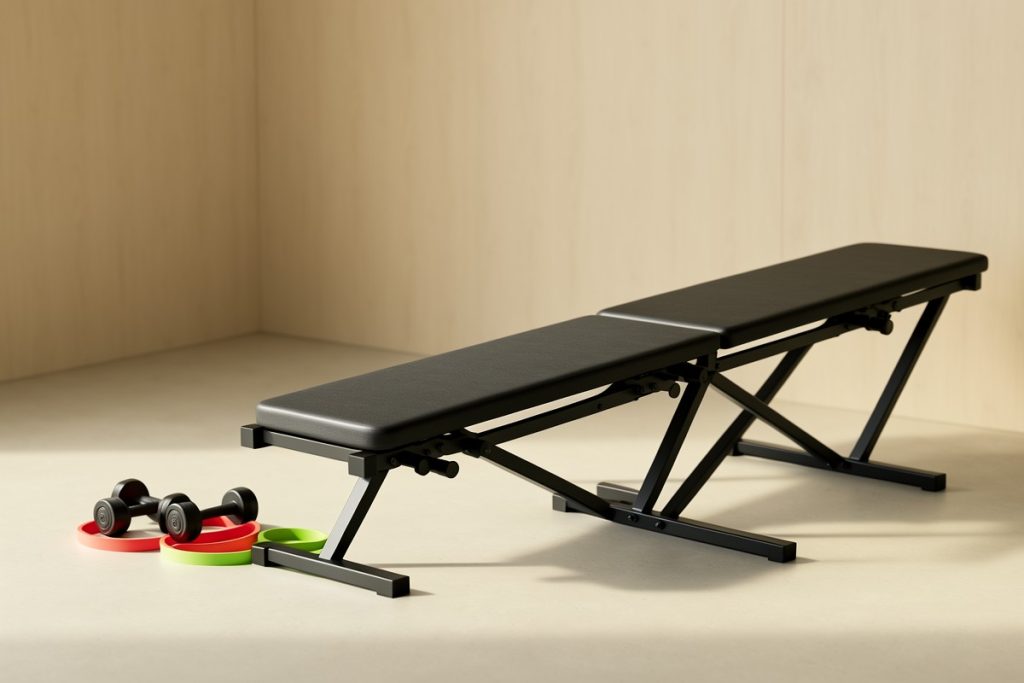
The Finer Form Multi-Functional Adjustable FID Weight Bench and Roman Chair is a reasonable option for someone who wants one bench to cover several body angles and also values an integrated Roman chair setup. Its listed features include flat, incline, and decline positions, 23 adjustment settings, transport wheels, an exercise chart, and a stated 1,000-pound capacity.
Those features make it relevant to a small home gym built around dumbbells and varied strength movements. The broad adjustment range may help users avoid buying multiple benches, while the wheels may make repositioning easier. The Roman chair function could also appeal to someone who wants dedicated support for certain back-extension or core exercises.
There are practical trade-offs to consider. A multi-functional bench may take up more space than a basic flat bench, and a Roman chair attachment may not be useful for every training style. Before ordering, compare the listed dimensions with your available floor area, confirm how the capacity is defined, and decide whether you will genuinely use the extra positions. This recommendation is based on the listed specifications, not personal hands-on testing.
A simple pre-purchase checklist
- Measure the exercise area, storage area, doorways, and ceiling clearance.
- List three to five exercises you will perform most often.
- Confirm the bench supports the positions those exercises require.
- Read how the manufacturer defines maximum capacity.
- Check that the frame, seat, and back pad remain supported in your preferred position.
- Decide where the bench will live between sessions.
Use the bench as part of a sustainable strength plan
A bench becomes valuable when it reduces friction without encouraging you to do too much too soon. Start with manageable loads, learn the adjustment system, and use controlled repetitions that let you maintain your position. Increase resistance gradually instead of treating the bench’s maximum capacity as a training target.
Before each session, check that the bench is on a stable surface, the back pad and seat are locked, and the surrounding floor is clear. If you are lifting a challenging load, use a spotter or choose an exercise setup that allows you to stop safely. Stop if you experience sharp pain, dizziness, or unusual shortness of breath, and seek qualified medical guidance when an injury or health condition affects your training.
Bottom line
For a small home gym, the right adjustable bench is the one that supports your most common movements, fits the room in both use and storage, and feels stable at your intended loads. Flat, incline, and decline positions can provide useful variety, but they should not outweigh secure adjustments, sensible dimensions, and clear capacity information. Treat the Finer Form model as a feature-rich option to compare, not an automatic solution for every home workout.
Last reviewed: 2026-09-18
Sources
- Physical Activity Guidelines for Americans, 2nd edition — U.S. Department of Health and Human Services.
- Physical Activity Basics: Adult Activity Guidelines — Centers for Disease Control and Prevention.
- Progression Models in Resistance Training for Healthy Adults — American College of Sports Medicine position stand.