
Quick answer
An onion slicer holder can make repeated vegetable prep more controlled by keeping an onion or similar ingredient steadier as you cut. The best choice has a comfortable grip, useful cutting slots, easy-to-clean construction, and enough flexibility for the foods you actually prepare. It should support careful knife technique, not replace it or promise perfectly uniform slices automatically.
Key takeaways
- Choose a holder that feels stable and gives your knife clear, useful cutting gaps.
- Stainless steel can be practical, but the material alone does not confirm dishwasher safety or rust resistance.
- Check whether the design suits onions as well as softer foods such as tomatoes, avocados, and eggs.
- Wash produce before cutting and clean the tool promptly according to its care instructions.
Cutting an onion sounds simple until the layers slide, the shape changes as you work, and the final pieces come out in noticeably different sizes. That inconsistency matters when you are preparing onions for burgers, salads, soups, omelets, or garnishes. A dedicated onion holder is designed to give the ingredient more structure while you guide a knife through it.
What problem does an onion slicer holder solve?
An onion slicer holder is a small kitchen tool intended to stabilize food during slicing. Most designs use a handle or grip connected to several narrow dividers. You place the ingredient between or beneath those dividers, then cut through the open spaces. The holder does not do the cutting itself; it simply gives you a more predictable way to position the food.
That can be useful if you find loose onion layers difficult to control, want more consistent slices, or regularly prepare several vegetables by hand. It may also help reduce the need to hold a rounded, slippery ingredient directly while cutting. However, it is not a guarantee against cuts, and it cannot compensate for a dull knife, rushed movements, or an unstable cutting board.
The main question is therefore not whether the gadget sounds convenient. It is whether it addresses a recurring problem in your kitchen often enough to justify another utensil in the drawer.
Features worth checking before you buy
Grip and control: A holder should be easy to grasp without forcing your fingers into an awkward position. Look for a handle that appears substantial enough to control the ingredient while leaving your cutting hand unobstructed. If the grip is too short or narrow for you, the tool may create frustration rather than stability.
Spacing between dividers: The gaps determine the approximate thickness of your slices. Narrow spacing may suit garnishes or sandwiches, while wider spacing can be more practical for cooking. More dividers do not automatically mean better results; the spacing must work with the size of the onion or vegetable you normally buy.
Ingredient compatibility: Onions vary considerably in diameter and shape. A useful holder should accommodate the ingredients you prepare instead of working only with one ideal-sized onion. If you are interested in using it for tomatoes, avocados, eggs, or other vegetables, treat those uses as separate considerations. Soft foods may behave differently from firm onions.
Cleaning: Food can collect around dividers, joints, and handle connections. A simple construction with few hard-to-reach areas is generally easier to maintain. The FDA Food Code offers a helpful benchmark for food-contact equipment, describing surfaces as durable, corrosion-resistant, nonabsorbent, smooth, and easily cleanable. That standard does not certify every home gadget, but it is a sensible way to think about construction and upkeep.
Material and care instructions: Stainless steel is a practical material to consider for a kitchen utensil, but “stainless steel” does not tell you everything about its finish, durability, or cleaning requirements. Check the product instructions before putting it in a dishwasher, soaking it, or storing it while damp. Avoid assuming that a metal tool is maintenance-free.
A simple comparison checklist
| What to compare | Why it matters | What to look for |
|---|---|---|
| Grip | Controls the ingredient during cutting | A handle that feels easy to hold and does not block the knife path |
| Divider spacing | Influences slice thickness | Gaps suited to your usual onion and serving style |
| Construction | Affects cleaning and storage | Few crevices, secure connections, and clear care guidance |
| Versatility | Determines whether it earns drawer space | Compatibility with the foods you genuinely prepare |
Is the featured stainless steel holder worth considering?
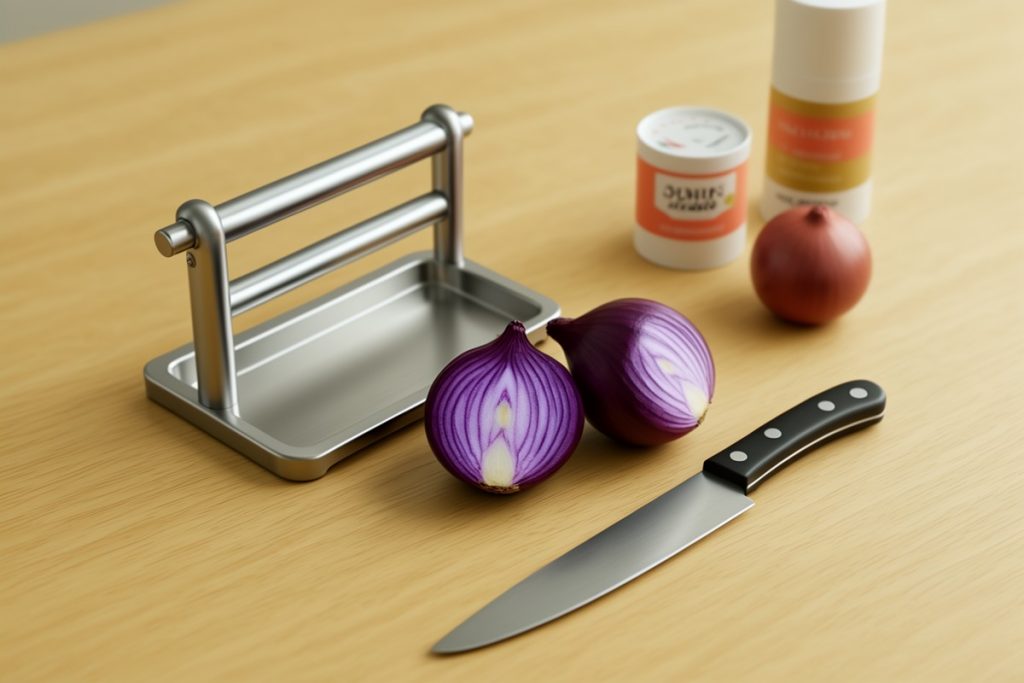
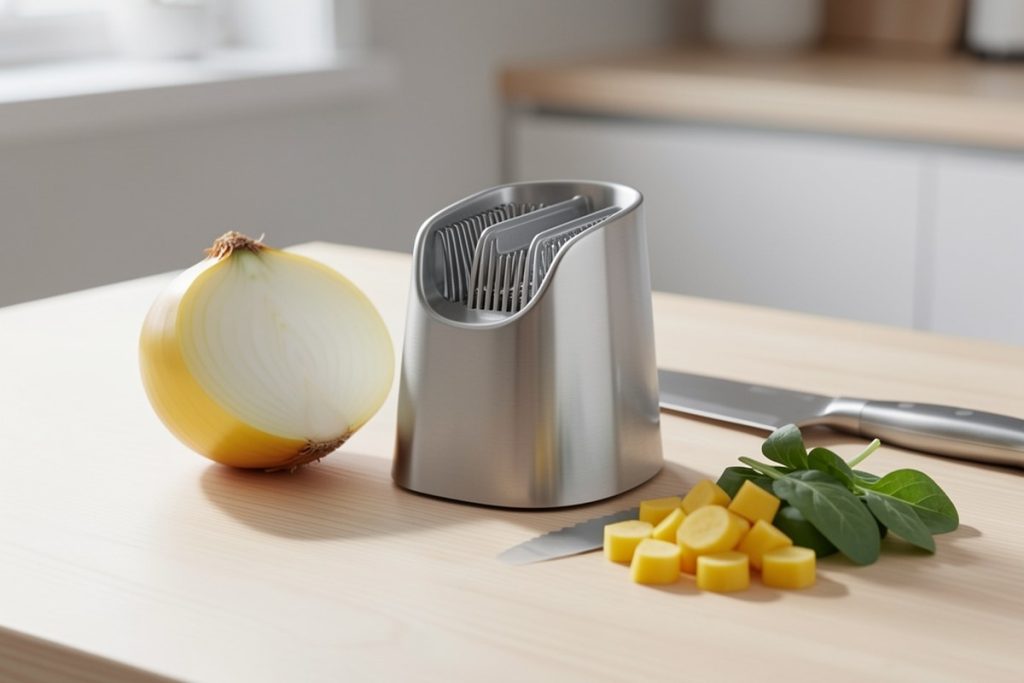
For someone specifically looking for a compact tool to steady onions during manual slicing, the Stainless Steel Onion Holder for Slicing is a reasonable candidate to investigate. The supplied product listing identifies it as a stainless-steel onion holder and presents it for onions, tomatoes, avocados, eggs, and other vegetables. That range makes it more appealing than a tool designed around only one narrow task.
Still, the listing description alone does not establish how comfortable the grip will feel, how well it fits different ingredient sizes, whether it is dishwasher-safe, or how evenly it performs in everyday use. Those details should be confirmed from the current product information and care instructions before buying. It is also wise to check recent customer feedback for practical issues such as difficult cleaning, loose parts, or an awkward handle, without treating ratings as proof of performance.
This product makes the most sense for a cook who already slices vegetables by hand and wants a simple stabilizing aid. It is less compelling if you rarely use onions, prefer rough chopping, or already own a kitchen tool that handles the same task comfortably.
How to use a holder more effectively
Start with a stable cutting board on a clear counter. A board that shifts while you cut makes any accessory less useful. Prepare the onion by removing the outer skin and trimming it in a way that leaves a reasonably flat, manageable surface. Do not force an unusually small or misshapen piece into the holder.
Wash fresh produce before cutting. The USDA Food Safety and Inspection Service recommends rinsing fruits and vegetables under running water, even when you plan to peel them. Drying the outside can also make the ingredient easier to control.
Place the holder so its dividers align with the direction and thickness of the slices you want. Use slow, deliberate strokes and stop if the knife begins to bind. Keep the non-cutting hand on the tool’s grip rather than near the blade path. When the remaining piece becomes too small to control comfortably, finish the job with a safer setup instead of chasing the last slice.
Afterward, remove trapped food promptly. Rinse and wash every food-contact area according to the manufacturer’s instructions, then dry it thoroughly before storage. If the design has narrow gaps, a small cleaning brush may be useful, provided the care instructions allow it.
When a different tool may be better
A chef’s knife remains the most flexible option for cooks who want to control slice thickness, dice onions, or work with irregular pieces. It requires more technique, but it also handles tasks a dedicated holder cannot. A mandoline may offer faster, more uniform slicing, though it requires careful handling and usually creates more cleanup. A food processor is better suited to larger quantities or finely chopped ingredients, not a few neat slices.
Think about the job before choosing the gadget. If your goal is occasional onion preparation, a holder may be enough. If you prepare many vegetables in different shapes, versatility and cleaning convenience may matter more than the product’s headline use. The best kitchen purchase is the one that removes a repeated annoyance without adding a new maintenance problem.
Bottom line
An onion slicer holder can be a useful, low-complexity addition for cooks who want steadier manual slicing and more consistent results. Prioritize grip, divider spacing, ingredient fit, and cleanability over impressive-sounding claims. The featured stainless-steel model is worth comparing if you want one tool aimed at onions and several other vegetables, but confirm its care instructions and practical fit for your kitchen before purchasing.
Last reviewed: 2026-08-24