
Quick answer
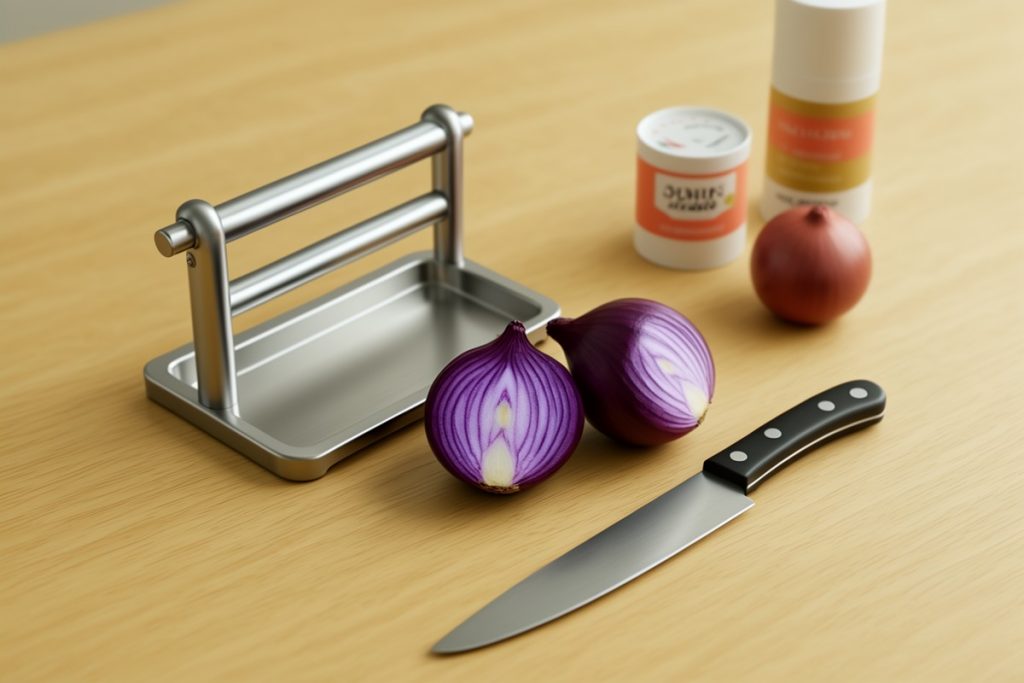
The best onion slicer is one that improves control without adding awkward cleanup or storage problems. A stainless-steel onion holder can help guide repeated cuts and keep an onion steadier, but it does not replace a sharp knife or careful technique. Before buying, check the grip, spacing, material, protective storage, cleaning method, and whether the tool fits the vegetables you actually prepare.
Key takeaways
- Choose a holder that gives you a firm grip and enough spacing for your preferred slice thickness.
- Stainless steel and a protective case may be useful for durability and storage, but inspect edges and joints for food residue.
- A slicing guide can improve consistency; it cannot eliminate the need for careful knife handling.
- Wash produce before cutting, including onions and other vegetables that will be peeled.
What problem does an onion slicer solve?
Cutting an onion is a small task that can become frustrating when slices vary widely in thickness. Thin pieces may soften quickly in a pan, while thick pieces can remain crunchy. Uneven cuts also make it harder to judge cooking time, especially in stir-fries, soups, sandwiches, salads, and sheet-pan meals.
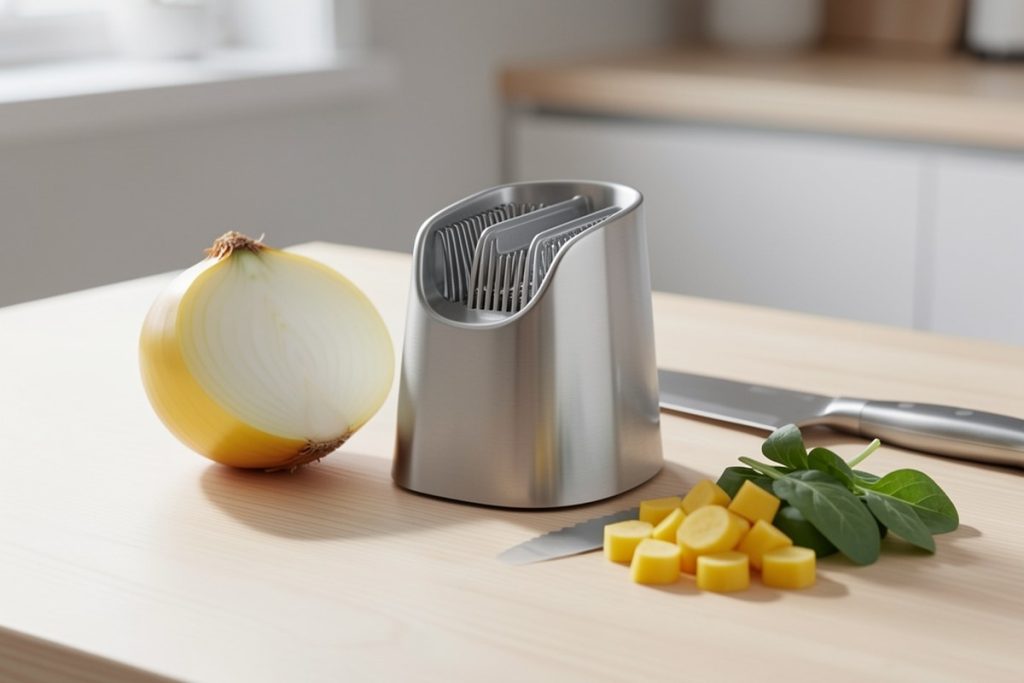
An onion holder addresses the control problem rather than doing the cutting by itself. Its prongs or slots are designed to hold part of the onion in position while a knife passes between the guides. That can make repeated cuts easier to aim and may reduce the need to steady a rounded vegetable directly beside the blade.
The trade-off is that a holder adds another item to wash and store. It also cannot compensate for a dull knife, excessive force, or an onion that is too small for the tool. The useful question is not whether an onion slicer sounds convenient; it is whether its shape matches your normal prep routine.
What to look for in an onion slicing holder
Start with control. A useful holder should be comfortable to grip and should remain stable while you cut. Look for a handle that leaves enough room for your fingers and a frame that does not flex noticeably when pressure is applied. If the tool feels difficult to position, it may slow you down rather than simplify prep.
Next, consider spacing. Closely spaced guides are suited to thinner slices, while wider spacing produces chunkier pieces. Fixed spacing is simple, but it gives you less flexibility than a tool with adjustable settings. For most home cooks, straightforward construction is often more valuable than a complicated mechanism that is difficult to clean.
Material matters, but product descriptions should be read precisely. The candidate stainless-steel onion slicing holder with a protective case is presented as a kitchen slicing assistant for onions and several other foods, including lemon, potato, tomato, avocado, and egg. That description establishes the intended use and listed materials; it does not prove that every food will fit comfortably or that the tool will produce identical results in every kitchen.
Finally, inspect the cleaning and storage design. Food can collect around slots, joins, and prongs. A protective case may help keep the tool contained in a drawer, but it should be fully dry before storage. If the product cannot be cleaned easily by hand, its convenience may disappear after the first few uses.
How to use one safely and consistently
An onion holder is a guide, not a substitute for basic knife safety. Begin by placing the onion on a stable cutting board. Trim the ends as needed, remove the dry outer skin, and position the holder so it has a secure grip. Keep the knife moving in a controlled path rather than forcing it through the vegetable.
Use a knife that is sharp enough to cut cleanly with moderate pressure. A dull blade is more likely to slip when you try to push it through a firm onion. Keep your free hand on the holder’s handle or away from the cutting path, and do not rush simply because the tool has guides.
Food preparation begins before slicing. The U.S. Food and Drug Administration advises washing hands before and after preparing produce, rinsing produce before peeling it, and gently rubbing it under plain running water. Onions should be rinsed before cutting if dirt or residue may be present on the outside. After cutting, wash the holder according to its care instructions and dry it completely.
Quick buying checklist
Use this checklist before choosing an onion slicer. It focuses on practical fit rather than impressive-sounding claims.
| Feature | Why it matters | What to check |
|---|---|---|
| Grip | Controls the holder while the knife moves | Comfortable handle, no obvious wobble |
| Guide spacing | Influences slice thickness | Fixed spacing that suits your recipes, or adjustable guides |
| Material | Affects feel, cleaning, and storage | Clearly described food-contact surfaces and smooth construction |
| Cleaning | Prevents residue from collecting | Accessible slots, joins, and prongs |
| Storage | Keeps sharp or pointed parts contained | Protective case or a safe, dedicated drawer location |
| Food size | Determines whether the holder is practical | Whether it accommodates the onions and vegetables you commonly buy |
When an onion slicer is worth buying
This type of tool makes the most sense for cooks who prepare onions frequently, want more consistent slices, or dislike holding a rounded vegetable close to a knife. It may also help someone who finds repetitive cutting uncomfortable and prefers a guided setup.
It is less compelling if you usually dice onions, use a food processor, or already have a cutting technique that feels fast and controlled. A holder is designed primarily for guided slicing; it will not automatically improve a fine dice, rough chop, or very small garnish. It may also be inconvenient when an onion is unusually large, small, soft, or irregularly shaped.
Before buying, consider the full workflow: take the tool from storage, prepare the onion, slice it, wash the holder, dry it, and put it away. If that process saves time and improves confidence, the product category has a clear purpose. If cleanup is likely to become a nuisance, a sharp chef’s knife and a stable cutting board may be the simpler choice.
Bottom line
A good onion slicer should make controlled, repeatable cuts easier without creating a new cleaning headache. The stainless-steel holder discussed here is a reasonable option to investigate if you want a dedicated guide with a protective storage case and plan to slice onions regularly. Treat its listed uses as a starting point, not a guarantee of fit or performance. Compare the grip, spacing, cleaning access, and storage design before deciding.
Last reviewed: 2026-09-11