
Quick answer
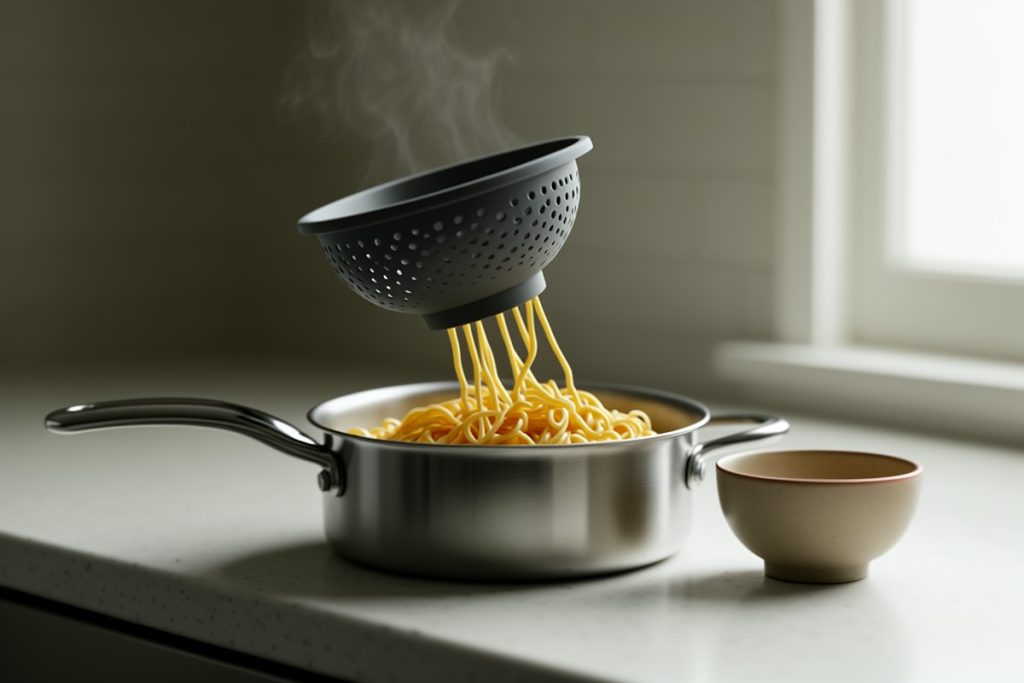
For a small kitchen, a clip-on colander can be more practical than a traditional bowl-shaped strainer because it uses less storage space and leaves both hands free for draining. Look for a secure rim grip, heat-resistant food-contact materials, a wide draining opening, and easy cleaning. The Kitchen Gizmo Snap N’ Strain is worth considering if its clip fits your most-used pots and pans.
Key takeaways
- Clip-on strainers save cabinet space by attaching directly to cookware.
- Rim compatibility matters more than appearance; measure or inspect your pots before buying.
- A compact strainer is best for pasta, vegetables, and small batches, but may not replace a large colander.
- Heat resistance does not automatically prove that a product is suitable for every food-contact or cleaning condition.
By Zara Ahmed (Deep Research Reviewer)
Last reviewed: 2026-09-07
Why a clip-on colander makes sense in a small kitchen
Traditional colanders are useful, but their wide bowls can take up more cabinet space than expected. They also need a separate surface or a sink large enough to hold them while you pour. That becomes inconvenient in a studio apartment, galley kitchen, shared home, or any kitchen where counter space is limited.
A clip-on strainer takes a different approach. Instead of standing in the sink or resting over a bowl, it attaches to the edge of a pot or pan. You pour through the attached strainer, then remove it when the water has drained. The design is particularly appealing for pasta, boiled vegetables, canned foods, and other ingredients that need quick draining without transferring them to another container.
The main benefit is not that it drains more effectively than every full-size colander. The benefit is that it combines cookware and strainer into one compact workflow. That can mean fewer dishes, less lifting, and less storage space.
Clip-on strainer versus traditional and collapsible colanders
No single design is ideal for every cooking task. The right choice depends on how much food you prepare, where you store kitchen equipment, and whether your cookware has a compatible rim.
| Type | Best for | Main limitation |
|---|---|---|
| Clip-on strainer | Small kitchens, pasta, vegetables, quick draining | May not fit every pot or handle heavy batches |
| Traditional bowl colander | Large portions, rinsing produce, draining in a sink | Uses more storage space and may require a separate bowl |
| Collapsible colander | Flexible storage and general-purpose kitchen use | Can still need counter or sink space when open |
A traditional colander remains the safer all-purpose choice if you regularly drain large pots of pasta, wash bulky produce, or need a stable container for several ingredients. A collapsible model is a reasonable compromise when you want a larger draining surface but have limited cabinet space.
A clip-on model is more targeted. It is most useful when your usual task is pouring liquid from cookware directly into the sink. Before buying, consider whether that narrow use case matches your routine rather than assuming a compact design can replace every straining tool.
What to check before buying a clip-on colander
1. Rim and handle compatibility
The most important question is whether the strainer can grip your cookware securely. Pots and pans vary in rim thickness, curvature, handle position, and interior shape. A strainer that fits a straight-sided saucepan may be awkward on a wide skillet or a pot with a pronounced lip.
Check the product’s stated compatibility and compare it with the cookware you use most often. If the listing does not provide enough detail, treat compatibility as uncertain rather than assuming the clip will fit universally. A secure attachment should not wobble, slide, or require you to force the cookware into an unusual angle.
2. Capacity and drainage area
Compact strainers are convenient partly because they are small. That also limits how much food they can handle at once. For a single serving or a modest family portion, a clip-on design may be adequate. For a full stockpot of noodles, the draining area may feel restrictive and require slower pouring.
Look for openings that allow water to escape quickly without letting the food pass through. Very small holes may slow draining or trap soft ingredients, while very large openings may be unsuitable for rice, small vegetables, or thin noodles. The best pattern depends on what you cook most often.
3. Material and heat handling
Silicone is common in compact kitchen tools because it is flexible and can provide grip against cookware. The product listing for the recommended model describes it as heat resistant, but “heat resistant” is not a complete safety specification. It does not tell you the safe temperature range, whether the item is intended for direct contact with a heating element, or how it should be cleaned.
Use the manufacturer’s instructions for temperature limits and care. The U.S. Food and Drug Administration explains that materials intended to contact food are evaluated through the food-contact-substance framework, so it is sensible to look for clear material and use information rather than relying only on a product photograph.
4. Cleaning and storage
A strainer touches starchy water, oils, sauces, and food particles, so its shape should be easy to rinse thoroughly. Pay attention to narrow crevices around clips, folds, and attachment points. These areas can retain residue if the tool is not rinsed promptly.
Storage is one of the strongest reasons to choose a clip-on model. It should fit comfortably in a drawer or narrow cabinet without being bent, crushed, or wedged beneath heavier cookware. If you have to store it in an inconvenient location, its space-saving advantage may disappear.
Where the Kitchen Gizmo Snap N’ Strain fits
The Kitchen Gizmo Snap N’ Strain is a feature-based option for shoppers who want a silicone, clip-on strainer for pots and pans. Its listed design is aimed at draining vegetables and noodles while taking up less space than a standalone colander. That makes it a natural match for small kitchens and cooks who often prepare simple, one-pot meals.
The recommendation comes with limits. The product should not be treated as a universal substitute for a large colander without confirming that its clip fits your cookware. It may also be less convenient for very large portions or ingredients that need to be rinsed under running water. This assessment is based on the listed design and features, not personal hands-on testing.
A practical buying checklist
- Measure the rim or inspect the shape of the pot you use most often.
- Confirm the strainer is intended for hot food and follow the stated temperature limits.
- Check whether the opening pattern suits pasta, vegetables, rice, or other foods you prepare.
- Look for smooth, accessible surfaces around the clip and draining area.
- Decide whether you need a compact tool or a larger colander for bulk cooking.
- Read the care instructions before assuming it is suitable for a dishwasher or soaking.
How to use a clip-on colander more safely
Attach the strainer before lifting or tipping the cookware, and check that it is seated evenly on the rim. Keep the opening directed toward the sink and pour slowly, especially when working with boiling water or a heavy pot. Steam can cause burns even when the strainer itself is designed to tolerate heat.
Do not rely on the clip to support the full weight of a pot. Hold the cookware securely with both hands or use the manufacturer’s recommended handling method. After draining, place the tool somewhere stable to cool before washing it. If the silicone develops cracks, tears, persistent odors, or a loose attachment point, replace it rather than continuing to use it.
Bottom line
A clip-on colander is a smart space-saving purchase when your main need is draining modest portions directly from pots and pans. It is less compelling for large-batch cooking, frequent produce washing, or cookware with unusual rims. The Kitchen Gizmo Snap N’ Strain deserves consideration for the first use case, provided you verify compatibility and follow its care and heat instructions. Choose it as a focused convenience tool, not automatically as your only colander.
Sources
- Kitchen Gizmo Snap N’ Strain product listing — product description and listed design features.
- Food Safety Basics — U.S. Department of Agriculture guidance on safe food handling and preparation.