
Quick answer
If public bathrooms make you tense while traveling, reduce the uncertainty rather than trying to force yourself to feel calm. Locate facilities ahead of time, carry a small hygiene-and-comfort kit, use a slow exhale before entering, and avoid holding bowel movements for long periods. Odor-control spray can make the experience feel more private, but it is optional and never replaces handwashing.
Key takeaways
- Plan restroom stops before discomfort becomes urgent.
- Use a longer exhale to create a brief pause before entering.
- Pack simple supplies that give you more control without creating clutter.
- Use fragrance products only as optional odor control, not as sanitation products.
Why public bathrooms can feel stressful
Bathroom anxiety during travel is often less about the bathroom itself and more about uncertainty. You may not know whether a facility will be clean, private, crowded, or easy to find. If you are already tired, rushing, or worried about an accident, a small inconvenience can feel much bigger.
The goal is not to create a perfect bathroom experience. It is to make the next step predictable enough that your body and attention do not have to solve every problem at once. A simple plan can reduce decision-making: know where you might stop, keep a few useful supplies together, and give yourself enough time to use the facility without rushing.
It also helps to separate discomfort from danger. A public restroom may be unpleasant, but ordinary hygiene habits—especially washing your hands with soap and water—are practical ways to reduce exposure to germs. The Centers for Disease Control and Prevention’s handwashing guidance recommends washing with soap and water for at least 20 seconds when possible.
Make your bathroom plan before leaving
Planning works best when it is specific and lightweight. Before a road trip, flight, long meeting, or sightseeing day, identify likely restroom locations such as the airport, a café, a museum, a library, or a larger shop. You do not need to map every stop; one backup option is usually enough.
Notice your personal pattern, too. If coffee tends to make you need the bathroom quickly, allow extra time after drinking it. If you feel uncomfortable using a restroom only when the urge is intense, take a break earlier. Regularly delaying bowel movements can contribute to constipation for some people, so avoiding the urge indefinitely is not a useful long-term strategy. The National Institute of Diabetes and Digestive and Kidney Diseases’ constipation guidance discusses the connection between ignoring bowel urges and constipation.
Choose the least stressful option rather than the theoretically perfect one. A single-occupancy facility may offer more privacy, while a quieter restroom away from the main entrance may be easier if noise is the trigger. Give yourself permission to leave and find another facility if the first option feels unusually crowded or uncomfortable.
Use a 60-second reset before you enter
When you notice yourself becoming tense, try a short reset instead of arguing with the feeling. Stand still if it is safe, relax your shoulders, and breathe in gently. Then make your exhale a little longer than your inhale. Repeat this for four or five breaths while noticing one neutral detail, such as the temperature of the air or the feeling of your feet inside your shoes.
This is not a test of whether you can make anxiety disappear. It is a way to interrupt rushing and return your attention to the next manageable action. Relaxation techniques are generally low-risk for many people, but they are not a substitute for care when anxiety is persistent or disabling. The National Center for Complementary and Integrative Health overview of relaxation techniques explains how these practices may support stress management and where their limits lie.
Pack a small, practical comfort kit
A compact kit can reduce the worry of being unprepared without turning travel into a complicated ritual. Keep everything in a washable pouch so you can reach it quickly and restock it easily.
- Travel-size tissues or toilet paper for unexpected shortages.
- Alcohol-based hand sanitizer for moments when soap and water are unavailable; wash properly when you can.
- Unscented wipes for cleaning your hands or touching a visibly dirty surface, not for flushing unless the facility specifically permits it.
- A spare pair of underwear or a small change of clothes if accidents are a particular concern.
- Any prescribed medication or personal supplies you already rely on.
- Optional odor-control spray if scent and privacy are part of your worry.
Keep the kit simple enough that you will actually carry it. Adding ten “just in case” items can reinforce the idea that every bathroom stop is a crisis. Choose the two or three supplies that solve your real concerns and leave the rest at home.
Where an odor-control spray can fit
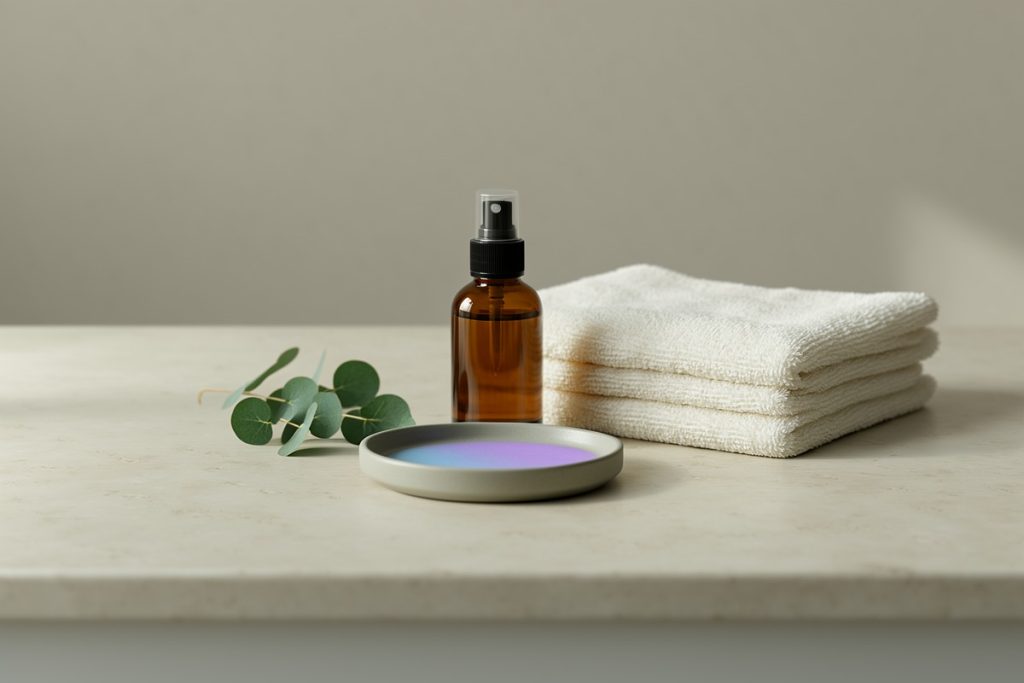
If your main worry is leaving an odor behind in a shared restroom, an optional courtesy product may make the experience feel more private. The Poo-Pourri Before-You-Go Pocket Toilet Spray is a 1-fl-oz travel-size deodorizer with essential oils and a coconut-orchid scent, listed as a TSA-approved size. It is designed for use before using the toilet, so it may suit someone who wants a small, dedicated travel item rather than a full-size bathroom product.
Keep the recommendation in perspective. A scented spray does not replace handwashing, clean facilities, ventilation, or medical treatment, and fragrance can be unpleasant for people who are scent-sensitive. If you use one, follow the product directions, avoid spraying it on your skin, and skip it when another traveler could be bothered by the scent. Trying it at home first is a sensible way to learn whether you actually like the fragrance and format.
Know when bathroom worry needs more support
Occasional discomfort in an unfamiliar restroom is common. It deserves more attention when it changes your daily choices: avoiding trips, skipping meals or drinks, refusing to leave home, repeatedly checking for bathrooms, or holding urine or bowel movements until you are in pain.
Talk with a healthcare professional if you have ongoing constipation, blood in your stool, severe abdominal pain, vomiting, unexplained weight loss, painful urination, or a sudden change in bowel or bladder habits. Seek mental-health support if fear of public bathrooms is limiting work, school, relationships, or travel. Practical planning can help, but you should not have to organize your life around avoiding a basic bodily need.
A repeatable routine for your next trip
Before you leave, identify one likely restroom and one backup. Put your small kit somewhere reachable rather than buried at the bottom of your luggage. When the urge appears, respond early if you can. At the facility, take four slow breaths, use the supplies you genuinely need, wash your hands, and move on without grading the experience.
With repetition, the routine can become familiar even when the surroundings are not. The aim is not to enjoy every public bathroom. It is to travel with enough preparation and self-trust that an ordinary restroom stop does not control the rest of your day.
Last reviewed: 2026-09-07