
Quick answer
You can build effective low-impact cardio at home with a stair stepper, a short warm-up, and consistent pacing. Start with 15 to 20 minutes, keep enough control to speak in short sentences, and increase time before intensity. Pair two or three cardio sessions weekly with strength training so your routine improves fitness without depending on a treadmill or exhausting every workout.
Key takeaways
- Begin with controlled stepping, not maximum speed.
- Use a 20-minute session with gradual warm-up and cooldown periods.
- Increase duration before adding resistance or faster intervals.
- Check stability, stride comfort, dimensions, and weight limits before buying equipment.
By Jax Morrison, High-Energy Motivator
Why low-impact cardio at home can work
Cardio does not have to mean running outdoors or spending an hour on a treadmill. The most useful home routine is one you can repeat consistently, recover from, and fit around your actual schedule. Stair stepping raises your heart rate while keeping the workout contained in a small indoor space.
For many people, stepping can feel more approachable than running because it avoids repeated forward impact. That does not make it effortless or automatically comfortable for every body. Your knees, hips, ankles, and lower back still need to tolerate the movement, so begin conservatively and pay attention to how you feel during and after each session.
Federal activity guidelines recommend that adults work toward 150 to 300 minutes of moderate-intensity aerobic activity weekly, plus muscle-strengthening activity on at least two days. You do not need to reach that total immediately. A few manageable sessions are a better starting point than an ambitious plan abandoned after one week.
Use this 20-minute stair-stepper workout
This beginner-friendly structure gives you enough time to warm up, build effort, and finish under control. Use a pace that feels purposeful but technically smooth.
| Workout stage | Time | What to do |
|---|---|---|
| Warm-up | 4 minutes | Step slowly and focus on an even rhythm. |
| Steady work | 8 minutes | Use a moderate pace; you should be able to speak in short sentences. |
| Intervals | 4 minutes | Alternate 30 seconds slightly faster with 30 seconds easy. |
| Cooldown | 4 minutes | Gradually slow down rather than stopping abruptly. |
Keep the first session easier than you think you need. If 20 minutes feels excessive, complete the warm-up, five minutes of steady work, and a cooldown. The goal is to finish feeling like you could have done a little more. That reserve makes it easier to return for the next session.
Use form that keeps the workout productive
Stand tall instead of folding over the machine. Keep your shoulders relaxed, brace your midsection gently, and let your legs create the movement. If the equipment has support handles, use them for balance rather than pulling your body upward or leaning heavily into them.
Short, controlled steps are usually more useful than forcing an exaggerated range of motion. Keep your feet planted securely and avoid rushing when fatigue changes your technique. If your knees collapse inward, your lower back starts to arch, or you need to grip tightly to stay stable, reduce the pace or stop the interval.
Muscle fatigue and heavier breathing are normal. Sharp pain, dizziness, chest pressure, or unusual shortness of breath are reasons to stop. Anyone returning from an injury or managing a medical condition should get individualized guidance before increasing exercise volume.
Progress without turning every workout into a test
Progress works best when you change one training variable at a time. For the first two weeks, keep the pace steady and add only a few minutes when the workout feels manageable. After that, introduce brief faster intervals while keeping the total session length similar.
- First priority: improve consistency by completing two or three weekly sessions.
- Second priority: add five minutes to one session, not every session.
- Third priority: add short faster intervals once your form remains controlled.
- Recovery check: if soreness or fatigue affects normal activity, repeat the same workload or take an extra rest day.
Do not judge progress only by how tired you feel. A better sign is that the same pace feels more controlled, your breathing settles sooner afterward, or you can complete the session without sacrificing form.
A simple weekly plan for beginners
Three cardio sessions can fit neatly into a balanced week, but they do not need to be consecutive. For example, complete the 20-minute workout on Monday, perform strength training on Tuesday, rest or walk on Wednesday, repeat an easier cardio session on Thursday, and finish with a steady session on Saturday.
Strength work can include squats to a chair, wall push-ups, hip hinges, rows with a resistance band, and a simple plank variation. The purpose is not to exhaust the same muscles before every stepping session. Leave enough recovery between demanding lower-body workouts so that your next cardio session remains coordinated and comfortable.
If three sessions are too much at first, use two. Building a routine you can maintain for a month is more valuable than completing a perfect schedule for four days.
When a compact stair stepper makes sense
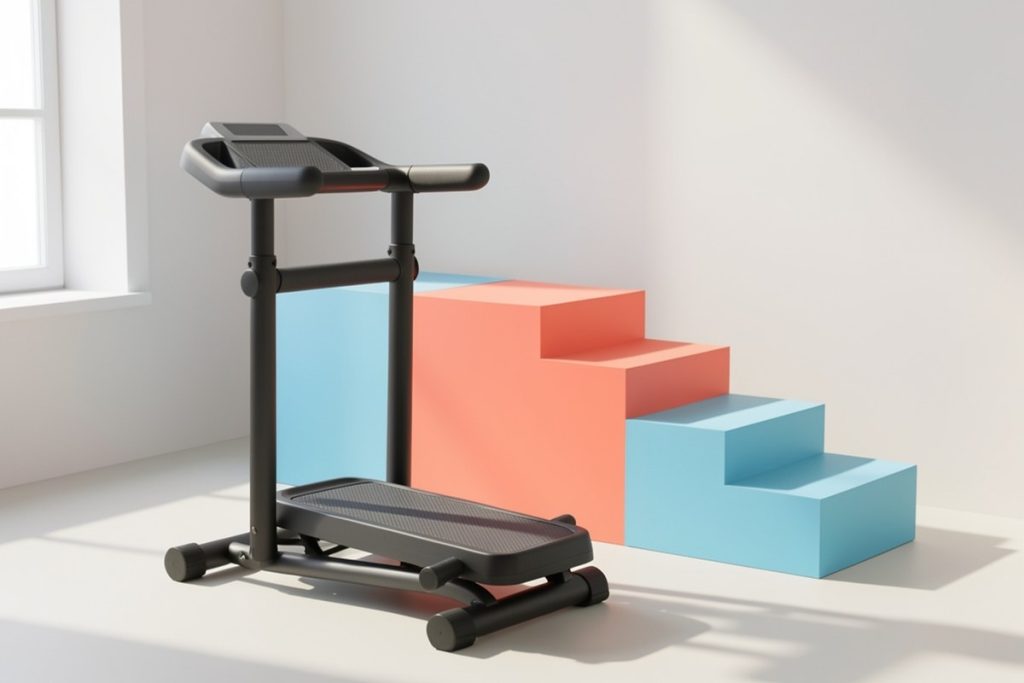
The Sunny Health & Fitness Stair Stepper & Climber Exercise Equipment for Home Workout, Compact Cardio Training Machine may suit someone who wants a dedicated stepping option for home cardio and has limited floor space. Its listed purpose is straightforward: provide a compact way to train the stepping motion indoors.
That description is not a guarantee that it will suit everyone. Before buying, check the current dimensions, maximum user weight, stability features, return policy, and whether the stride feels comfortable for your height and mobility. Also consider where you will store it and whether you can use it without bumping into furniture. A compact machine is only useful if you can set it up safely and reach for it regularly.
Skip this type of equipment if stepping aggravates an existing joint problem, you need a longer walking stride, or you would rather exercise outdoors. A brisk walk, resistance bands, bodyweight circuits, or a stationary bike can all support the same broader goal: accumulating regular aerobic activity in a way you can sustain.
Use this pre-workout checklist
- Place the equipment on a stable, non-slippery surface.
- Clear enough space to step safely and dismount without twisting.
- Wear supportive shoes and keep water nearby.
- Choose a pace that preserves balance and controlled breathing.
- Write down session time and how difficult it felt.
The best home cardio plan is not the most punishing one. Start with a repeatable session, protect your form, and build gradually. When the routine feels simple enough to repeat, it becomes much easier to reach the weekly activity targets that support long-term fitness.
Last reviewed: 2026-09-14
Sources
- Physical Activity Guidelines for Americans, 2nd edition — U.S. Department of Health and Human Services
- WHO Guidelines on Physical Activity and Sedentary Behaviour — World Health Organization