
Quick answer
For running and gym sessions, the best wireless earbuds are not necessarily the ones with the longest advertised battery life. Compare secure fit, usable controls, realistic battery expectations, sweat protection, and return terms first. Hook-style models can help when standard earbuds slip, but they may feel bulkier. The bmani model is worth considering for its listed hook, button controls, microphone, and charging-case battery claim—provided you verify fit and water-resistance details before buying.
Key takeaways
- Choose the retention style before comparing sound features: standard in-ear, hook-style, and open-ear designs solve different problems.
- For workouts, physical buttons and a secure fit can matter more than extra listening modes.
- Treat an advertised total playtime as a case-and-earbud estimate, not necessarily one continuous charge.
- Do not assume sweat or water protection unless the listing provides a clear rating.
By Jordan Blake, Data-Driven Comparison Expert
Last reviewed: 2026-09-18
Start with the problem your earbuds need to solve
“Best workout earbuds” is too broad to produce a fair winner. A runner who loses standard earbuds every few minutes needs a different design from someone who mainly wants clear calls during a commute. Before comparing specifications, identify the failure that annoys you most: slipping, uncomfortable pressure, difficult controls, short battery life, poor call handling, or uncertainty about sweat resistance.
This approach keeps the comparison apples to apples. Instead of rewarding the longest feature list, you compare each model against the same use case. For exercise, retention and controls usually deserve more attention than cosmetic features. For office use, microphone behavior and comfort over several hours may matter more.
Compare the three main fit styles
| Fit style | Best suited to | Tradeoffs to check |
|---|---|---|
| Standard in-ear | Compact everyday listening and users who already get a reliable seal | May loosen during running; ear-tip size and shape make a major difference |
| Over-ear hook | Movement-heavy workouts and listeners who need extra retention | Can feel bulkier, interact with glasses, or become less comfortable under hats |
| Open-ear | Situations where awareness of surrounding sounds is a priority | Usually offers a different listening experience and may provide less isolation |
An over-ear hook does not automatically mean a perfect fit. It adds a physical anchor, but the earbud still needs to sit comfortably and remain stable. Look for information about hook flexibility, ear-tip choices, left-and-right fit, and whether the design can be worn for the length of your normal session. If a seller does not explain these points, the return policy becomes especially important.
Separate sound quality from fit and convenience
Specifications such as “stereo sound” describe the product category, not how enjoyable it will be for you. Sound preferences vary, and a secure earbud can seem better simply because it stays positioned consistently. When comparing models, ask whether the listing provides useful detail about codecs, equalizer support, noise cancellation, or transparency modes. If those details are missing, do not treat the absence as proof that a feature is included.
Controls deserve their own comparison. Physical buttons can be easier to operate while moving, wearing gloves, or dealing with sweat than small touch surfaces, because you can feel a click instead of guessing where to tap. They may also require more pressure against the ear. Check which functions the buttons control: play and pause, track changes, volume, calls, or voice assistants are not always mapped the same way.
Microphone claims should also be kept modest. A built-in microphone makes calls possible, but it does not guarantee that your voice will remain clear beside traffic, wind, or gym equipment. If calls are important, prioritize independent microphone tests or a generous return period rather than assuming every “with mic” model performs equally.
Read battery claims the right way
Battery figures can be useful, but they need context. A total playtime number may combine multiple earbud charges from the charging case. It is different from the number of hours the earbuds can run before returning to the case. Ask three questions:
- What is the claimed single-charge runtime?
- Does the total figure include the charging case?
- How long does the case itself take to recharge, and what charging cable or port does it use?
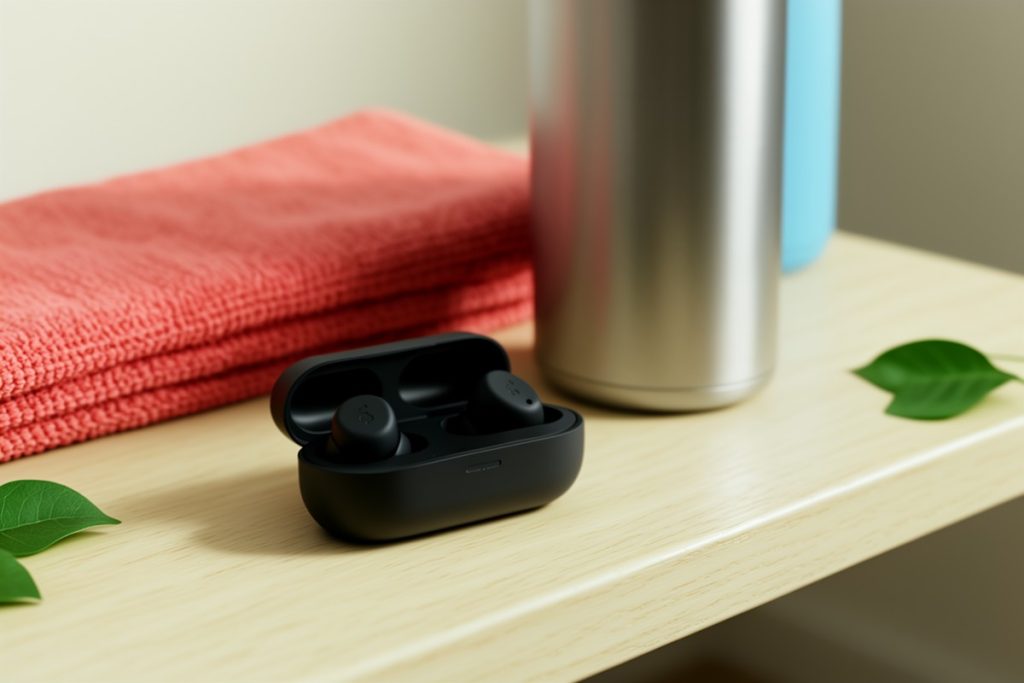
The catalog description for bmani Ear Buds Wireless Earbuds lists an 80-hour playtime claim, an LED display case, over-ear hooks, a microphone, stereo sound, and button controls. Those features make it a logical candidate for someone whose main problem is earbuds slipping during workouts or needing frequent recharging. They do not, by themselves, establish the actual runtime in your listening conditions, the display’s exact information, or the product’s long-term durability.
Check sweat protection instead of guessing
Exercise use creates a particularly important comparison gap: a product can be marketed for running or the gym without giving enough information about resistance to sweat, rain, or splashes. Look for a clearly stated IP rating and determine whether it applies to the earbuds, the case, or both. A charging case generally needs different handling from the earbuds themselves, even when the earbuds are designed for active use.
If the listing does not state a rating, treat the product as unverified for wet conditions. That does not prove it will fail, but it does mean you should avoid promising yourself protection the manufacturer has not documented. Also check cleaning instructions and whether the hooks or ear tips can be removed without damaging the fit.
Use this pre-purchase checklist
- Identify your main problem: slipping, discomfort, battery, controls, or calls.
- Confirm the fit style and check whether replacement ear tips are included.
- Find the single-charge runtime, not just the total case-assisted figure.
- Look for a specific water-resistance rating and clarify what it covers.
- Check button functions, charging method, microphone details, and return terms.
- Compare the full package rather than one headline specification.
Bottom line: prioritize reliable fit over impressive numbers
For active listening, a secure and comfortable fit is the foundation of the comparison. Hook-style earbuds are worth considering when standard in-ear models repeatedly move out of place, while compact standard earbuds may be preferable if bulk and glasses compatibility are concerns. The bmani model has a credible feature match for the hook-style use case based on its catalog description, but its advertised battery figure and workout positioning should not replace verification of fit, water resistance, and return options.
The most honest buying decision is the one that matches your routine. Compare the same criteria across every candidate, discount claims that lack detail, and choose the model that solves your biggest annoyance without introducing a new one.