
Quick answer
For a small kitchen, RV, office breakroom, or emergency drawer, choose one manual opener that handles both screw-top jars and bottle caps without electricity. Prioritize a secure grip, useful leverage, easy cleaning, durable working parts, and storage that does not crowd a drawer. Before buying, confirm the lid sizes it supports and whether its shape feels comfortable for the person who will use it.
Key takeaways
- A compact manual opener is most useful when it performs more than one kitchen task.
- Measure your storage space before choosing a handheld tool.
- Look for clear information about compatible lids, bottle caps, materials, and cleaning.
- The Uinxan model is a candidate for shoppers who want a manual jar-and-bottle opener, but its listing claims should not be treated as independent performance testing.
By Nate Cooper, Value-Driven Gear Expert
Why a compact manual jar opener can be the right choice
Not every kitchen needs an electric opener. A powered appliance takes up counter or cabinet space, needs a place to charge or plug in, and may be excessive if you only open a jar occasionally. A compact manual tool can live in a utensil drawer and come out when a sealed lid, sauce jar, pickle jar, or bottle cap needs attention.
The strongest use case is not simply “opening jars.” It is reducing the number of single-purpose gadgets in a limited space. A tool that handles screw-top lids and bottle caps may be more practical for a studio apartment, camper, dorm kitchen, office kitchenette, or emergency food kit than separate openers.
That said, compact does not automatically mean useful. A tool that is difficult to position, accepts only a narrow range of lids, or has no sensible storage plan can become drawer clutter. The goal is a small tool with a clearly defined job and enough versatility to justify keeping it.
What to check before buying a handheld opener
1. Storage footprint
Check the product’s dimensions before purchasing, especially if it will live in a shallow drawer. A slim profile is helpful, but a hanging hole or compact shape may matter more than a small measurement if your drawers are already full. For an RV or emergency kit, consider whether the tool can be stored without snagging other items.
2. The types of closures it supports
“Jar opener” can describe several different designs. Some are intended only to break a vacuum seal. Others grip and turn a lid. Some are made for pull tabs or bottle caps. Read the product description carefully and look for explicit wording about screw-top lids and bottle caps rather than assuming one tool does everything.
3. Contact and leverage
A useful opener should give you a stable place to position it and a handle that provides enough turning leverage. The mechanism should make it clear where the tool contacts the lid. If the tool requires awkward twisting, slips during positioning, or is too short to hold comfortably, its compact size may work against it.
4. Materials and cleaning
For a kitchen tool, materials affect care as well as durability. Stainless steel working parts are appealing because they are easy to wipe down and less concerning around food than difficult-to-clean surfaces. Still, do not assume every component has the same material or that the entire tool is dishwasher-safe. Check the care instructions, then dry the tool thoroughly after cleaning.
5. Comfort and control
Look for a grip that can be held securely without excessive squeezing. This is not a medical device, and a more expensive opener is not automatically better for every user. If someone experiences persistent hand pain, numbness, or a noticeable change in grip, an opener should not be treated as a substitute for professional medical advice. The National Institute of Arthritis and Musculoskeletal and Skin Diseases explains that hand osteoarthritis can affect pain, stiffness, and everyday gripping tasks.
Where the Uinxan handheld opener fits
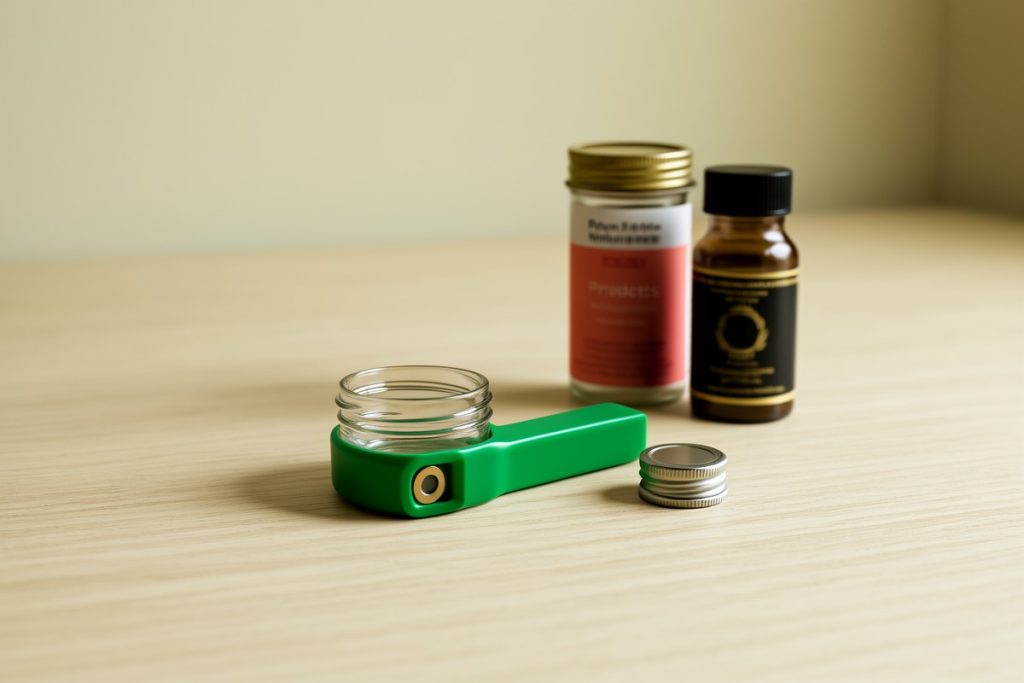
The Uinxan Jar Opener for Weak Hands & Seniors with Arthritis is a reasonable candidate for shoppers who want one manual tool for both screw lids and bottle caps. Its listed feature set includes a handheld manual design, 304 stainless steel, a green finish, and a stated purpose covering stubborn screw lids and bottle caps.
Those details make it relevant to compact kitchens and backup kits because the tool is designed around two common closure types rather than a single jar-opening function. However, the product listing does not replace a hands-on test. It does not, by itself, prove how easily the opener handles every lid size, how comfortable it feels over repeated use, or how long the mechanism will last.
Before ordering, verify the current dimensions, supported closure sizes, cleaning directions, and return terms on the product page. If you need a tool for unusually wide jars, very small caps, or a specific accessibility requirement, those details matter more than the general product description.
Choose the right setup for your space
| Use case | Prioritize | Likely tradeoff |
|---|---|---|
| Small apartment kitchen | Compact storage and two-in-one use | A smaller tool may offer less leverage |
| RV or camper | Manual operation, easy cleaning, and secure storage | Limited countertop space makes positioning important |
| Emergency food kit | Durable construction and no batteries | Confirm it works with the container types in the kit |
| Office breakroom | Simple operation and easy-to-clean surfaces | Shared users may need clear storage and care rules |
A practical buying and setup checklist
- Measure the drawer, cabinet, or kit compartment where the opener will live.
- Confirm that the product explicitly supports the jar lids and bottle caps you use most.
- Check whether the grip and handle look large enough for controlled use.
- Read the cleaning instructions before exposing the tool to food residue or moisture.
- After delivery, inspect the opener for rough edges, loose parts, or a mechanism that does not move smoothly.
- Use it on a stable counter and keep the jar upright; do not force a tool against cracked glass or a damaged lid.
When a manual opener is not enough
A manual opener is not guaranteed to release every stuck lid. A lid may be unusually large, damaged, rusted, or sealed so tightly that forcing it creates a safety problem. If the tool does not engage securely, stop rather than repeatedly twisting harder. Wiping a clean, dry lid and using a stable work surface may help, but do not use knives, sharp objects, or striking tools to improvise leverage.
For recurring difficulty, consider whether the container itself is the problem. Smaller containers, easy-open packaging, or transferring frequently used foods into resealable containers may be more practical than relying on one opener for everything. The best product is the one that reduces daily friction without creating another awkward task.
Bottom line
A compact manual jar opener makes sense when storage space is limited and you want one battery-free tool for more than one type of closure. Judge it by fit, leverage, grip, cleanability, and the manufacturer’s actual specifications—not by broad claims about convenience. The Uinxan model is worth considering for its listed jar-and-bottle-cap focus, but confirm compatibility and dimensions before buying.
Last reviewed: 2026-09-21
Sources
- Osteoarthritis: Symptoms, Causes, and Risk Factors — National Institute of Arthritis and Musculoskeletal and Skin Diseases, National Institutes of Health.
- Ergonomics — Overview — Occupational Safety and Health Administration, U.S. Department of Labor.