
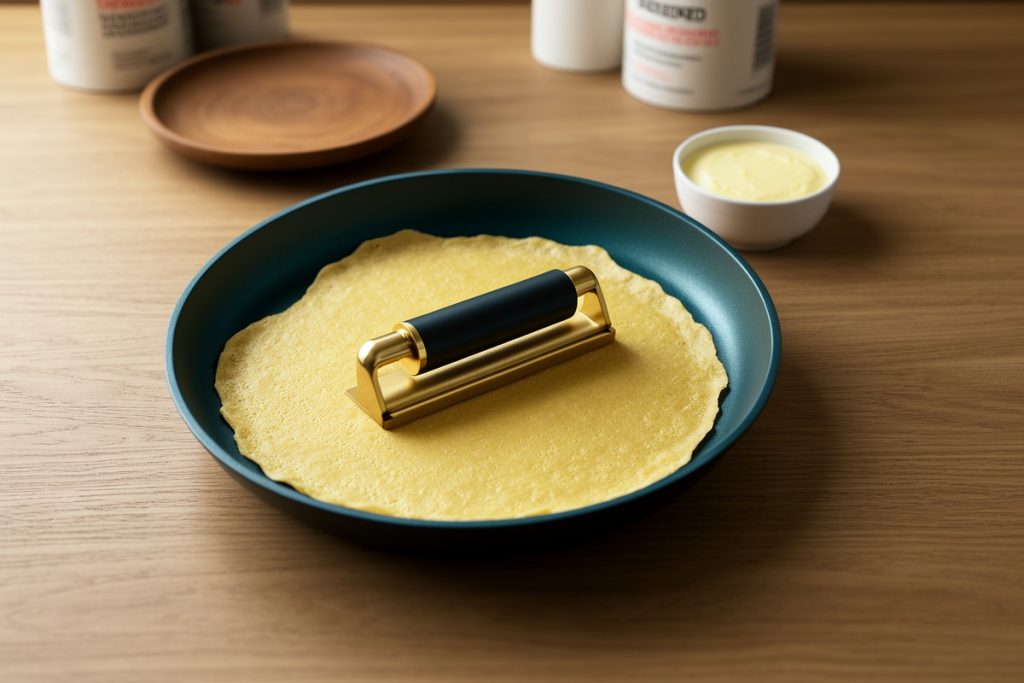
Quick answer
For making thin crepes at home, look for a spreader with a smooth, rounded edge, enough reach to cover most of your pan, and a shape you can control while rotating the pan. Traditional T-shaped spreaders offer repeatable coverage, while compact food-safe tools are easier to store. The best choice depends on your pan size, preferred technique, and how often you make crepes.
Key takeaways
- A spreader cannot compensate for batter that is too thick or a pan that is not properly heated.
- A smooth, flexible edge is generally more useful than an elaborate shape.
- Choose a tool that reaches across your pan without forcing your wrist into an awkward angle.
- For occasional cooks, compact storage and easy cleaning may matter more than traditional design.
Why a crepe spreader makes a difference
Thin crepes are difficult to spread with the back of a spoon or a standard silicone spatula. Those tools are designed to lift, fold, or scrape food, not guide a very thin layer of batter across a hot surface. Their wider edges can drag through the batter, leaving holes or thick ridges.
A proper crepe spreader gives you a long, smooth edge that can distribute batter with light pressure. The goal is not to press the batter into the pan. Instead, you pour a small amount into the center, tilt or rotate the pan, and gently guide the batter outward before it sets.
This is especially helpful when you want consistent crepes for layered desserts, filled breakfast crepes, or savory wraps. It also reduces the temptation to add too much batter, which is one of the easiest ways to end up with a pancake rather than a crepe.
What to look for in a home crepe spreader
Edge shape
The working edge should be smooth and free of sharp corners. A slightly rounded edge is easier to glide across batter without gouging the surface. If the edge is rigid and rough, it can catch on partially cooked batter and tear the crepe.
Reach and pan size
Match the spreader to the pan you actually use. A tool that is too short may leave you chasing batter around the pan. One that is too long can feel difficult to control, especially in a small skillet. For most home cooks, a compact spreader that reaches comfortably from the center toward the rim is more practical than an oversized restaurant-style tool.
Grip and control
Crepe spreading involves small movements rather than force. Look for a handle or body that gives you a stable grip without requiring a tight fist. If the tool has a novelty shape, check whether you can still keep the working edge flat while rotating the pan.
Material and care
Choose a tool clearly identified for food contact and follow its cleaning instructions. Smooth, nonporous surfaces are usually easier to rinse between crepes, while unfinished wood may require more careful drying. Avoid assuming that every tool is dishwasher-safe; heat and detergents can affect some materials or finishes.
Traditional spreader versus compact kitchen gadget
| Option | Best for | Trade-off |
|---|---|---|
| Wooden T-shaped spreader | Frequent crepe making and repeatable coverage | Needs more drawer space and careful drying |
| Compact shaped spreader | Occasional use, small kitchens, or gifting | May take practice to hold at the correct angle |
| Standard silicone spatula | Folding, lifting, and serving finished crepes | Usually less effective for spreading raw batter |
There is no universal winner. A traditional T-shaped tool tends to make the spreading motion obvious, while a compact gadget may be easier to keep in a crowded utensil drawer. The better choice is the one that lets you maintain a light, level touch.
How to spread batter without tearing the crepe
- Preheat the pan. Use the heat level recommended by your recipe and allow the cooking surface to warm evenly. Batter should begin setting soon after it hits the pan, but it should not seize immediately.
- Use less batter first. Start with a small pour. It is easier to add slightly more than to remove excess batter after it has begun cooking.
- Rotate instead of pressing. Tilt the pan and guide the spreader with gentle, continuous movements. Heavy pressure can create thin spots and scrape the surface.
- Work quickly but calmly. The batter becomes less cooperative as it cooks. Have your spreader ready before pouring rather than searching for it afterward.
- Clean the edge between batches. Dried batter on the working edge creates drag and can tear the next crepe.
Expect the first crepe to be a calibration round. Use it to judge whether you need less batter, a different heat setting, or a slightly faster spreading motion. Consistency usually comes from repeating the same sequence rather than buying a more complicated tool.
Where the OTOTO Splatypus fits
The OTOTO Splatypus Jar Spatula is a natural fit for cooks who want a compact crepe-spreading tool with a playful design. Its listing describes it as BPA-free, food-safe, and intended for crepe spreading. That makes it worth considering for occasional breakfasts, small kitchens, or a practical food-themed gift.
It is not automatically a better choice than a traditional T-shaped spreader. If you make several dozen crepes at a time, prefer a familiar commercial-style motion, or use a very large pan, a dedicated wooden spreader may offer more predictable reach. If storage, appearance, and occasional use are higher priorities, the compact option may be more appealing.
Because shape and handling are personal, treat the product description as a starting point rather than proof of superior performance. Check the tool’s care instructions, compare its dimensions with your pan, and choose based on how you expect to use it.
A quick buying checklist
- Does the working edge look smooth and rounded?
- Will it reach across your preferred pan without awkward wrist movement?
- Is the material clearly identified for food contact?
- Are the cleaning and drying instructions practical for your kitchen?
- Would a traditional T-shape better match the way you want to cook?
If you can answer these questions before buying, you are less likely to mistake a visually interesting utensil for a genuinely useful one. The spreader should support good batter technique, not distract from it.
Last reviewed: 2026-10-02
Sources
- USDA FSIS: Clean and Sanitize — practical guidance for cleaning food-contact surfaces and utensils.