
Quick answer
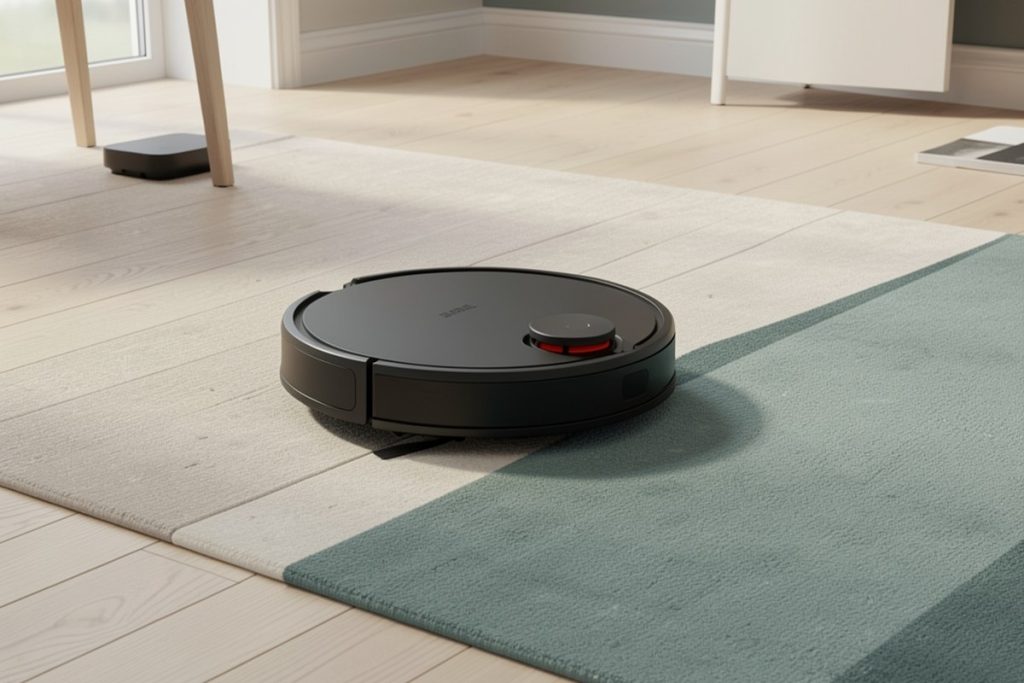
The best robot vacuum for a small apartment is the one that can leave its dock, cover every usable floor area, cross your thresholds, avoid common obstacles, and return to charge without help. Measure your doorway lips, furniture clearance, rug edges, and dock location before comparing suction, mapping, or app features. A compact layout can expose navigation problems quickly.
Key takeaways
- Measure thresholds, sofa clearance, rug edges, and the open floor path before shopping.
- Place the dock where the robot has a clear approach and enough room to turn.
- Judge mapping by repeatable coverage and recovery from obstacles, not by feature names alone.
- A mop function is useful only if your hard floors are accessible and you can manage pad maintenance.
- Use the same layout test for every model instead of comparing isolated suction or battery claims.
Start with the apartment’s floor plan, not the product page
Small apartments create a misleading buying question: “Which robot vacuum has the most features?” In practice, the more important question is whether the robot can move through your particular home. A 500-square-foot apartment may have a simple open plan, or it may contain narrow passages, raised thresholds, tightly packed furniture, and rugs that divide each room into awkward sections.
That is why a useful apples-to-apples comparison begins with your floor plan. Draw the route from the charging dock to the kitchen, living area, bedroom, and bathroom. Mark places where a robot must turn, pass beneath furniture, cross from one surface to another, or navigate around a chair leg. The robot is a poor fit if its path to those areas is blocked, even when its headline specifications look impressive.
Also separate “total apartment size” from “cleanable floor area.” A bathroom with a closed door, a closet full of stored items, or a bedroom blocked by a tall threshold may not be part of the robot’s practical route. Compare models based on the floor they can repeatedly reach, not the square footage printed in a listing.
Measure the four layout problems that cause the most trouble
You do not need specialized equipment. A tape measure, a ruler, and a few minutes of observation will reveal most fit issues.
| What to measure | Why it matters | What to look for |
|---|---|---|
| Doorway thresholds | A raised strip can stop or redirect the robot. | Compare the height and shape with the manufacturer’s stated clearance. |
| Furniture clearance | The robot may enter but fail to turn or leave. | Measure the lowest open route beneath sofas, beds, and cabinets. |
| Rug edges and tassels | Loose edges can catch or change the robot’s route. | Check whether rugs lie flat and whether fringe can be tucked away. |
| Dock approach | A cramped dock can prevent reliable charging. | Choose a level wall area with an unobstructed approach and turning space. |
Thresholds deserve special attention because a robot may handle a flat transition but struggle with a steep or irregular one. If a room has a visibly high doorway lip, do not assume mapping will solve the problem. Mapping helps a robot understand where it is; it does not automatically give the wheels enough traction or clearance to climb.
Furniture can create a second hidden issue. A robot that fits under a cabinet may become trapped if the space narrows near the back. Measure the full route, not just the entrance. If you regularly leave dining chairs, laundry baskets, charging cables, or pet bowls in the robot’s path, include those objects in your test rather than imagining an always-perfect room.
Compare navigation by coverage and recovery
Mapping is valuable in a small apartment because it can make cleaning more orderly and reduce random wandering. But “has mapping” is not a complete performance conclusion. Navigation systems generally combine a representation of the environment with planning, localization, and obstacle information. In everyday use, that translates into three questions: Does the robot know where it has been? Can it plan around a blocked route? Can it recover when the environment changes?
A good comparison therefore looks for repeatable behavior. If you move a dining chair, leave a laundry basket in the hall, or close one door, does the robot still complete the accessible rooms? Does it return to its dock after cleaning? Can you identify which areas were skipped, or does the app merely make the robot appear organized? A polished map is helpful, but coverage and recovery are the practical outcomes.
For a small home, prioritize a model that can clean in sections or follow room-level instructions if those controls are supported. That lets you run the robot when the kitchen is clear, keep it away from a cluttered workspace, or clean a high-traffic entryway more often. Treat voice control as convenience rather than a deciding factor. It cannot compensate for a dock placed behind furniture or a threshold the robot cannot cross.
Decide whether the mop function earns its space
A vacuum-mop combo can be a sensible choice when an apartment combines hard flooring with a few low-pile rugs. It may reduce the number of separate cleaning sessions, but the mop feature is not automatically useful in every home. If most of the floor is carpet, or if the hard-floor sections are covered with cords, bath mats, and movable objects, the extra function may add maintenance without adding much value.
Think about the daily routine around mopping. You may need to fill a water tank, attach or remove a pad, empty dirty water, wash the pad, or create no-mop zones for rugs. Those steps are not defects; they are part of comparing the total effort. A device that vacuums reliably but requires frequent manual preparation may be a better fit than one with a broader feature list that you rarely use.
The Carpet and Rug Institute recommends regular vacuuming, more frequent cleaning in high-traffic areas, and prompt treatment of spills. A robot can support that routine, but it does not replace spot cleaning or periodic deep cleaning. Likewise, the EPA notes that indoor particles can come from cooking, combustion, outdoor infiltration, and other household sources. Automated floor cleaning is one maintenance tool, not a complete indoor-air strategy.
Where the approved candidate fits—and where it does not
The Robot Vacuum and Mop Combo is a reasonable candidate to evaluate for an apartment with both carpets and hard floors because its listing describes mapping, LiDAR navigation, a self-emptying station, Wi-Fi and app controls, Alexa voice control, and a stated 6000Pa suction rating. Those are relevant features for reducing routine intervention and organizing cleaning across rooms.
That description is not the same as independent proof that it will fit your home. Before buying, verify the unit’s physical dimensions, dock-clearance requirements, threshold guidance, water-tank and pad instructions, and compatibility with your flooring. Also check whether the app supports the room controls you actually want. A self-emptying station may reduce emptying frequency, but it still needs a practical location and ongoing consumables or maintenance.
This candidate is less compelling if your apartment has tall transitions, thick shag rugs, many loose cables, or very little room around the dock. It may also be excessive if you only need a compact vacuum for one mostly open room. The honest recommendation depends on the layout test, not on the product’s feature count.
Use this 10-minute layout checklist
- Measure the robot’s proposed parking area and confirm that the dock can sit level.
- Measure the lowest furniture clearance along the intended route.
- Record every threshold, including transitions between rooms and flooring types.
- Flatten rug corners and remove or secure cords before judging the route.
- Identify spaces that should remain off-limits, such as bathrooms with loose mats or feeding areas.
- Decide whether you will run vacuuming and mopping together or on separate schedules.
- Compare each model’s dimensions, clearance guidance, dock needs, and control options in the same table.
If a model passes these checks, then compare secondary factors such as noise, replacement-part cost, warranty terms, and app quality. If it fails a basic movement test, no extra suction claim or voice shortcut fixes the underlying mismatch. In a small apartment, dependable access is usually worth more than a longer list of features.
Last reviewed: 2026-08-14