
Quick answer
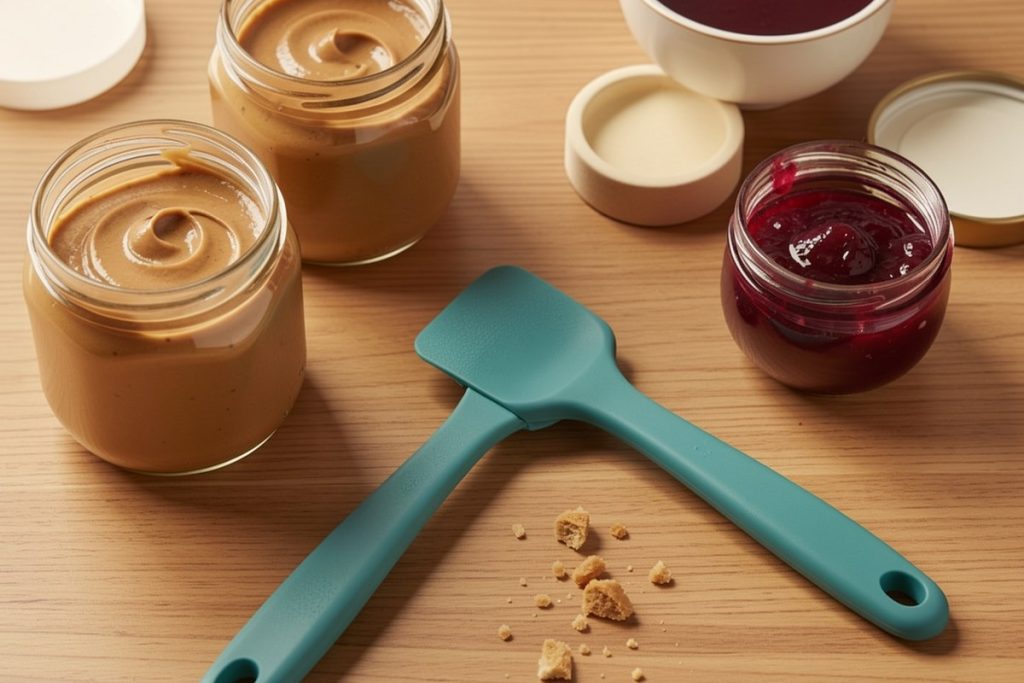
The best jar spatula for peanut butter and jam is narrow enough to reach the corners, flexible enough to follow the container, and sturdy enough to spread what it collects. The OTOTO Splatypus Jar Spatula is a practical choice for small jars, condiments, batter, and spreads, though a wider scraper remains better for bowls and large containers.
Key takeaways
- Choose a narrow, flexible blade for scraping curved jar walls and bottom corners.
- A jar spatula reduces leftover food, but it cannot make an awkward jar easy to clean.
- The OTOTO Splatypus is best suited to spreads, sauces, and small-batch kitchen tasks.
- Check food-contact materials and cleaning instructions before buying any kitchen utensil.
Jars are excellent at storing sticky foods and frustrating at letting you retrieve them. Peanut butter settles into the corners, jam clings to the shoulder beneath the lid, and the final spoonful often becomes a choice between wasted food and a messy scraping session.
A jar spatula is designed for that specific problem. Unlike a broad baking scraper, it has a slim profile that can move along the inside wall of a container. The right one turns leftover spread into something usable without forcing you to balance a knife inside a glass jar.
What makes a good jar spatula?
The most important feature is reach. A utensil can be flexible and well made, but it will not help much if its head is too wide for the opening or its handle stops short of the bottom. Before buying, think about the jars you use most often: short jam jars, tall nut-butter containers, narrow condiment bottles, or wide pantry tubs all call for slightly different proportions.
Flexibility matters too. A rigid blade may push food around without conforming to the curve of the jar. A flexible silicone head can bend against the wall and lift more of the residue. It should still have enough structure to spread the food afterward; a floppy head that folds over at the first sign of resistance is frustrating in a different way.
The handle deserves attention because sticky foods create drag. A comfortable handle gives you better control when pulling through dense peanut butter or thick frosting. A slim handle may fit small jars more easily, while a thicker grip can feel more secure during repeated scraping. There is no universal best shape, but a handle that is easy to rinse and does not trap food around seams is usually the more practical choice.
Where the OTOTO Splatypus fits
The OTOTO Splatypus Jar Spatula for Scooping and Scraping naturally fits shoppers looking for a compact tool for jars, spreads, and small kitchen jobs. Its catalog description identifies it as BPA-free and food safe, and also presents it as a crepe spreader. That combination suggests a utensil intended to do more than scrape: it can collect food from a container and help distribute it on a surface.
Its strongest use case is convenience rather than dramatic kitchen transformation. A narrow spatula can reach places a regular spoon misses, especially around the bottom edge and inner walls of a jar. It can also help portion sticky ingredients into a mixing bowl with less residue left behind on the spoon.
The trade-off is scale. A small jar utensil is not the fastest tool for cleaning a large mixing bowl, spreading frosting across a full cake, or stirring a dense recipe. It is also not a replacement for a spoon when you need to scoop a large amount quickly. The value comes from matching the tool to the task: use it where precision and access matter more than volume.
Jar spatula versus common kitchen tools
| Tool | Best use | Main limitation |
|---|---|---|
| Jar spatula | Scraping narrow jars, condiments, spreads, and small containers | Less efficient for large bowls or high-volume mixing |
| Tablespoon | Scooping and measuring thicker foods | Often misses curved walls and bottom corners |
| Wide silicone scraper | Mixing bowls, batter, frosting, and pan cleanup | May not fit through a narrow jar opening |
| Butter knife | Spreading soft foods across bread or toast | Not shaped for retrieving food from deep containers |
If most of your frustration comes from tall jars, prioritize reach and a head that fits through the opening. If you mainly want to spread jam or soft butter, blade shape and edge control may matter more than length. For baking, a second wide scraper will probably remain useful even if you buy a jar spatula.
How to choose one for peanut butter, jam, and sauces
Start with the texture of the food. Dense nut butter needs a blade with enough firmness to push into the contents without twisting away. Jam and honey benefit from a smooth, flexible edge that can sweep the sides clean. Thick sauces may require a longer handle, particularly when stored in a tall container.
Next, consider cleanup. One-piece construction is generally simpler to wash than a head joined to a handle with a deep seam. Dishwasher compatibility can be convenient, but always follow the product’s care instructions rather than assuming every silicone utensil should be treated the same way. Food-contact materials should also be described clearly by the manufacturer. The U.S. Food and Drug Administration explains that substances used in materials contacting food are evaluated according to their intended use, but that does not mean every product is automatically suitable for every temperature or application.
Finally, do not confuse “food safe” with “indestructible.” A utensil may be appropriate for ordinary food contact while still requiring sensible use. Avoid exposing it to temperatures or conditions outside the maker’s instructions, and replace it if the blade becomes damaged, cracked, or difficult to clean.
A quick buying checklist
- Does the head fit through your most-used jar opening?
- Is the blade flexible but firm enough for dense spreads?
- Can it reach the bottom without your fingers touching the jar?
- Is the construction easy to clean around the handle?
- Are the material and care claims clearly provided?
- Will you use it often enough to justify a dedicated utensil?
Is a jar spatula worth buying?
For households that regularly use nut butter, jam, hummus, sauces, frosting, or other sticky foods, a jar spatula can earn its place quickly. It is a small purchase with a narrow purpose, but that purpose is easy to understand: reach food that spoons and knives leave behind.
It is less compelling if your pantry contains mostly wide containers or if you already own a narrow silicone scraper that performs the same job. In that case, another utensil may add clutter rather than usefulness. The best decision depends on whether the tool solves a repeated annoyance, not whether it promises to replace every scraper in the kitchen.
The OTOTO option is worth considering when you want a compact, multipurpose utensil for scraping and spreading. Its playful design may appeal to gift buyers and foodies, while its practical value depends on fit, reach, flexibility, and how often you deal with stubborn leftovers. Treat it as a targeted kitchen helper—not a universal replacement for a spoon, spatula, or bowl scraper.
Last reviewed: 2026-08-24
Sources
- Food Additive Status List — U.S. Food and Drug Administration