
Quick answer
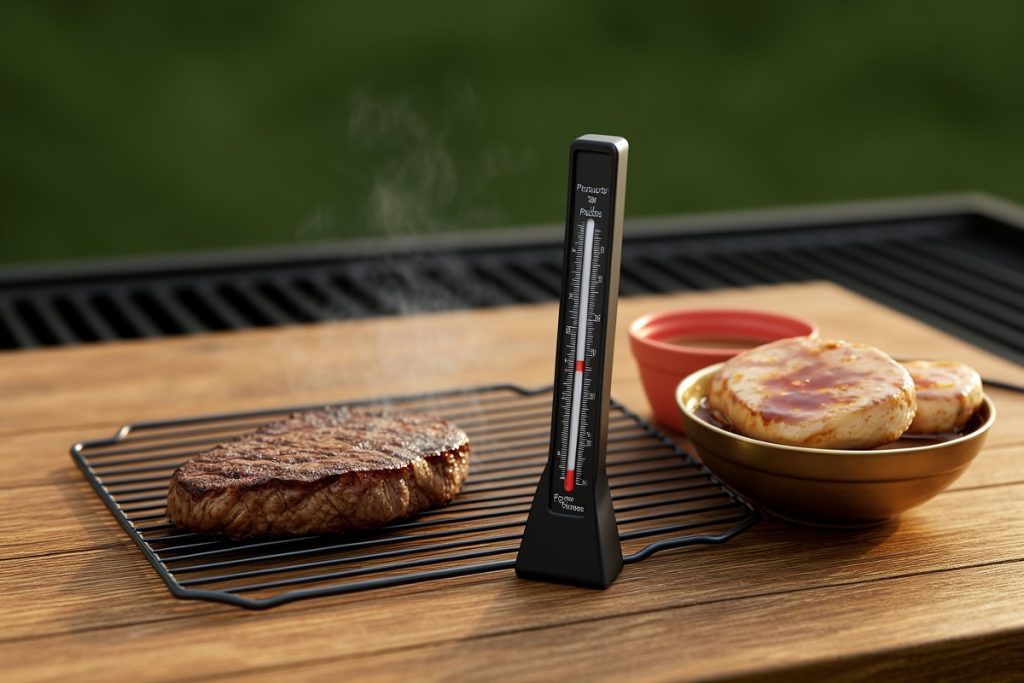
The best instant-read meat thermometer for grilling is easy to insert, quick to read, simple to clean, and suited to both thick cuts and thinner foods. Prioritize a readable display, a useful probe, water resistance, and clear care instructions rather than relying on a product’s marketing title. The listed Meat Thermometer Digital is a practical candidate for cooks who want one tool for grilling, kitchen cooking, candy, and liquids.
Key takeaways
- Use internal temperature, not color or cooking time alone, to judge doneness.
- Look for an instant-read design, a readable display, a probe suited to your food, and easy cleanup.
- Insert the probe into the thickest part and avoid touching bone, the pan, or the grill grate.
- The listed thermometer is versatile on paper, but the product listing does not prove accuracy, battery life, or long-term durability.
Why an instant-read thermometer is useful for grilling
Grilling creates a frustrating tradeoff: the outside of food can brown quickly while the center remains undercooked, or the inside can reach a safe temperature after the exterior has become dry. A thermometer gives you information that timing alone cannot provide. Thickness, starting temperature, weather, grill design, lid position, and the amount of fuel can all change how quickly food cooks.
This matters most with foods that are difficult to judge visually. A thick chicken breast may look finished before its center is safe, while a steak can continue cooking after it leaves the grill. Checking the internal temperature near the end of cooking lets you make a more informed decision instead of cutting into the food repeatedly and losing juices.
The thermometer is not a replacement for good food handling. It is one part of a process that includes keeping raw and cooked foods separate, washing hands and tools, and refrigerating leftovers promptly. Used correctly, it is a small tool that can make grilling more predictable.
Features that matter when choosing a digital meat thermometer
| Feature | Why it matters | What to check |
|---|---|---|
| Instant-read design | Lets you check food near the end of cooking without leaving a probe in the grill. | Look for a clear readout and a probe that opens or stores safely. |
| Probe shape and length | Thick roasts and shallow foods have different measuring needs. | Choose a probe that can reach the center without forcing your hand close to heat. |
| Water resistance | Grilling tools encounter grease, marinades, steam, and frequent cleaning. | Confirm the level of water resistance and the cleaning instructions. |
| Readability | A small or dim display is inconvenient outdoors. | Check whether the display is easy to read in the lighting where you cook. |
| Care and storage | Clean storage helps protect the probe and prevents cross-contamination. | Look for a protective sleeve, case, or clear storage method. |
Accuracy is especially important, but it is also the feature shoppers should avoid assuming. A product title may say “instant read” without telling you its response time, tolerance, calibration process, or operating range. If a manufacturer publishes those specifications, compare them directly. If it does not, treat the thermometer as a convenience tool rather than assuming laboratory-level precision.
How to use a meat thermometer correctly
Place the probe in the thickest part of the food, aiming for the center. Avoid touching bone, the grill grate, a pan, or a pocket of fat, because those surfaces can give you a misleading reading. For thin foods, insert the probe from the side so the sensing area reaches the middle rather than passing through the food.
Check more than one spot when cooking a large roast, a whole bird, or several pieces at once. Food can cook unevenly, particularly when pieces vary in size or sit over different heat zones. If the readings differ, use the coolest reading as the one that needs attention.
The United States Department of Agriculture recommends 165°F for poultry and leftovers, 160°F for ground meats, and 145°F for whole cuts of beef, pork, lamb, and veal followed by a three-minute rest. These are food-safety benchmarks, not universal preferences for texture. Some grillers prefer a steak at a different level of doneness, but the thermometer still helps reveal what is happening inside the food.
Clean the probe after checking raw food and before using it on cooked food. Follow the product’s care instructions rather than submerging the entire device automatically. Even a thermometer described as waterproof may have specific limits around its display housing, battery compartment, or storage conditions.
Where the listed Meat Thermometer Digital fits
The approved candidate, Meat Thermometer Digital, Instant Read Meat ThermometerI, is a reasonable match for shoppers who want one thermometer for grilling and general kitchen use. Its listing describes it as an instant-read, waterproof food thermometer intended for cooking outdoors and indoors, including barbecue, turkey, candy, liquids, and beef. That range is useful if you do not want separate tools for grilling and other temperature-sensitive tasks.
There are limits to what can be concluded from the listed description alone. It does not establish the thermometer’s measured accuracy, exact response time, probe length, display brightness, battery longevity, or ability to hold calibration over time. Those details may matter more than a broad list of intended uses. Before buying, review the current product specifications and care instructions, particularly if you regularly cook large roasts or work over very high heat.
For an occasional home griller, a versatile waterproof design may be more valuable than advanced features. For someone who cooks professionally or relies on tightly controlled temperatures, a model with published calibration information, a documented accuracy range, and replaceable parts may be a better fit. The right choice depends on how often you cook, what foods you prepare, and how much uncertainty you are willing to accept.
A practical buying checklist
- Confirm that the product is intended for the temperatures and foods you cook most often.
- Check whether the probe can reach the center of your usual steaks, roasts, or poultry.
- Look for clear instructions on cleaning, storage, batteries, and water exposure.
- Verify that the display will be readable in your kitchen and outdoor cooking area.
- Compare published accuracy and calibration details when available.
- Make sure the design is comfortable to use without placing your hand too close to heat.
What a thermometer cannot tell you
A temperature reading confirms what is happening at the point where the probe is inserted; it does not guarantee that every part of a large or irregular food is identical. It also cannot tell you whether the exterior is crisp enough, whether a steak has the texture you prefer, or whether food was handled safely before cooking.
Think of the thermometer as a decision aid. Use it near the expected finish time, take readings from appropriate locations, and combine the result with sound food-safety habits. That approach is more reliable than setting a timer and hoping the grill behaves exactly as it did last time.
Last reviewed: 2026-09-14