
Quick answer
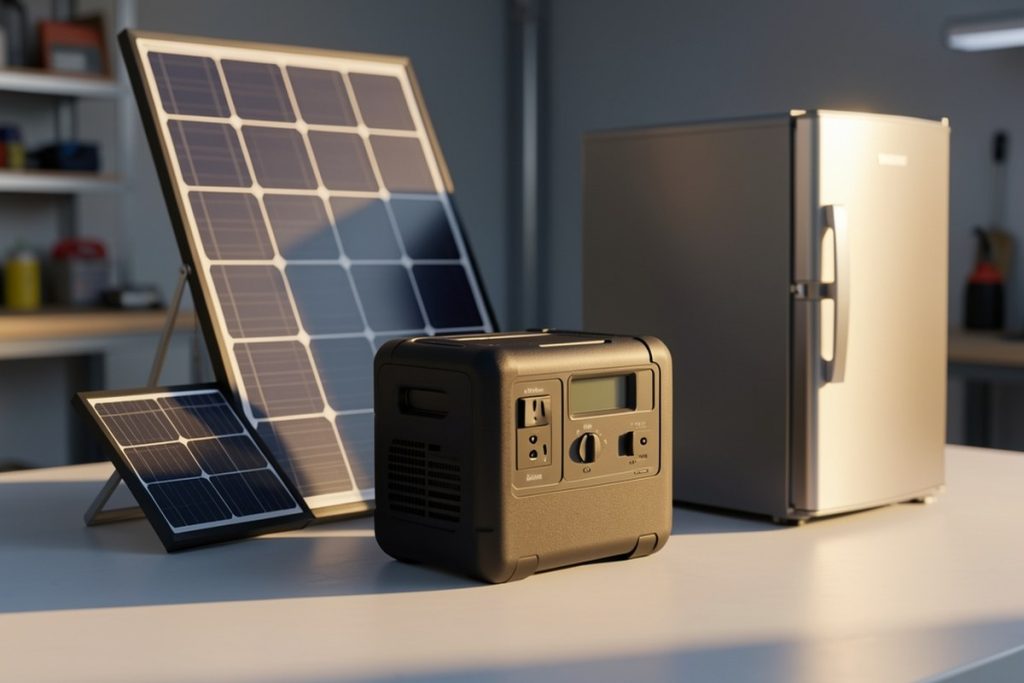
For a refrigerator during a short outage, choose a solar generator by measured energy use, startup surge, battery capacity, and safe charging options—not headline wattage alone. A 1,024 Wh LFP power station with 2,200 W continuous output may suit a fridge plus small essentials, but runtime depends on the appliance, inverter losses, temperature, and whether compatible solar panels can recharge it.
Key takeaways
- Check both your refrigerator’s running wattage and compressor startup surge.
- Battery capacity affects runtime; output wattage determines whether the appliance can start safely.
- A 1,024 Wh power station is more suitable for short outages and essential loads than whole-home backup.
- Solar recharging depends on compatible panels, connectors, weather, placement, and available sunlight.
Start with the refrigerator, not the power station
The biggest mistake people make when shopping for outage backup is starting with a product’s advertised wattage. A better approach is to begin with the appliance you need to protect.
Refrigerators are challenging because their compressors do not draw the same amount of electricity continuously. The compressor cycles on and off, and it can briefly require more power when starting than it uses while running. The number printed on the refrigerator’s rating plate may therefore tell you only part of the story.
Look for the appliance’s running watts, amps, or voltage information. If the label does not make the expected load clear, a plug-in electricity meter can help you measure consumption during normal operation. For the most reliable sizing, observe the refrigerator through several cooling cycles rather than relying on a single reading.
Also consider what else you want to run. A modem or router, a few LED lights, a phone charger, or a small medical device may be important during an outage. Add those loads before choosing a power station. If the refrigerator and other devices start at the same time, their combined demand matters.
Understand the two numbers that matter most
Portable power stations are usually described with two primary electrical figures: watt-hours and watts.
- Watt-hours (Wh): the battery’s stored energy. More watt-hours generally means more runtime.
- Continuous output watts: the power the inverter can provide steadily to connected devices.
- Peak or surge output: the short-duration capacity available for startup demands, if the manufacturer specifies it.
A simple planning formula is:
Estimated energy needed = average load in watts × hours of use.
For example, if a refrigerator averages 100 watts while operating and you want 12 hours of backup, the basic estimate is 1,200 Wh. That does not mean a 1,200 Wh power station will deliver exactly that amount to the refrigerator. Conversion losses, battery reserve, temperature, cable losses, and the refrigerator’s cycling pattern all affect the result.
That is why a power station’s nominal battery capacity should be treated as a planning figure, not a guaranteed runtime. Leave a reasonable reserve instead of sizing the battery to the exact result of your calculation.
What to check before buying
| Check | What to find | Why it matters |
|---|---|---|
| Refrigerator load | Running watts and startup demand | The unit must handle both normal operation and compressor startup. |
| Battery capacity | Wh rating and expected usable energy | This determines how long essential devices can operate. |
| Output type | AC outlet specifications and waveform information | Household appliances need compatible, stable AC power. |
| Recharge method | Solar input, connector, panel limits, and AC charging | Solar charging is not automatic; the components must work together. |
| Safety and placement | Temperature, moisture, and operating instructions | Correct storage and use reduce avoidable risks. |
Pay special attention to the solar input. A power station marketed as a solar generator is generally a battery power station paired with solar panels or another compatible charging source. The battery does not create electricity on its own. If clouds, shade, short winter days, or poor panel placement reduce solar production, recharge times can be much longer than expected.
Where the DJI Power 1000 may fit
For readers looking for portable backup rather than a permanent home battery, the DJI Power 1000 Portable Power Station, 1024Wh LFP (LiFePO4) Battery | 2200W Stable Output, Solar Generator, Home Backup, Camping & RVs, Off-grid, Power Outage, 70-Minute Fast Charging is a reasonable product to investigate.
According to DJI’s published specifications, the unit has a 1,024 Wh battery, LFP chemistry, and up to 2,200 watts of continuous AC output for the applicable U.S. model. Those figures make it potentially relevant for a refrigerator and a limited number of smaller essentials during a short outage, assuming the refrigerator’s startup demand and total load stay within the unit’s limits.
The specifications also list USB-C, USB-A, AC, and SDC connections, along with a stated cycle-life result measured under DJI’s specified laboratory conditions. That information is useful when comparing battery chemistry and connection options, but it does not predict your refrigerator’s actual runtime. Your appliance, ambient temperature, battery age, connected devices, and charging setup will determine real-world results.
This product is not automatically the right choice for every home. A refrigerator with unusually high startup demand may need a different solution. A household seeking automatic whole-home backup will also need to consider a permanently installed battery system, transfer equipment, electrical permits, and professional installation. Never improvise a connection that could send power backward through household wiring.
Plan the solar charging side separately
If you want the system to recharge during a prolonged outage, verify the complete solar setup rather than looking only at the battery. Confirm the supported solar input range, maximum input, connector type, and whether the panel configuration falls within the manufacturer’s limits. Using incompatible equipment can prevent charging or damage components.
Place panels where they receive the least shade possible during the useful part of the day. A panel in full sun for part of the day may outperform a larger panel that spends much of the day behind a tree or building. Weather and season also matter. Solar production varies by location, orientation, tilt, cloud cover, and daylight hours; tools such as the National Renewable Energy Laboratory’s PVWatts calculator can help estimate production for a site.
Keep expectations realistic. Solar panels may maintain essential power during daylight, but they may not replace all the energy a refrigerator uses overnight. For multi-day outages, reduce the load, keep refrigerator doors closed, and prioritize food safety and other critical needs.
Use a practical outage test before you need it
Testing your setup in advance is more useful than assuming the specifications will translate perfectly at home. Charge the power station, connect the refrigerator, and observe whether it starts and runs normally. If the unit displays input or output information, record what you see during compressor startup and regular cycling.
- Measure the refrigerator’s typical consumption over several hours.
- Test the power station with the refrigerator by itself first.
- Add other essential devices one at a time.
- Check cables and connectors for secure fits and signs of heat.
- Confirm how solar panels will be positioned and stored before an emergency.
Keep the power station dry, out of excessive heat, and away from physical damage. Follow the manufacturer’s charging, storage, and temperature instructions. If you also own a fuel-burning generator, keep it outdoors and away from doors, windows, and vents because carbon monoxide can build up indoors. A battery power station and a combustion generator have different safety considerations, so do not treat them as interchangeable.
When a solar generator is the wrong solution
A portable power station is best viewed as an emergency buffer. It can be useful for short outages, camping, RV use, and selected appliances, but it may be undersized for central air conditioning, electric heating, well pumps, electric ranges, or an entire home.
Choose a larger or permanently installed system if you need automatic switchover, multiple high-demand circuits, several days of autonomy, or integration with a rooftop solar array. If the refrigerator is protecting medication or another critical item, ask the appliance or equipment manufacturer about acceptable backup power and consult a qualified electrician.
The most honest buying decision comes from matching the battery to a measured load, keeping a reserve, and planning how the system will recharge. For a brief outage, the right portable solar setup can protect food and keep essential communication devices running without pretending to replace the electrical grid.
Last reviewed: 2026-08-14