
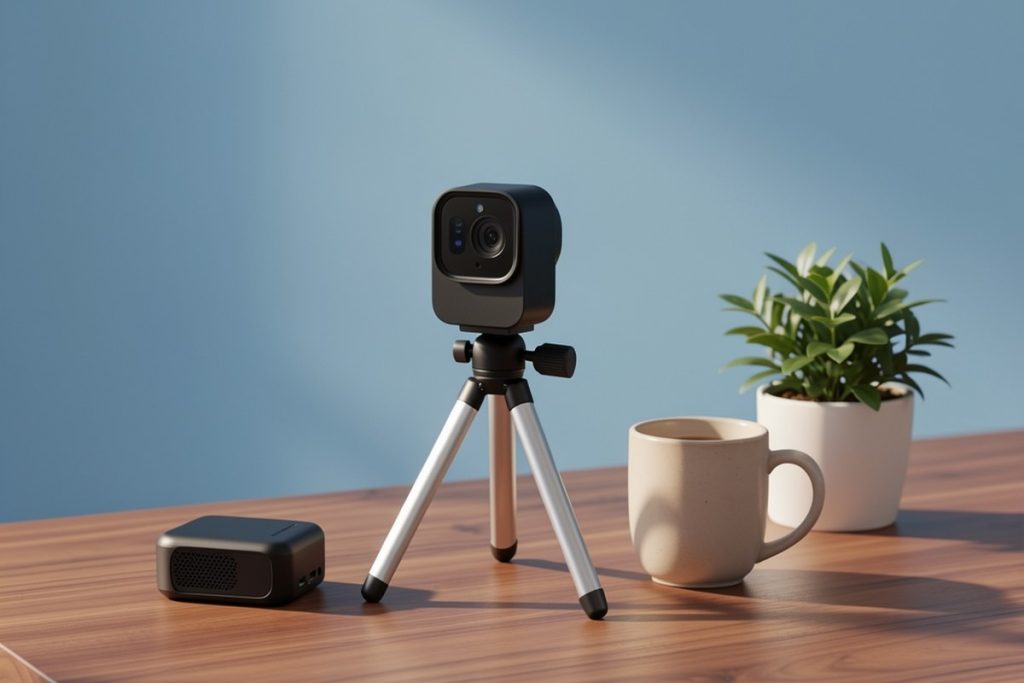
Quick answer
An AI webcam is worth considering when you regularly stream, teach, present, or move around during calls and want automatic framing without constantly adjusting the camera. Prioritize reliable autofocus, useful tracking, clear microphones, easy software compatibility, and physical privacy controls. A 4K PTZ model such as the EMEET PIXY may suit active creators, but a simpler fixed webcam can be better for a stationary desk.
Key takeaways
- AI tracking is most useful when you move within a defined area, not when you sit still all day.
- Autofocus, microphone quality, lighting, and software compatibility matter as much as resolution.
- PTZ movement adds flexibility but also creates more setup decisions and potential distractions.
- Review camera permissions and disable features you do not need before using an AI-enabled device.
By Derek Holt, Data-Driven Analyst
What problem does an AI webcam actually solve?
The main advantage of an AI webcam is not simply a sharper picture. It is reduced friction. A traditional webcam captures one fixed frame, so you must remain centered or manually reposition the device. An AI-powered pan-tilt-zoom camera can use tracking and movement to keep you in view as you shift position, demonstrate an object, teach from a small room, or host a live presentation.
That makes this category especially relevant to streamers, online instructors, consultants, remote presenters, and anyone who records while standing. It is less compelling for a person who sits in one position, uses a separate microphone, and already has good lighting. In that situation, a fixed camera may deliver a cleaner, simpler setup for less complexity.
Which features matter most when comparing AI webcams?
Start with the way you work rather than the feature list. A camera can advertise advanced AI functions and still be a poor fit if its movement is distracting, its microphones are weak, or its software does not work with your preferred platform.
| Feature | What to check | Why it matters |
|---|---|---|
| Tracking | Whether it follows movement smoothly and lets you disable it | Useful for presentations and streams; unnecessary for a fixed desk |
| Autofocus | Speed, consistency, and performance in changing light | Keeps your face or demonstration in focus without manual adjustment |
| Microphones | Number of microphones and whether your room is treated | Built-in audio can simplify calls, but it may not replace a dedicated mic |
| Resolution | Whether your software and upload speed support 4K | Higher resolution can provide cropping flexibility, but does not fix poor lighting |
| Compatibility | Support for your operating system, streaming app, and connection type | Prevents buying hardware that is difficult to use in practice |
When the EMEET PIXY makes sense
For readers comparing AI webcams for streaming or movement-heavy video calls, the EMEET PIXY Dual-Camera AI-Powered PTZ Camera is a reasonable model to investigate because its listed design targets that specific use case. The product description identifies dual cameras, PTZ movement, AI tracking, PDAF autofocus rated at 0.2 seconds, a 1/2.55-inch Sony sensor, three microphones, presets, and 4K webcam capability.
Those specifications suggest flexibility rather than a one-size-fits-all purchase. PTZ movement and tracking could help someone who alternates between sitting and standing, demonstrates products, or needs a wider presentation area. Presets may also reduce repeated manual repositioning when switching between common shooting positions.
However, the listed specifications are not proof that the camera will look perfect in every room. A sensor still needs adequate light. Autofocus can still make mistakes when objects move close to the lens. Built-in microphones can still pick up keyboard noise, fans, or room echo. Treat the advertised features as reasons to evaluate the model, not as a substitute for checking your own environment.
4K is helpful, but it is not the whole picture
Resolution is easy to compare, which is why it often dominates webcam buying decisions. In practice, image quality also depends on light, lens behavior, exposure, color, framing, and the video platform receiving the feed. Many meeting and streaming services compress video or limit the resolution they display, so a 4K camera may not produce a visibly 4K result in every call.
Higher resolution can still be useful. It may give you more room to crop a recording, create a cleaner close-up, or preserve detail when your subject is farther from the camera. But if the room is dim or the background is cluttered, adding light and improving composition may make a larger difference than moving from a lower resolution to 4K.
How to set up an AI webcam without making the frame distracting
Place the camera at roughly eye level and leave enough space around your usual movement area for tracking to work naturally. Avoid putting it so close to the edge of a desk that a small pan makes the composition feel unstable. A plain background, a soft front light, and separation between you and the wall usually create a more professional result than a busy background full of visual distractions.
Before an important call or stream, test the camera inside the actual application you will use. Confirm that the correct camera and microphone are selected, then walk through your normal movements. Watch for unwanted reframing, delayed tracking, autofocus hunting, or a microphone that sounds distant. If the camera supports presets, save only the positions you genuinely use.
- Set the lens near eye level and aim for a stable, uncluttered background.
- Put a soft light in front of you rather than relying only on overhead lighting.
- Test tracking while seated, standing, and reaching toward a demonstration area.
- Compare the built-in microphones with headphones or a dedicated microphone.
- Turn off tracking, pan, tilt, or other automation when a fixed frame is preferable.
Privacy and control deserve equal attention
An AI-enabled camera is still a camera and microphone connected to a computer. Before using one, check which applications have access to those devices and understand how the camera’s tracking features are enabled or disabled. The National Institute of Standards and Technology’s AI Risk Management Framework is a useful reminder to evaluate AI systems for context, risks, and human control rather than accepting automation automatically.
For sensitive meetings, consider physically covering or disconnecting the camera when it is not needed. Use application-level controls as an additional safeguard, not your only one. If other people share the room, explain when recording or live streaming is active and avoid capturing private conversations in the background.
Who should buy an AI PTZ webcam?
Choose this type of camera if you present from more than one position, stream regularly, teach demonstrations, or want automated framing with the option to control the shot manually. It can also be helpful when a single camera needs to support both video calls and content creation.
Choose a simpler webcam instead if you remain seated, already own a good microphone, rarely change framing, or prefer a setup with fewer moving parts. The best camera is the one that works consistently in your room and with your software. Advanced features are valuable only when they remove a real problem.
Last reviewed: 2026-08-28