
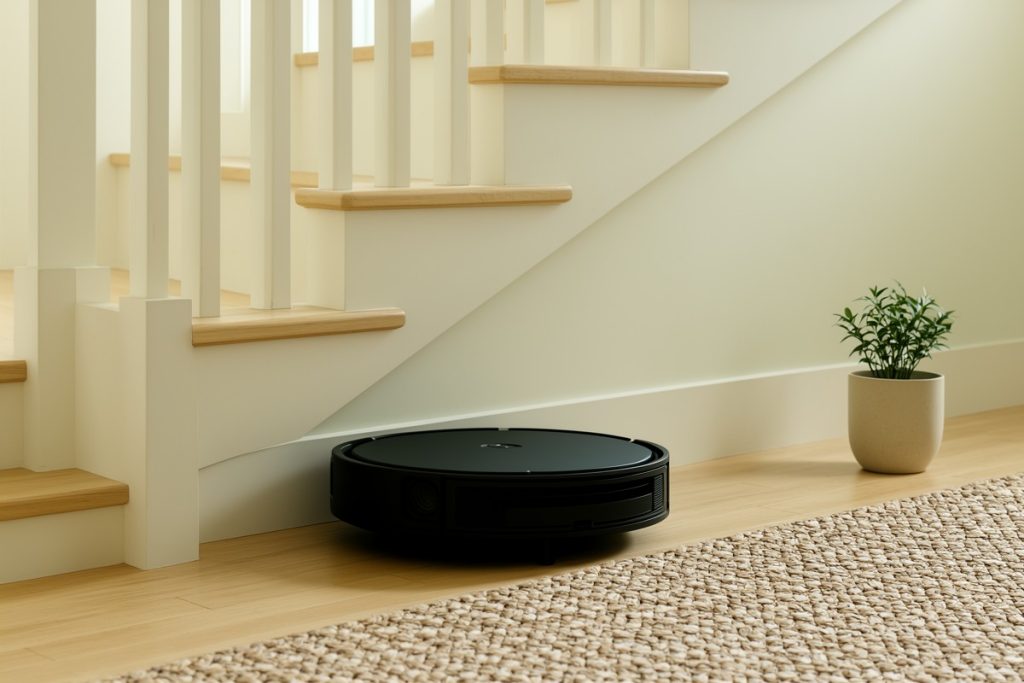
Quick answer
For a two-story home, choose a robot vacuum with reliable mapping, strong obstacle awareness, practical floor-by-floor management, and a charging plan that does not depend on climbing stairs. Multi-level mapping can make separate floors easier to clean, but no robot vacuum carries itself upstairs. Before buying, check dock placement, threshold clearance, maintenance needs, and whether you are comfortable moving the unit between levels.
Key takeaways
- Multi-level mapping helps organize different floors but does not eliminate the need to carry the robot upstairs.
- A dock on only one level means the robot may not recharge or resume cleaning independently on the other floor.
- LiDAR navigation is most useful when rooms, furniture, and no-go areas need consistent mapping.
- Measure thresholds, inspect stair access, and plan where the robot will start and finish before buying.
Why two-story homes require a different buying decision
A robot vacuum can be convenient in a single-level apartment because the machine, map, and dock all stay in one place. Stairs change that arrangement. The vacuum can clean a floor, but it cannot safely travel up or down a staircase unless a person moves it. That makes the best choice less about headline suction alone and more about how easily the robot fits into your routine.
The central question is simple: can you place the robot on each floor, let it understand that floor, and retrieve it without creating extra work? If the answer is yes, a robot vacuum may still save time. If you expect fully automatic whole-home cleaning across stairs, even an advanced model will disappoint.
Look for mapping that supports separate floors
Multi-level mapping is one of the most relevant features for a two-story home. A robot with this capability can store or recognize more than one floor layout, reducing the need to start mapping from scratch every time you move it. That can be particularly useful when bedrooms are upstairs and the main living areas are downstairs.
LiDAR navigation is also worth considering. It uses distance measurements to build a spatial map and help the robot plan routes around rooms and furniture. In practical terms, that is more useful than watching the vacuum wander randomly: you can usually expect a clearer cleaning pattern and more predictable room coverage.
Still, mapping features vary. Before purchasing, confirm how many maps the specific model supports, how maps are selected, and whether room cleaning or no-go zones remain available on each stored floor. Do not assume that “multi-level mapping” means the robot knows when you have carried it upstairs or that it can find its dock on every level.
Plan the charging dock before you buy
The dock is often the overlooked limitation in a multi-floor setup. A robot can generally return to its dock only when the dock is on the same level and reachable by an unobstructed path. If the charging station remains downstairs, an upstairs cleaning run may end with the robot stopped wherever its battery becomes low.
For many households, the simplest arrangement is to keep one permanent dock on the main floor and manually place the robot upstairs for shorter cleaning sessions. When the upstairs job is complete, bring it back down. This works best when the upstairs area is compact and you can start the robot with enough charge.
A second dock may be more convenient, but compatibility and cost should be checked separately. Do not buy an extra station until the manufacturer confirms that the robot supports it. Also consider whether the dock needs open space on both sides or in front; a narrow hallway or landing may not work well even if the vacuum itself fits there.
Compare the features that matter in a two-floor routine
| Feature | Why it matters | What to verify |
|---|---|---|
| Multi-level maps | Keeps floor layouts separate | Number of supported maps and how switching works |
| LiDAR navigation | Improves route planning around rooms and furniture | Whether maps support room selection and restricted areas |
| Self-charging | Helps the robot resume work on its docked floor | Whether it can recharge only at the dock or use additional stations |
| Obstacle and edge handling | Reduces interruptions near furniture and stair edges | Stair sensors, threshold limits, and known trouble spots |
| Maintenance access | Makes frequent floor-by-floor use less frustrating | How easily the bin, brush, filter, and mop components can be cleaned |
Is the Roborock Q7 L5 a sensible candidate?
The Roborock Q7 L5 is a plausible fit for shoppers whose main problem is organizing cleaning across multiple floors rather than avoiding every manual step. The supplied product listing states that it includes 8,000Pa suction, LiDAR navigation, multi-level mapping, a dual anti-tangle system, and self-charging. Those features align with the needs of a home where the robot must be moved between floors and then navigate each floor methodically.
That does not make it an automatic whole-house solution. You would still need to carry it upstairs, choose the correct map if required, and decide where it should begin and end. Self-charging is most valuable on the floor where the dock lives. If upstairs cleaning is your priority, confirm the manufacturer’s current instructions for map handling, stair-edge behavior, and any additional dock options before ordering.
It is also sensible to separate verified specifications from expected results. Suction ratings are not a guarantee that every carpet, pet-hair problem, or embedded crumb will be handled perfectly. Floor type, brush maintenance, debris size, and room layout all affect performance. Treat the Q7 L5 as a potentially practical mapping-focused option, not as proof that every two-story cleaning problem is solved.
Use this setup checklist before the first run
- Measure the tallest thresholds between rooms on each floor.
- Choose a clear, permanent dock location on the primary floor.
- Remove cords, loose fabric, and small objects from the test area.
- Map one floor at a time and check that rooms are divided correctly.
- Create restricted areas near delicate objects, pet bowls, or awkward drop-offs.
- Carry the robot upstairs with enough battery for a complete session.
- After cleaning, check the brush, filter, wheels, and bin rather than waiting for a warning.
When a robot vacuum may not be worth it
A two-story robot vacuum may not be the right purchase if stairs make up a large part of your home, if every room has high thresholds, or if you dislike moving the machine manually. It may also be a poor fit when the upstairs floor has frequent clutter that requires preparation before every run. In those cases, a lightweight conventional vacuum can be faster and simpler for stairs, edges, and spot cleaning.
For homes with mostly open floors, consistent furniture placement, and a manageable routine for carrying the robot, mapping can make the trade-off worthwhile. The best choice is the one that reduces repeated sweeping without introducing a charging and setup chore you will avoid.
Last reviewed: 2026-08-31