
Quick answer
For meal prep, choose a heat-resistant, multi-blade chopper that breaks cooked ground turkey into consistent crumbles without repeated knife work. The PGYARD Meat Chopper Hamburger Grinder may suit this task based on its listed nylon blades, heat-resistant design, and dishwasher-safe construction. It is a feature-based recommendation, not a hands-on performance test, so verify cookware compatibility before use.
Key takeaways
- Consistent crumbles make ground turkey easier to portion into burrito bowls, pasta sauces, tacos, and freezer meals.
- A multi-blade head is more useful for batch cooking than a single flat spoon or narrow spatula.
- Nylon blades may be preferable around some cookware, but you should still follow the pan manufacturer’s care instructions.
- Use a food thermometer to confirm ground turkey reaches 165°F, then refrigerate leftovers promptly.
Why evenly crumbled ground turkey matters for meal prep
Ground turkey is convenient for batch cooking, but large clumps can create uneven seasoning, inconsistent portions, and awkward bites after reheating. If some pieces are fine while others remain compact, sauce may coat the surface without reaching the center of each clump. That problem becomes more noticeable when preparing several servings at once.
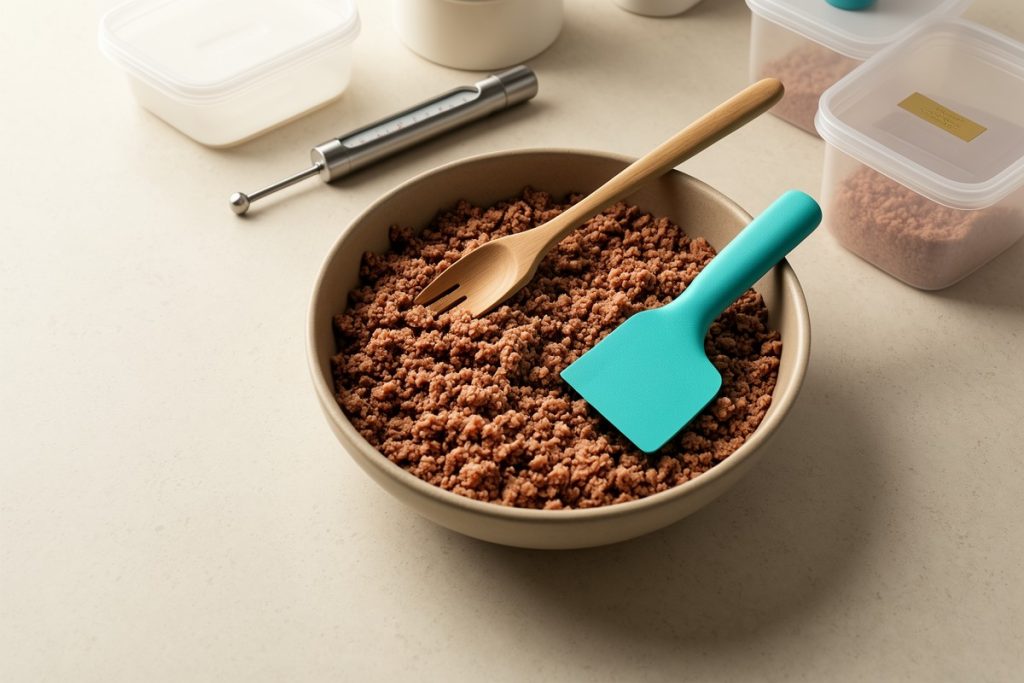
A good chopper helps turn the cooked meat into smaller, more uniform pieces while it is still in the pan or a mixing bowl. The practical benefit is not restaurant-style presentation. It is repeatability: each container gets a similar amount of meat, vegetables, sauce, and seasoning.
This makes a dedicated chopper particularly useful for people preparing turkey for several meals, rather than someone cooking a single portion occasionally. It can also help combine cooked ground turkey with ingredients such as beans, diced vegetables, or mashed potatoes, provided the tool and cookware are suitable for that use.
What to look for in a ground turkey meal-prep tool
Product descriptions often emphasize the number of blades, but that is only one part of the decision. Consider how the tool will fit into your actual cooking routine.
| What you need | Feature to look for | Why it helps |
|---|---|---|
| Even crumbles | Several raised blades or a broad chopping head | Distributes pressure across more of the food instead of repeatedly working one small spot. |
| Batch cooking | A comfortable handle and head wide enough for your pan | Reduces the need to chase clumps around a large skillet or bowl. |
| Cookware protection | Nylon or another material approved for your cookware | May reduce the risk associated with using sharp metal utensils, but does not guarantee compatibility with every coating. |
| Fast cleanup | Few seams and dishwasher-safe parts, when confirmed by the listing | Makes the tool more practical after preparing several portions. |
| Food safety | A separate instant-read thermometer | A chopper can break up food, but it cannot confirm that the center reached a safe temperature. |
How to break up ground turkey evenly during batch cooking
- Preheat the cookware as directed by your recipe. Add the turkey and begin separating it as the exterior starts to cook. Avoid pressing aggressively if the meat is still cold and firm, since that can make the process feel harder than necessary.
- Work in sections. Move the chopper through one area at a time, using short downward presses and turns. Scrape across the bottom occasionally so cooked pieces do not remain underneath larger clumps.
- Pause before seasoning heavily. Once the turkey is mostly separated, inspect the pan for oversized pieces. Breaking those apart before adding a thick sauce makes the final mixture more consistent.
- Check doneness with a thermometer. Ground poultry should reach 165°F, measured with a food thermometer. Color and texture can provide clues, but they are not substitutes for a temperature check.
- Portion after a brief cooling period. Divide the turkey into shallow containers so it cools more efficiently, then refrigerate it promptly rather than leaving a large hot batch on the counter.
The goal is a uniform texture, not pulverized meat. Stop once the pieces are small enough for the recipe. Overworking the turkey can make it less appealing, especially if you plan to reheat it later.
Is the featured nylon chopper a sensible fit?
Based on the listed product information, the PGYARD model is designed around the features that matter for this use: five nylon blades, heat-resistant construction, and dishwasher-safe cleaning. Those details make it a reasonable candidate for cooks who want one tool for breaking up ground meat and mixing soft ingredients.
There are still limits to what a product listing can establish. It does not prove how quickly the tool will break apart a particular batch, how comfortable it will feel over repeated use, or whether it is safe for every type of coated pan. Before using it in cookware, check the pan maker’s utensil guidance. If that guidance is unclear, use a bowl or another approved surface instead.
Also consider storage. A chopper that is easy to clean but awkward to fit in a drawer may become a rarely used gadget. If your meal prep usually involves one or two servings, a sturdy spatula may already meet your needs. A dedicated multi-blade tool makes more sense when you regularly cook larger batches and care about consistent crumbles.
A quick buying checklist
Before choosing a ground turkey chopper for meal prep, check these points:
- Does the head have enough width for the pan or bowl you normally use?
- Is the blade material clearly identified?
- Does the manufacturer or retailer state whether it is dishwasher safe?
- Can you clean around the blade joints without leaving food trapped?
- Does your cookware manufacturer permit that material?
- Will the handle remain comfortable during a full batch?
If the answers are unclear, do not treat a promotional description as proof of performance. Choose the tool with the clearest care instructions and the best fit for your existing kitchen equipment.
Food safety and storage reminders
Ground turkey should be cooked to 165°F, according to the U.S. Department of Agriculture. After cooking, divide leftovers into shallow containers and refrigerate them within two hours. If the surrounding temperature is above 90°F, the USDA advises refrigerating perishable food within one hour.
Use refrigerated cooked turkey within three to four days, or freeze portions for longer storage. When reheating, warm the food thoroughly and check the center of the portion rather than relying only on a hot surface. These steps matter more than the choice of chopper: the tool improves preparation, but safe cooking and storage protect the finished meal.
Last reviewed: 2026-08-31
Sources
- Safe Minimum Internal Temperature Chart — U.S. Department of Agriculture Food Safety and Inspection Service
- Leftovers and Food Safety — U.S. Department of Agriculture Food Safety and Inspection Service