Quick answer
To start crocheting, choose one medium-weight yarn, a matching 5 mm or 5.5 mm hook, and one simple project. Learn the slip knot, chain stitch, single crochet, and how to turn your work. Practice a small square before attempting a scarf. Keep your tension loose, count stitches regularly, and fix mistakes early instead of crocheting past them.
Key takeaways
- Medium-weight yarn and a 5 mm or 5.5 mm hook are forgiving choices for beginners.
- Learn four skills first: slip knot, chain stitch, single crochet, and turning.
- Use stitch counts to catch mistakes before they spread through a project.
- Start with a small square or coaster rather than a large, time-consuming item.
By Tommy Ruiz, Everyday Problem Solver
What you need for your first crochet project
Beginning crochet is easier when you limit your choices. A crowded craft aisle can make the hobby look more complicated than it is, but your first project only needs three essentials: yarn, a crochet hook, and scissors. A yarn needle is also useful for hiding the loose ends when you finish.
Choose a smooth, medium-weight yarn rather than fuzzy, very thin, or novelty yarn. Smooth yarn lets you see each loop clearly, and medium-weight yarn is large enough to handle without being bulky. The Craft Yarn Council identifies medium-weight yarn as category 4, commonly called worsted or aran weight. Check the yarn label for its suggested hook range, then start near the middle of that range.
A 5 mm or 5.5 mm hook is a practical starting point for many medium-weight yarns. The exact match depends on the yarn and your tension, so treat the label recommendation as a starting guide rather than a rule. Light-colored yarn is usually easier to inspect than black or very dark yarn.
The four crochet skills to learn first
You do not need to memorize a large vocabulary before making something. Focus on these four actions in order:
- Slip knot: Make an adjustable loop that sits on the hook. It should move slightly along the hook without sliding off.
- Chain stitch: Wrap the yarn over the hook and pull it through the loop already on the hook. Repeating this creates a foundation chain.
- Single crochet: Insert the hook into a stitch, yarn over, pull up a loop, yarn over again, and pull through both loops on the hook.
- Turning: At the end of a row, make the required turning chain, rotate the work, and crochet back across the row.
When practicing, aim for consistent loops rather than speed. If the hook feels difficult to insert, your tension may be too tight. If the fabric looks loose and uneven, pull the working yarn gently but do not yank it. Your hands will develop a natural rhythm after several rows.
How to make a small practice square
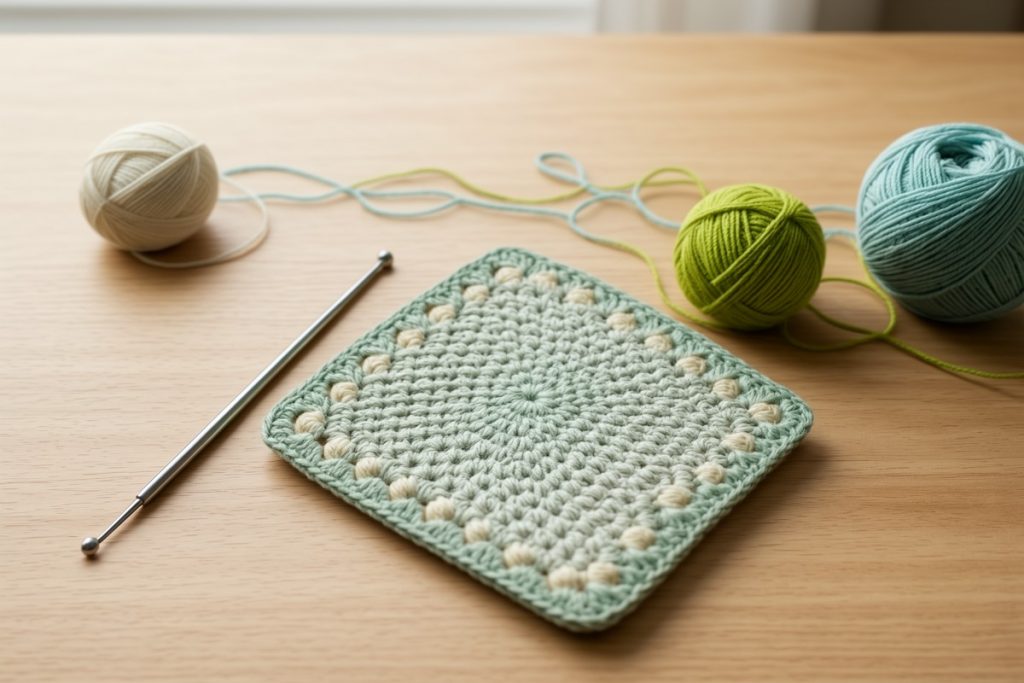
A small square gives you a low-pressure way to practice while revealing common problems. Start with a foundation chain of about 15 stitches. Work one single crochet into each chain across the row. When you reach the end, make one turning chain, turn the piece, and work back across.
Repeat until the piece looks roughly square. Do not worry if your first attempt is not perfectly even. The goal is to learn how the stitches sit, where to insert the hook, and how to keep the edges straight.
Count the stitches in every row. If you began with 15 stitches, most rows should contain 15 single crochets. A missing stitch usually makes the edge shrink; an extra stitch often makes it widen. Find the first uneven edge and compare the current row with the previous one. Undoing a few stitches is faster than trying to disguise a mistake several rows later.
| What you notice | Likely cause | What to try |
|---|---|---|
| The fabric feels stiff | Tension is too tight | Relax your grip and use a slightly larger hook if needed |
| The edges narrow | A stitch was missed at the row end | Count each row and identify the final stitch |
| The edges flare outward | An extra stitch was added | Check whether you crocheted into the turning chain by mistake |
| Loops are hard to see | Yarn is dark, fuzzy, or splitty | Switch to smooth, light-colored yarn |
How to keep your edges straight
Row edges cause many beginner frustrations because the first and last stitch can be easy to overlook. Place a removable stitch marker in the first stitch of each row if you have trouble finding it. You can also use a small scrap of contrasting yarn as a temporary marker.
Pay attention to the turning chain instructions for the specific pattern. Some patterns count the turning chain as a stitch, while others do not. Mixing those approaches can add or remove stitches from every row. If a pattern says to work into the first stitch, do that consistently; if it says to skip the first stitch because the turning chain counts, follow that instruction instead.
Read the pattern abbreviations before starting. A reliable beginner pattern should explain terms such as “sc” for single crochet, state the required hook and yarn, and tell you how many stitches each row should contain. If those details are missing, choose a clearer pattern for your first project.
Choosing a first finished project
Once you can make several even rows, choose a small project with one repeating stitch. A coaster, dishcloth, narrow headband, or simple scarf is easier to manage than a fitted garment or complex stuffed figure. Select a project that lets you stop after a short practice session without losing your place.
If you prefer a guided sequence instead of piecing together separate tutorials, Crochet Basics Made Simple: A Beginner’s Guide to Learn Crochet and Creating Easy Projects from Day One is a relevant beginner-focused book to consider. Its stated focus matches someone who wants foundational instruction and easy projects. Compare its teaching style and project format with your preferred learning method before choosing it; a book is helpful only if you will actually follow its explanations.
A practical beginner checklist
- Choose smooth category 4 yarn in a light or medium color.
- Use the hook size suggested on the yarn label, starting around 5 mm or 5.5 mm when appropriate.
- Practice the slip knot and chain until the loops are similar in size.
- Make a small single-crochet square before starting a large project.
- Count stitches at the end of every row.
- Keep a yarn needle nearby for finishing loose ends.
When to move beyond the basics
Move to half double crochet, double crochet, color changes, and circular projects after your single-crochet rows are reasonably consistent. You do not need perfect tension, but you should be able to identify the first and last stitch and maintain a similar stitch count across several rows.
Before beginning a larger project, make a small test piece with the same yarn and hook. This helps you see the fabric’s texture and whether you enjoy working with that combination. If the result is too stiff, try a larger hook; if it is too loose, try a smaller one. Keep the test piece as a reference for future projects.
The most useful beginner habit is simple: pause whenever something looks wrong. Count the stitches, inspect the last row, and undo only as far as necessary. Crochet becomes much less intimidating when each mistake is treated as information rather than failure.
Last reviewed: 2026-08-28