
Quick answer
Choose a home gym machine by starting with your actual space, training goals, budget, and willingness to use it regularly. Measure the footprint and moving clearance before comparing features. Then assess resistance, adjustability, safety instructions, maintenance, and setup time. A machine is worthwhile when it removes barriers to consistent strength training—not simply because it offers the most attachments.
Key takeaways
- Measure both the machine’s footprint and the clearance needed to use it safely.
- Choose resistance and adjustments that match your current ability, not an imagined future routine.
- Prioritize easy access, clear instructions, and reliable maintenance over a long feature list.
- Compare the machine with simpler options such as bands, dumbbells, or bodyweight training.
By Coach Amy Lin, Sustainable Fitness Coach
Start with the problem you want the machine to solve
The best home gym machine is not necessarily the largest, newest, or most versatile model. It is the one that solves a specific problem well enough for you to keep using it.
Maybe you avoid the gym because commuting takes too long. Perhaps you want more structure than a collection of loose weights provides. You may also need a stable setup that makes resistance training feel less intimidating. Write down the main obstacle in one sentence before shopping. For example: “I need a compact strength setup that is ready to use after work.”
This question keeps your decision practical. If your main barrier is time, a machine that takes several minutes to unfold or adjust may not help. If your main barrier is uncertainty, clear adjustment points and a straightforward exercise selection may matter more than having dozens of possible movements.
Measure your room before comparing features
Start with a tape measure, not a product page. Record the width, depth, and height of the area where the machine will sit. Then check the space required for the movements you expect to perform. A station may fit against a wall but still need room in front, above, or to either side for handles, seats, cables, or body movement.
Also consider the route into the room. Measure doorways, stairwells, tight corners, and elevators if applicable. Check the flooring and whether the surface is level. Heavy equipment can damage delicate flooring or become unstable when placed on an uneven surface.
Make sure the location has enough light and ventilation. A cramped, dark corner can become an emotional barrier even when the equipment itself is suitable. Leave a clear walkway around the station, and avoid blocking doors, windows, heating vents, or emergency exits.
Match the equipment to your training goals
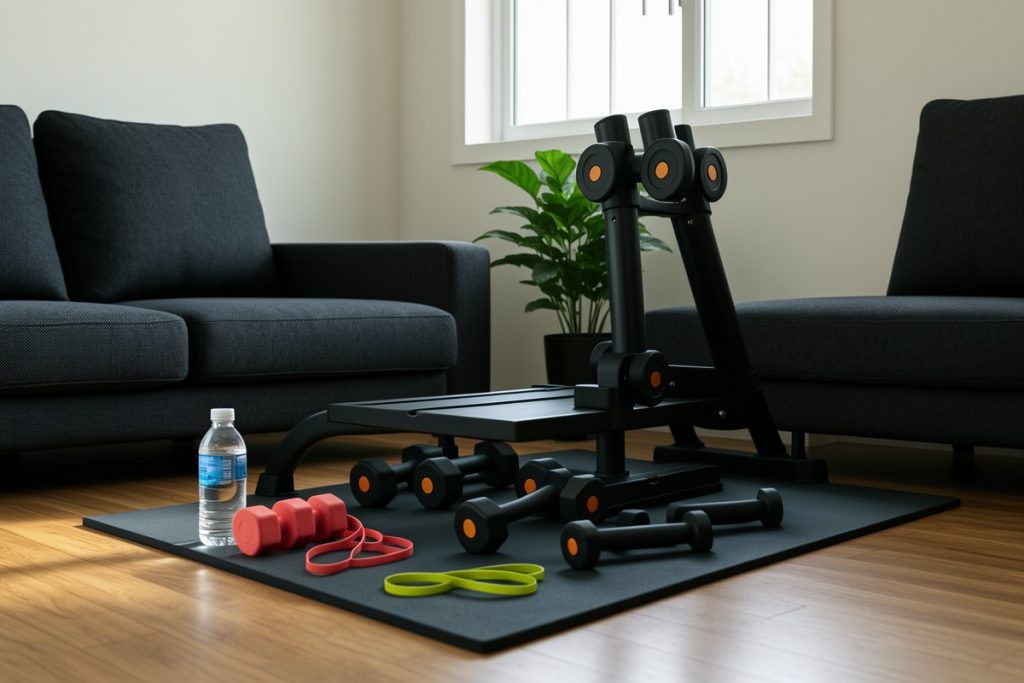
Different home gym designs support different habits. A cable-based station may appeal to someone who likes guided resistance and adjustable pulling angles. A rack may be better for someone who already knows barbell movements and has the room and safety equipment to support them. Adjustable dumbbells can be easier to store, while resistance bands are often the simplest choice for limited space or travel.
Think in terms of movements rather than brand names or attachment counts. A balanced beginner setup should give you practical ways to train patterns such as pushing, pulling, squatting, hinging, carrying, and bracing. You do not need every pattern in one session, but your equipment should support the movements you genuinely intend to practice.
Be honest about your experience level. More options can create more confusion. If you are new to strength training, a smaller range of well-understood movements may be more useful than a machine that requires frequent technical adjustments.
Compare the features that affect everyday use
| What to assess | Look for | Be cautious if |
|---|---|---|
| Footprint | Measured dimensions plus usable clearance | The listing shows only folded or minimal dimensions |
| Resistance | A manageable starting level and gradual increases | The first resistance jump feels too large |
| Adjustability | Settings you can change quickly and securely | Adjustments are unclear or require excessive force |
| Construction | Stable frame, protected moving parts, and clear maintenance guidance | You cannot tell how wear or loose fasteners will be checked |
| Setup | Instructions, tools, and assembly requirements are clearly described | You have no safe plan for delivery or assembly |
Resistance capacity is only useful if it matches your needs. A very high maximum does not make a machine better for a beginner, and it does not guarantee a smooth or comfortable experience at lower levels. Look for enough range to progress gradually without forcing you to make large jumps.
Consider the real cost of ownership
The purchase price is only one part of the decision. Consider delivery, assembly, floor protection, storage, maintenance, and the possibility of needing professional help. If the machine requires two people to assemble, identify who can safely help before ordering it.
Read the instructions before buying when they are available. Look for information about required tools, ceiling height, anchoring, lubrication, cable inspection, replacement parts, and recommended user limits. These details may be less exciting than a list of exercises, but they affect whether the equipment remains usable and safe.
Maintenance should be simple enough that you will actually do it. A quick inspection of bolts, pins, cables, pulleys, and upholstery can help you notice wear before it becomes a larger problem. Follow the manufacturer’s directions rather than improvising repairs or modifications.
Where a multifunctional station may fit
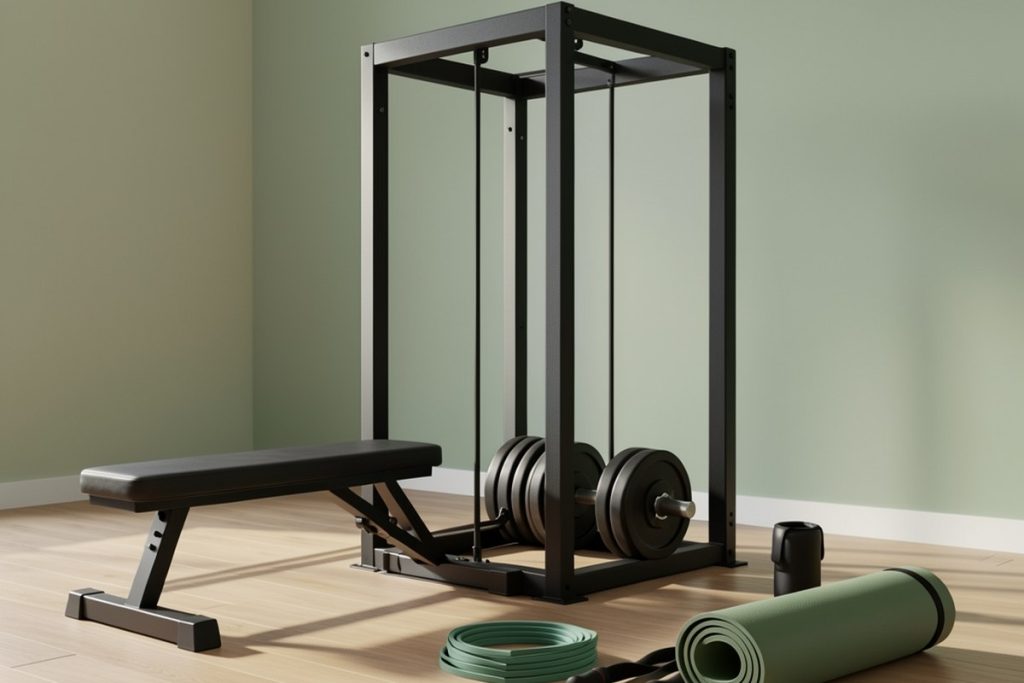
A multifunctional home gym station with a 100-pound weight stack and lat pulldown system may suit a beginner who wants one dedicated resistance-training area and has enough room for a permanent setup. The listed features create a reasonable starting point for evaluation, but they do not prove that the station will fit every body, room, or training style.
Before choosing it, confirm the assembled dimensions, required clearance, delivery details, assembly requirements, adjustment process, and safety guidance. Consider whether the resistance range is appropriate for the exercises you plan to perform. If you live in a small apartment, share a room, or prefer workouts that can move around the house, bands or adjustable dumbbells may be more practical.
This is a feature-based recommendation, not a claim of hands-on testing. Treat the [multifunctional home gym station with a 100-pound weight stack and lat pulldown system](https://www.amazon.com/dp/B0GF7X6C9G?tag=getwitty-20) as one option to investigate rather than an automatic best choice.
Use a simple pre-purchase checklist
- Space: Have I measured the full footprint, movement clearance, ceiling height, and delivery route?
- Purpose: Can I explain the main training problem this machine will solve?
- Access: Can I begin a workout without moving furniture or completing a complicated setup?
- Progression: Does the resistance allow small, manageable increases?
- Safety: Have I read the instructions and identified how the equipment will be assembled, inspected, and maintained?
- Alternatives: Would a smaller or less expensive setup solve the same problem more simply?
Choose the setup you will keep using
Equipment can support a fitness habit, but it cannot create one by itself. Place your machine where it is visible and accessible, schedule two realistic weekly sessions, and decide what your minimum workout looks like on a busy day. A short session is more useful than an ideal session that never happens.
Start with controlled movements and leave some effort in reserve while you learn the equipment. Increase resistance only when your technique remains steady and the current level feels repeatable. Stop if you experience sharp pain, chest pain, faintness, or unusual shortness of breath, and seek appropriate medical guidance.
Adults are generally advised to perform muscle-strengthening activity on at least two days each week, but your starting point can be modest. The sustainable choice is the one that fits your space, your schedule, and your confidence. Select equipment for the life you actually live, then let consistent use—not novelty—determine its value.
Last reviewed: 2026-09-07
Sources
- Physical Activity Guidelines for Americans, 2nd edition — U.S. Department of Health and Human Services.
- Quantity and Quality of Exercise for Developing and Maintaining Cardiorespiratory, Musculoskeletal, and Neuromotor Fitness in Apparently Healthy Adults — American College of Sports Medicine position stand.