
Quick answer
Choose a resistance band that makes your final few repetitions challenging while allowing smooth, controlled movement and consistent form. Start lighter than you think, test the band for 8–12 repetitions, and keep about two good repetitions in reserve. Progress by adding repetitions, increasing tension, or moving to a stronger band—not by forcing painful or jerky movements.
Key takeaways
- Band colors are not standardized, so judge resistance by how the band feels and how well you move.
- A suitable band makes the last few repetitions difficult without changing your technique.
- Use body position, band length, repetitions, and tempo to adjust difficulty before buying a heavier band.
- Inspect bands regularly and stop if you feel sharp pain, numbness, or loss of control.
Start with the movement, not the band color
Resistance bands are sold in different colors, thicknesses, lengths, and materials. There is no universal color system, so a red band from one manufacturer may feel very different from a red band from another. The useful question is not “Which color should I buy?” It is “Which band lets me perform this movement well while still creating a meaningful challenge?”
Choose the exercise first, then select resistance for that movement. A band that feels manageable for a standing row may feel much too difficult for a shoulder raise. Your body position, the length of the band, and the direction of the pull all change the challenge.
For beginners, the best starting band is usually one that permits a full, comfortable range of motion. If the band pulls you out of position before you feel the target muscles working, it is too strong for that exercise, even if you can technically move it.
Use the final-repetitions test
A simple test can help you choose without guessing. Perform the movement slowly for 8–12 repetitions. The first repetitions should feel controlled, the middle repetitions should require attention, and the final few should be challenging without becoming sloppy.
At the end, ask yourself three questions:
- Could I complete the next repetition with the same range of motion?
- Did I keep my posture and breathing under control?
- Did the intended muscles do most of the work?
If the answer to all three is yes and you could perform many more repetitions, use more resistance or create more tension. If you cannot reach eight controlled repetitions, or if your joints and body position take over, use a lighter band or reduce the tension. A useful target is to finish with roughly two good repetitions still available rather than reaching complete failure every time.
How to adjust resistance without changing bands
You do not need a large collection of bands to make progress. Small setup changes can make the same band easier or harder:
| Adjustment | Effect | Best use |
|---|---|---|
| Stand closer to the anchor or hold more slack | Less starting tension | Learning a new movement or managing fatigue |
| Step farther away or shorten the working length | More tension | Making a familiar movement harder |
| Slow the lowering phase | More control and time under tension | Improving technique before adding resistance |
| Add a few controlled repetitions | More total work | Progressing gradually with the same band |
| Use a stronger band | More external resistance | When the current band feels easy with excellent form |
Make only one change at a time. That makes it easier to identify what actually increased the difficulty and reduces the temptation to compensate with momentum.
Choose a band for your real training space
The right resistance is also the resistance you can use consistently. If you train in a small room, a loop band can be practical for lower-body work and simple upper-body movements without requiring a rack or large machine. If you plan to anchor a band to a door or another fixed point, use equipment designed for that purpose and follow its instructions. Never assume a loose door handle or unsuitable anchor is safe.
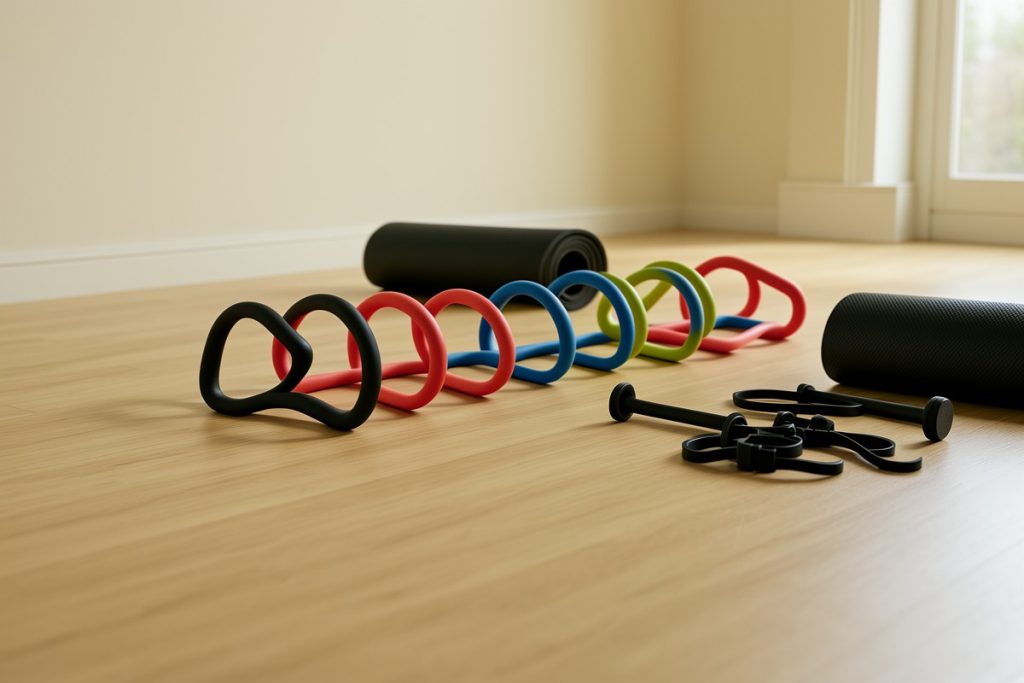
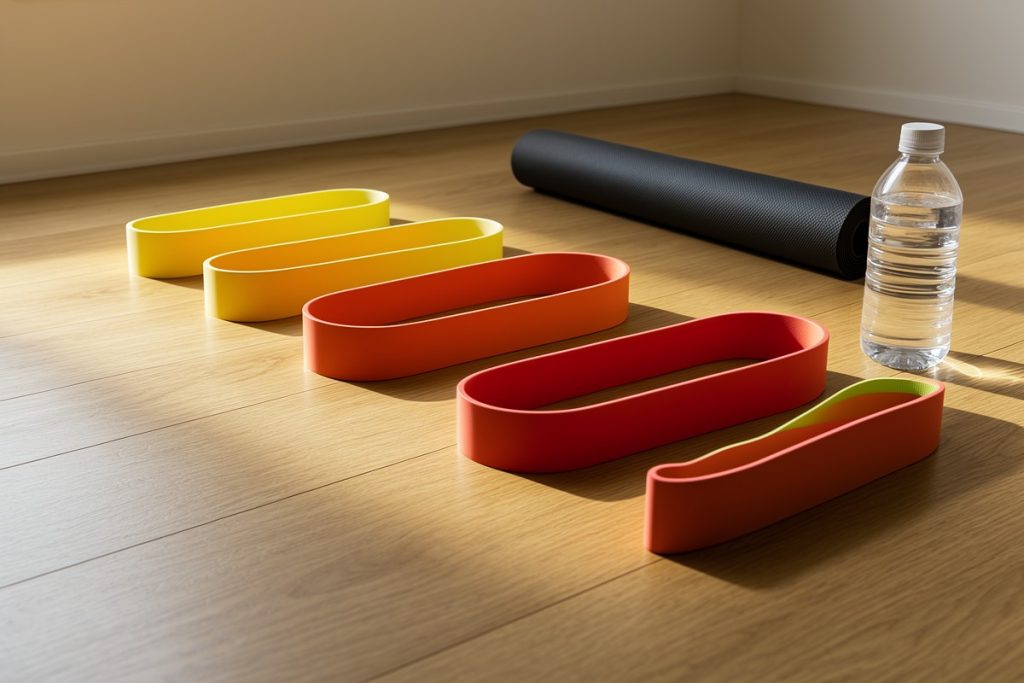
A multi-band set can be useful when one person wants different resistance for different movements, or when a beginner expects strength to change over time. The Fit Simplify Resistance Loop Exercise Bands set includes five loop bands, an instruction guide, and a carry bag according to its listing. That combination may suit someone who wants several options in a compact kit, but it is still important to test each band for the specific movement. A larger set does not automatically mean better training, and no band should be used past its safe, comfortable range.
Build progression around control
Strength training works best when the challenge gradually increases while your technique remains reliable. The American College of Sports Medicine describes progression as a planned increase in training demands, but progression does not have to mean jumping immediately to the heaviest available band.
Try this order:
- Learn the movement with a light band and controlled range of motion.
- Repeat the same resistance until your repetitions feel consistent.
- Add one or two repetitions while maintaining form.
- Increase tension slightly through your stance or band length.
- Move to a stronger band when the current option feels clearly manageable.
Keep a short record of the band used, repetitions completed, and how difficult the final repetitions felt. This prevents random changes and gives you a clear signal when it is time to progress.
Know when a band is too light or too heavy
A band is probably too light if you finish the set without slowing down, cannot feel a meaningful challenge, or could repeat the same number of repetitions several times without fatigue. In that case, first try creating slightly more tension or slowing the movement. If that still feels easy, choose a stronger band.
A band is probably too heavy if you shorten the range of motion, shrug, twist, hold your breath, snap through the movement, or lose control during the return phase. These are signs that the resistance is controlling you rather than supporting productive training. Choose a lighter option and rebuild the movement.
Stop and reassess if you feel sharp pain, tingling, numbness, unusual swelling, or pain that worsens as you continue. People returning after injury or managing a medical condition should ask a qualified health professional how to modify resistance training.
Beginner band-selection checklist
- Identify the movement and the muscles you intend to train.
- Start with the lightest practical option if the movement is unfamiliar.
- Test 8–12 smooth repetitions before deciding.
- Keep your breathing, posture, and range of motion consistent.
- Leave about two controlled repetitions in reserve.
- Inspect the band for cuts, cracks, thinning, or sticky areas before use.
- Progress one variable at a time and record what you did.
Adults are generally advised to include muscle-strengthening activity on at least two days per week, alongside regular aerobic activity. The best band is therefore not the most difficult one; it is the one that helps you train regularly, safely, and with enough challenge to keep improving.
Last reviewed: 2026-09-28