
Quick answer
A one-dumbbell workout can build useful full-body strength at home when you choose controlled exercises, train both sides evenly, and progress gradually. Start with squats, rows, floor presses, Romanian deadlifts, and carries for two or three rounds. Use a weight that lets you finish each set with steady form, leaving a few good repetitions in reserve.
Key takeaways
- One dumbbell is enough for a practical beginner routine covering legs, pushing, pulling, and core stability.
- Train two or more days per week, leaving at least one day between demanding strength sessions.
- Begin with two rounds and eight to twelve controlled repetitions for most exercises.
- Progress by adding repetitions, a round, slower lowering, or a heavier weight—not by sacrificing form.
By Jax Morrison
Why a one-dumbbell workout works
You do not need a full home gym to start strength training. A single dumbbell can create enough resistance to challenge your legs, chest, back, shoulders, and trunk. It also makes you work one side at a time, which can expose balance and coordination differences that are easy to ignore with a barbell or machine.
The bigger advantage is simplicity. There is less equipment to organize, less space required, and fewer decisions between exercises. That matters when your real obstacle is getting started consistently. A short routine you repeat twice a week will usually serve you better than an elaborate program you avoid.
Federal physical activity guidance recommends muscle-strengthening activity on at least two days per week, involving all major muscle groups. Your dumbbell workout can contribute to that goal, but it does not replace aerobic activity, mobility work, sleep, or recovery.
Choose the right weight before you begin
The correct weight is not the heaviest one you can lift once. It is a load you can control through the complete movement while keeping your posture steady. For a beginner, the final few repetitions should feel challenging without turning into a struggle.
Use this simple test: perform eight repetitions of the exercise. If your back rounds, your shoulder shifts, your knees collapse inward, or you need momentum, the weight is too heavy for that movement. If you could easily perform twenty repetitions, it may be too light to provide much challenge. Different exercises may require different loads, so judge the weight by the movement rather than by pride.
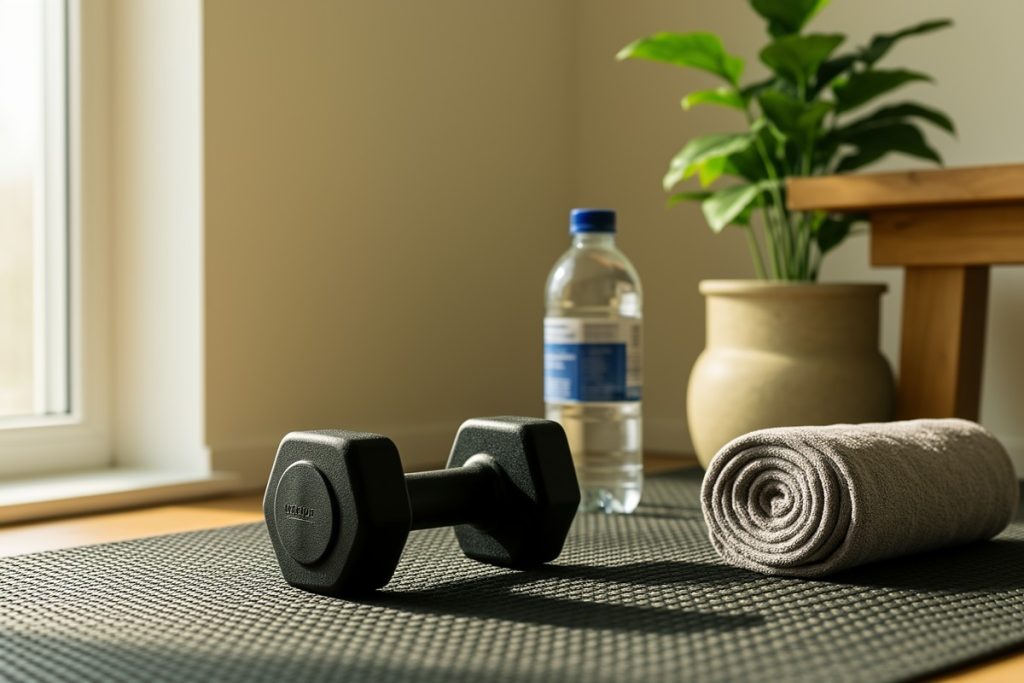
For a compact home setup, the Amazon Basics Rubber Hex Dumbbell Hand Weight can be a reasonable starting option for basic loaded exercises. It is not a complete home gym, and a single fixed dumbbell will not provide the same flexibility as an adjustable set or multiple pairs. Choose the available weight carefully, and make sure you have enough clear floor space to move safely.
The beginner one-dumbbell routine
Complete a five-minute warm-up first. March briskly in place, perform slow bodyweight squats, practice hip hinges, and use gentle arm circles. The goal is to raise your temperature and rehearse the patterns—not to exhaust yourself before the workout.
- Goblet squat: Hold the dumbbell close to your chest. Sit your hips down and back, keep your chest comfortably tall, then stand by pressing through your feet. Perform 8–12 repetitions.
- Supported one-arm row: Place your free hand on a sturdy bench, chair, or countertop. With a flat back, pull the dumbbell toward your lower ribs, pause briefly, and lower it under control. Perform 8–12 repetitions per side.
- One-arm floor press: Lie on your back with your knees bent and the dumbbell above your chest. Lower your elbow gently toward the floor, then press the weight back up without letting your shoulder roll forward. Perform 8–12 repetitions per side.
- Dumbbell Romanian deadlift: Hold the dumbbell with both hands or use one hand and switch sides after each set. Soften your knees, push your hips backward, and keep the weight close to your legs. Stand by driving your hips forward, not by leaning backward. Perform 8–12 repetitions.
- Suitcase carry: Stand tall while holding the dumbbell at one side. Walk slowly for 30–45 seconds without leaning toward or away from the weight. Switch sides and repeat.
Rest for 60–90 seconds between exercises as needed. Complete two rounds during your first few sessions. When that feels manageable, move to three rounds. If your available space is limited, perform the carry by marching in place with slow, deliberate steps.
How to progress without rushing
Progress does not have to mean jumping straight to a heavier dumbbell. First, make your current work more consistent. Track the number of repetitions and rounds in a notebook or phone note, then change only one variable at a time.
- Add repetitions: Move from eight toward twelve while preserving the same technique.
- Add a round: Increase from two rounds to three once recovery feels predictable.
- Slow the lowering phase: Take about three seconds to lower the weight, especially on squats, rows, and presses.
- Improve range of motion: Move through a comfortable, repeatable range before trying to lift more.
- Increase the load: Choose a heavier option only when the current weight feels controlled across all planned repetitions.
Do not progress every exercise on the same day. Your row may improve faster than your floor press, while your legs may outgrow a light dumbbell sooner than your shoulders. Let each movement develop at its own pace.
Practical checklist for safer home sessions
- Clear pets, loose rugs, furniture, and cords from your workout area.
- Check that your chair, bench, or countertop is stable before using it for support.
- Keep the weight close to your body during hinges, rows, and carries.
- Breathe continuously; exhale during the hardest part of each repetition.
- Stop for sharp pain, dizziness, unusual shortness of breath, or loss of control.
- Leave at least one recovery day before repeating a demanding full-body session.
When one dumbbell is not enough
One dumbbell is a strong entry point, but it has limits. You may eventually need more resistance for lower-body exercises, a second dumbbell for faster bilateral pressing, or an adjustable option if you want a broader progression range. You can also continue making the routine harder with single-leg variations, pauses, slower tempos, and longer carries, but those changes should follow solid technique.
If you have an injury, significant joint pain, balance concerns, or a medical condition that affects exercise, ask a qualified healthcare professional how to modify the routine. Strength training should make you more capable, not force you to ignore warning signs.
Build the habit first
Schedule two sessions on specific days, keep the workout to a manageable length, and finish while you still feel capable of returning next time. A one-dumbbell plan succeeds when it is repeatable: clear movements, sensible effort, gradual progression, and enough recovery. Start with two rounds this week, record what you did, and earn the next step through consistency.
Last reviewed: 2026-09-07
Sources
- Physical Activity Guidelines for Americans, 2nd edition — U.S. Department of Health and Human Services
- WHO Guidelines on Physical Activity and Sedentary Behaviour — World Health Organization
- Progression Models in Resistance Training for Healthy Adults — American College of Sports Medicine position stand