
Quick answer
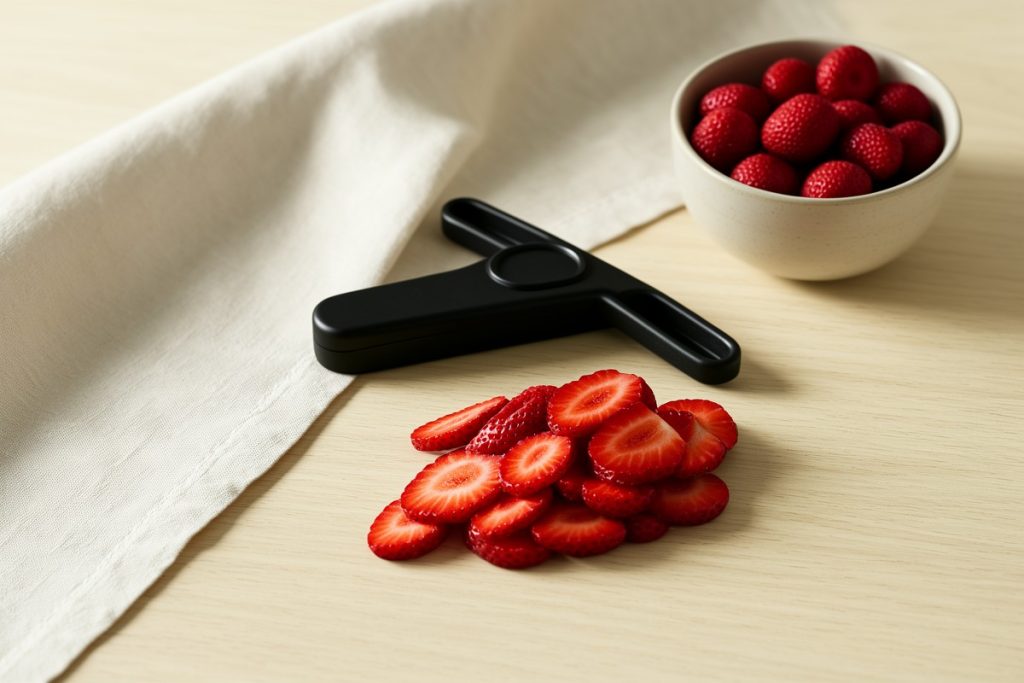
The best strawberry slicer for even dessert toppings is one that keeps the fruit centered, creates consistent slices, and is easy to clean between uses. A push-plate design can make repeated slicing quicker and more controlled than a knife, especially for shortcakes, cereal, cakes, and fruit plates. It is less useful for very soft, oversized, or irregular strawberries.
Key takeaways
- Choose a slicer that suits firm, similarly sized strawberries rather than assuming one tool handles every berry.
- A push plate can improve consistency and reduce the need to guide fruit close to a cutting edge.
- Detachable components are useful only if they can be rinsed, washed, and dried thoroughly.
- Keep a sharp kitchen knife available for large, soft, or uneven strawberries.
What a strawberry slicer should actually solve
A strawberry slicer is not a replacement for every kind of fruit preparation. Its main job is narrower: turning several similarly sized strawberries into reasonably even slices with less repetitive knife work.
That matters when presentation and portion control are part of the task. Even slices spread more predictably across a sponge cake, sit neatly on toast, and distribute better through yogurt or cereal. They also make a fruit platter look more deliberate without requiring advanced knife skills.
The trade-off is flexibility. A knife lets you remove damaged spots, change slice thickness, quarter a berry, or cut around an unusual shape. A dedicated slicer generally works best when the strawberries are washed, hulled, relatively firm, and close to the size the tool is designed to accept.
How to choose the right strawberry slicer
Start with the fruit you prepare most often. If you buy small berries for breakfast bowls, a compact slicer may be convenient. If you usually buy large, ripe berries for desserts, check whether the opening and cutting area appear large enough. A tool that requires force or repeated repositioning will undermine the time savings.
Look for four practical characteristics:
- Controlled positioning: The fruit should have somewhere to rest so it does not roll as you begin cutting.
- A push plate: This can help move the berry through the cutter in a consistent direction instead of relying entirely on fingertip pressure.
- Manageable cleaning: Strawberry juice and seeds can collect around small cutting parts, so detachable components should be accessible for washing and drying.
- Appropriate materials: Food-contact parts should be sturdy, free from cracks, and used according to the manufacturer’s care instructions.
Do not treat a low price, a dramatic product photo, or a large number of blades as proof of better results. The useful question is whether the design matches your fruit size, serving routine, storage space, and cleaning habits.
Where the push-plate design fits
The Creative Strawberry Slicer, Detachable Cutter with Push Plate (Black) is a reasonable option to consider when the goal is repeated strawberry slicing rather than general fruit prep. Its listed design points to two convenience features: a detachable cutter and a push plate.
A detachable cutter may make it easier to reach food residue than a permanently enclosed cutting area, but the actual cleaning experience depends on how the parts separate and what the care instructions allow. Confirm those details before purchase, particularly if you prefer dishwasher cleaning.
The push plate is most useful as a guiding component. It may help keep each berry moving in the same direction and make the process feel more repeatable. That does not guarantee identical slices, and it cannot compensate for fruit that is too soft, too large, or poorly positioned. Use the product as a focused prep aid, not as a universal replacement for a knife.
Quick comparison: slicer or kitchen knife?
| Task | Strawberry slicer | Kitchen knife |
|---|---|---|
| Several similar berries for toppings | Usually more consistent and repetitive-work friendly | Works, but requires more individual cuts |
| Very soft or irregular berries | May crush or struggle to position the fruit | More adaptable |
| Changing slice thickness | Often limited by the cutter design | Easy to adjust |
| Removing bruised areas | Limited once the berry is positioned | Precise and practical |
| Small kitchen storage | Needs a dedicated place | Knife is already multipurpose |
Use it safely and keep the fruit fresh
Wash strawberries before slicing. The U.S. Food and Drug Administration recommends rinsing produce under running water and does not recommend using soap, detergent, or commercial produce washes. Washing immediately before preparation can also help avoid storing berries while they are unnecessarily wet.
Set the slicer on a stable, clean surface and follow the product’s instructions for assembly. Keep fingers away from the cutting area, and do not force a berry through if it resists. Pressure can crush the fruit or cause the tool to shift. If the berry is unusually soft, cut it with a knife instead.
After use, separate removable parts if the instructions permit, rinse away visible pulp, wash with an appropriate dishwashing method, and dry thoroughly before storage. The FDA Food Code emphasizes keeping food-contact surfaces clean and in good condition, which is especially relevant for small tools with narrow spaces.
A simple buying checklist
Before choosing a strawberry slicer, answer these questions:
- Will it accept the typical size of strawberries in my household?
- Do I want faster repeated slicing, or more control over every cut?
- Can the cutting component be removed and cleaned thoroughly?
- Is there a stable way to hold or position the fruit?
- Would a knife still be needed for most of my berries?
If the first three answers are yes and you regularly prepare sliced strawberries, a dedicated tool can earn space in a kitchen drawer. If your berries vary widely or you only slice one or two at a time, a knife may remain the more useful choice.
Bottom line
A strawberry slicer makes the most sense for a specific, repeatable job: preparing reasonably firm berries into consistent slices for toppings and serving. A push plate can make that task more orderly, while a detachable cutter may simplify access for cleaning. Buy based on fruit size and maintenance rather than blade count or appearance, and keep a kitchen knife for fruit that does not fit the tool.
Last reviewed: 2026-10-02