
Quick answer
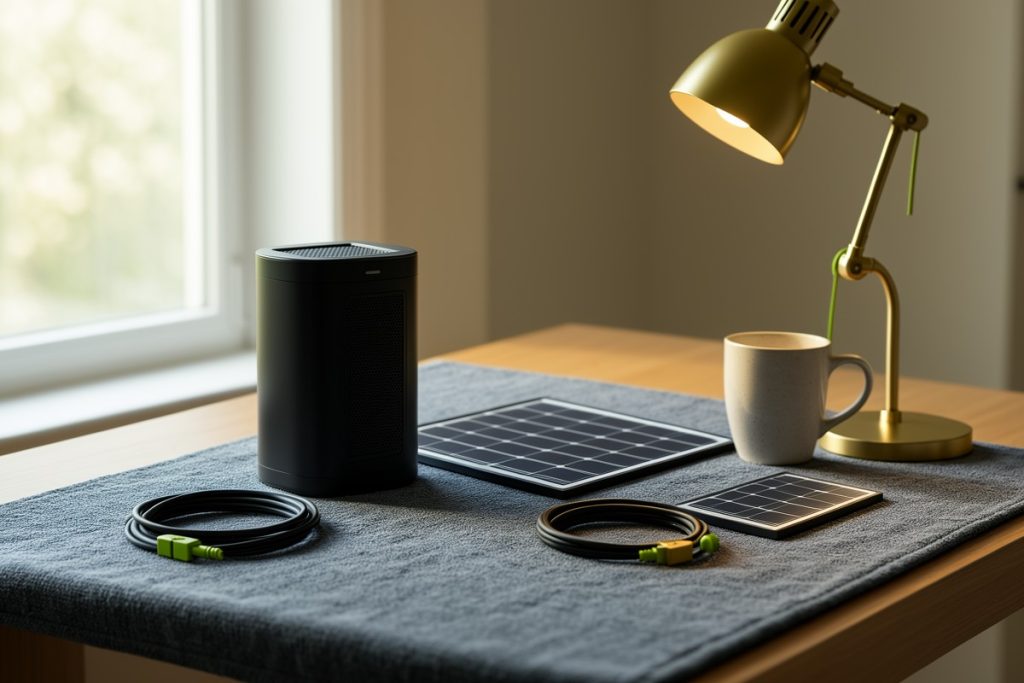
For emergency backup of phones, tablets, LED lights, and small power stations, a 50–100 watt portable solar panel is usually the practical sweet spot. Calculate your devices’ total daily watt-hour consumption, then divide by four to five peak sun hours and add a 25–30 percent efficiency buffer. If your essential load is under 200 watt-hours per day, a 60W panel with USB-C PD and DC outputs can keep you connected during multi-day outages.
Key takeaways
- Total your devices’ daily watt-hour needs before shopping; most small electronics need 150–250 Wh per day.
- A 60W portable panel realistically delivers 150–200 Wh per sunny day, enough for phones and small lights.
- Look for PD3.0 USB-C, QC3.0 USB-A, and DC outputs to charge modern power stations directly without adapters.
- IP65-rated weatherproofing and ETFE surfaces matter when you deploy panels outside during storms.
- Always pair a portable panel with a battery power station if you need electricity at night or during heavy cloud cover.
Why panel size is the decision that matters most
When the grid goes down, the first question people ask is not “Which brand is best?” but “Will this actually charge my stuff?” The portable solar market is crowded with foldable panels ranging from 15W phone chargers to 200W briefcase-style arrays. The wrong size means either sitting in the dark with a dead power station or overpaying for capacity you cannot use. If your goal is emergency readiness for small electronics, the decision starts with honest math, not marketing wattage.
How to calculate your emergency power budget
Portable solar sizing begins with watt-hours (Wh), the unit that tells you how much energy a device stores or consumes. A 20,000mAh phone battery pack holds roughly 74Wh. A small 200Wh power station can recharge that phone about two and a half times. To build your emergency budget, list the gear you actually need and estimate daily cycles.
Here is a realistic load table for a 48-hour outage:
| Device | Typical draw or capacity | Daily Wh needed |
|---|---|---|
| Smartphone (2 charges) | 15 Wh per charge | 30 Wh |
| LED lantern (4 hours) | 5W draw | 20 Wh |
| Portable radio | 3W draw × 4 hrs | 12 Wh |
| Tablet (1 charge) | 25 Wh | 25 Wh |
| Small power station (top-up) | 200 Wh capacity at 50% | 100 Wh |
| Daily total | — | 187 Wh |
In four to five peak sun hours, a panel rarely hits its rated nameplate wattage because of heat, angle, and haze. A safe rule is to expect 60–70 percent of the sticker number in real conditions. Therefore:
Required panel rating = Daily Wh needed ÷ Peak sun hours ÷ 0.70
For our 187 Wh example: 187 ÷ 4.5 ÷ 0.70 ≈ 59W. That is why a 60W class panel sits in the sweet spot for personal electronics. It will not run a refrigerator, but it can keep communication and lighting online indefinitely.
The output ports that determine compatibility
Raw wattage means little if the panel cannot talk to your devices. During emergencies, adapters get lost and time matters. Modern portable panels should ship with three output types. USB-C Power Delivery (PD 3.0) negotiates higher wattage for newer phones, tablets, and laptops. Quick Charge 3.0 (USB-A) covers older hardware and many battery packs. A dedicated DC output—usually a 5.5mm × 2.1mm barrel connector or proprietary cable—lets you charge small power stations directly, bypassing inefficient USB conversion losses. If a panel lacks DC out, you may need an adapter that adds bulk and failure points to your emergency kit.
Why real-world output lags the label
Solar panels are tested in laboratory conditions: 1,000 watts per square meter of irradiance, 25°C cell temperature, and perfect perpendicular alignment. Your backyard after a storm checks none of those boxes. Cell temperatures above 45°C reduce silicon efficiency by roughly 0.5 percent per degree Celsius. Light cloud cover can drop output by 30–50 percent. Dust and pollen add another penalty. A 60W panel might briefly hit 55W on a cool spring morning, but on a hot humid afternoon it could settle closer to 35–40W. Plan your emergency budget around conservative daily yield, not peak miracles.
Durability features worth paying for
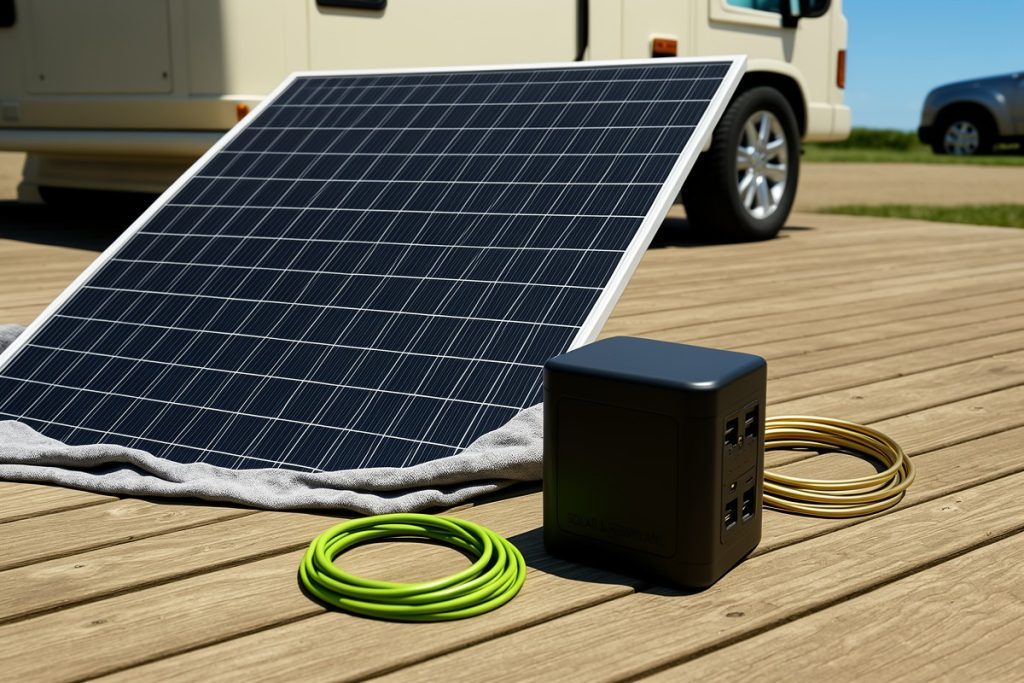
Emergency deployment is not gentle. You may prop a panel against a car window, lay it on wet grass, or pack it in a trunk with road salt and camping gear. IP65 ingress protection means the housing is dust-tight and handles low-pressure water jets—essentially rain and splashes. An ETFE surface layer resists scratches and yellowing better than cheaper PET films. Integrated kickstands help you angle the panel toward the sun without propping it on lawn chairs. These details separate a tool you can rely on from a toy that dies after one season.
When a 60W panel fits your kit
If your emergency plan revolves around keeping phones, LED lights, a tablet, and a small 150–300Wh power station topped off, a 60W class panel with modern ports is a rational, budget-friendly choice. It folds to the size of a briefcase, weighs under five pounds in most designs, and sets up in seconds.
One model that matches this profile is the FlexSolar 60W Portable Solar Panel. As an Amazon Associate, GetWitty may earn from qualifying purchases. It carries PD3.0 USB-C, QC3.0 USB-A, and DC outputs, which covers the three connection types mentioned above. The IP65 rating and foldable form factor fit the emergency-use case, and the 60W rating aligns with the math we walked through for small-device loads. It is not designed to recharge a rooftop battery bank or run a window AC unit, but for communication and lighting resilience, the specs line up with the need.
Pairing panels with storage
Solar is intermittent. A panel only produces when the sun is up, and storms bring clouds. If you need light at 9 p.m., you need a battery in between. A 200–300Wh lithium power station paired with a 60W panel creates a humble but effective micro-system. During the day, the panel feeds the station while also handling direct charging. At night, the station runs your devices. Size your station to cover one full evening and morning of use, then let the panel refill it the next day.
Bottom line
Do not buy portable solar on wattage alone. Add up your devices’ daily watt-hours, divide by conservative sun hours, and choose a panel that has the right ports and weather sealing for real emergencies. For modest electronic loads in the 150–250 Wh range, a 60W output class with PD3.0, QC3.0, and DC connections offers a practical balance of portability, price, and performance. Test your setup on a sunny weekend before the storm hits, so you know exactly which cable goes where when the grid drops.
Sources
- U.S. Department of Energy: Solar Energy Technologies Office — Federal guidelines on solar panel output, system sizing, and environmental factors.
- USB Implementers Forum: USB Power Delivery Specification — Technical standards for PD3.0 charging protocols referenced for device compatibility.
Last reviewed: 2026-08-07