
Quick answer
Aromatherapy can support a brief stress reset, but it is not a treatment for anxiety or a replacement for professional care. Choose a scent you tolerate, use it exactly as directed, pair it with slow breathing and a short pause, then take one practical next step. Stop if you develop coughing, wheezing, headache, dizziness, skin irritation, or breathing discomfort.
Key takeaways
- A scent works best as a cue for pausing, not as a cure for chronic stress.
- Pair aromatherapy with comfortable breathing, grounding, and one small action.
- Follow the product’s instructions and never swallow essential oils.
- People with asthma, fragrance-triggered migraines, allergies, or sensitive skin should use extra caution.
By Dr. Priya Sharma, Evidence-Based Health Expert
Why a short stress reset can be useful
Stress can make ordinary tasks feel urgent. You may keep rereading an email, rush through a decision, or carry tension in your shoulders without noticing. A short, repeatable pause does not solve the cause of stress, but it can create enough space to respond more deliberately.
Aromatherapy may help because it gives that pause a noticeable sensory cue. The scent becomes a reminder to stop, breathe, and check what you need next. That is a practical use—not evidence that a particular oil removes stress, treats anxiety, or changes your health condition.
The National Center for Complementary and Integrative Health’s aromatherapy guidance notes that research on aromatherapy is limited for many conditions. Results can also vary by the oil, how it is used, the person’s expectations, and the surrounding ritual. For that reason, treat aromatherapy as an optional wellness tool rather than a stand-alone intervention.
A five-minute aromatherapy stress reset
Use this routine during a work break, after a difficult conversation, before an appointment, or whenever you notice yourself becoming reactive. Keep it simple. The goal is to shift gears, not to perform a perfect relaxation exercise.
- Name what is happening. Say, silently or aloud, “I feel tense,” “I am overstimulated,” or “I am rushing.” Naming the current state can help you notice it before acting automatically.
- Use the scent safely. Follow the product label for inhalation, diffusion, or topical use. If the scent is intended for inhalation, take a gentle breath from the recommended distance rather than forcing a deep inhale.
- Make the exhale slightly longer. Breathe in comfortably for about four counts and out for about six, repeating five times. If counting makes you feel strained, stop counting and return to quiet, easy breathing.
- Ground yourself in the room. Notice three neutral details, such as the support of your chair, the temperature of the air, and a sound in the background. This gives your attention somewhere concrete to go.
- Choose one next action. Refill your water, walk for two minutes, answer one message, move a deadline, or schedule a conversation. A reset is more useful when it leads to a manageable action.
How to choose a scent without overthinking it
Start with tolerance, not popularity. A scent you find pleasant and can use comfortably is more practical than a highly recommended oil that gives you a headache. Minty and herbal aromas can feel noticeable and refreshing, while softer botanical scents may feel less stimulating. There is no universally best scent for stress.
Pay attention to the setting, too. A strong fragrance may be inappropriate in a shared office, around someone with sensitivities, or in a small poorly ventilated room. A personal inhaler or brief, low-intensity use may be more considerate than filling an entire space with aroma.
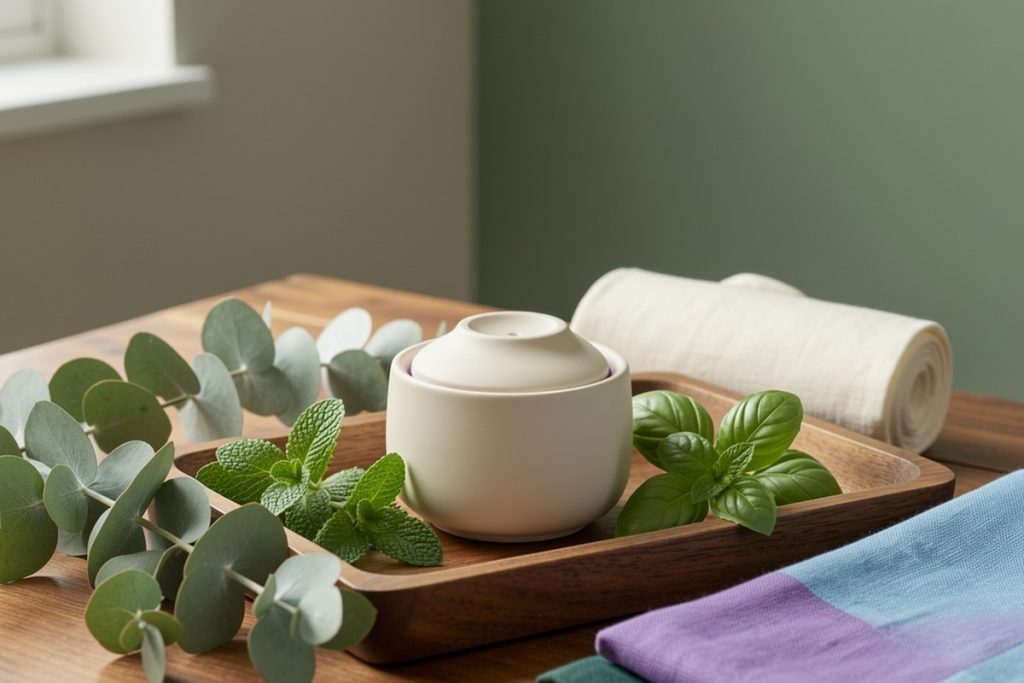
If you want a ready-made portable option, Origins Peace of Mind On-the-Spot Relief features eucalyptus, peppermint, and basil essential oils. Its useful role is convenience: it provides a defined blend for a short sensory ritual. That does not establish that it treats stress, anxiety, pain, or any medical condition. Check the current ingredients and directions before using it, particularly if you are sensitive to fragrance.
Essential-oil safety basics
Essential oils are concentrated substances. “Natural” does not automatically mean harmless, and safety depends on the oil, the route of exposure, the amount, and the person using it.
- Do not swallow essential oils. Keep them away from children and pets. If someone swallows an oil, contact a poison service or seek medical guidance promptly rather than waiting for symptoms.
- Protect sensitive areas. Keep oils away from the eyes, inside of the nose, and other delicate tissue. Wash your hands after topical use.
- Do not improvise topical dilution. Apply an oil to the skin only if the product is designed for that purpose and its instructions explain how to use it.
- Ventilate the area. Stop using the product if it causes coughing, wheezing, nausea, dizziness, headache, burning, or a rash.
- Ask before using strong fragrances. Speak with an appropriate health professional if you have asthma, eczema, fragrance-triggered migraines, significant allergies, are pregnant, or are using the product around a child or pet.
Poison Control’s essential-oil safety guidance explains that exposure can be harmful, especially when oils are swallowed or used improperly. Seek urgent medical help for trouble breathing, swelling, severe drowsiness, or other serious symptoms.
What to do if aromatherapy does not help
Do not keep increasing the amount or frequency simply because you still feel stressed. The problem may not be a lack of relaxation technique. You may need food, sleep, movement, a boundary, practical help, or a conversation with someone you trust.
If stress is persistent, interferes with work or relationships, causes repeated panic, or leaves you feeling hopeless, arrange support from a qualified clinician or counselor. A sensory ritual can accompany evidence-based care, but it should not delay it. If you are in immediate danger or thinking about harming yourself, contact local emergency services or a crisis service now.
Five-minute reset checklist
- Choose a scent you already tolerate.
- Read the product’s route-of-use instructions.
- Take five comfortable breaths, with a relaxed exhale.
- Notice three details in your surroundings.
- Select one small next action.
- Stop immediately if symptoms appear.
Last reviewed: 2026-10-19