
Quick answer
A 10-minute workday stress reset works best as a repeatable transition, not a perfect wellness ritual: step away, slow your exhale, loosen your body, drink water, and choose one next task. A diffuser may make the routine easier to remember, but it is optional and should never replace professional care for persistent anxiety or distress.
Key takeaways
- Step away from the trigger before trying to think clearly.
- Use comfortable, slower breathing rather than forcing deep breaths.
- Finish with one small action, not a long list of obligations.
- Treat aromatherapy as an optional sensory cue and follow safety directions.
By Luna Reyes, Mindful Wellness Guide
Why a short stress reset can help during the workday
A workday reset is not about eliminating every uncomfortable feeling. It creates a clear change of state: pause the input, settle your body, and return with a narrower focus. That can be useful when stress is being fed by constant notifications, rushed decisions, difficult conversations, or unfinished tasks.
Relaxation practices can include breathing, progressive muscle relaxation, guided imagery, and other techniques intended to encourage a calmer response. The National Center for Complementary and Integrative Health says these practices are generally considered safe for healthy people when used appropriately, while also noting that research quality and results vary. Think of this routine as a low-pressure skill, not a guaranteed treatment.
The 10-minute workday stress reset
1. Change your surroundings for one minute
Leave the desk if possible. Stand near a window, walk to refill your water, or simply turn your chair away from the work surface. Put your phone on silent and let your eyes rest on one fixed, neutral point. The goal is to interrupt the loop before you try to solve the problem.
2. Let your exhale become slightly longer for two minutes
Sit or stand comfortably. Breathe in gently, then breathe out at an easy, unforced pace. You can silently count a shorter inhale and a slightly longer exhale, but do not strain to fill your lungs. If counting makes you tense, drop it and focus on the sensation of air leaving your body.
Stop or return to normal breathing if you feel light-headed, uncomfortable, or short of breath. A useful reset should feel manageable, not like another performance task.
3. Release three areas of tension for two minutes
Notice your jaw, shoulders, and hands. Unclench your jaw, lower your shoulders, and let your fingers rest open. Then scan from your forehead to your feet and soften any area that is working harder than necessary.
You do not need a dramatic stretch. Small physical changes are easier to repeat in a busy office, and they help you notice whether you are holding tension without realizing it.
4. Add water and a sensory anchor for two minutes
Take a few unhurried sips of water. Choose one quiet sensory detail to notice: the coolness of the glass, the warmth of a mug, a plant’s texture, or the room’s natural light.
This is not a test of mindfulness. It is a way to move attention out of an abstract worry and back into the present environment. If scent is pleasant for you, it can be an optional sensory anchor, but the routine works without it.
5. Choose one next action for three minutes
Write or say one specific action that takes less than 10 minutes: answer one email, outline the first paragraph, open the needed file, or ask a clear question. If the task is larger, define its first visible step.
Start that action before the reset ends. A small completion gives your return a direction without pretending the whole workload has disappeared.
A practical checklist before you return to work
- Can I name the immediate trigger without replaying the entire story?
- Is my breathing comfortable and unforced?
- Have I relaxed at least one tense area?
- What is the single next action?
- Do I need a longer break, support from someone, or professional help instead?
How to use scent without making it the whole routine
A familiar scent can serve as a reminder that it is time to pause, but aromatherapy is optional. NCCIH describes aromatherapy as the use of essential oils from plants, commonly through inhalation or topical application, and says evidence for many claimed benefits remains limited.
A pleasant smell may help some people associate a space with calm. It should not be presented as a cure for anxiety, burnout, insomnia, or depression. The strongest part of this reset is the sequence itself: stepping away, breathing comfortably, releasing tension, grounding your attention, and choosing one next action.
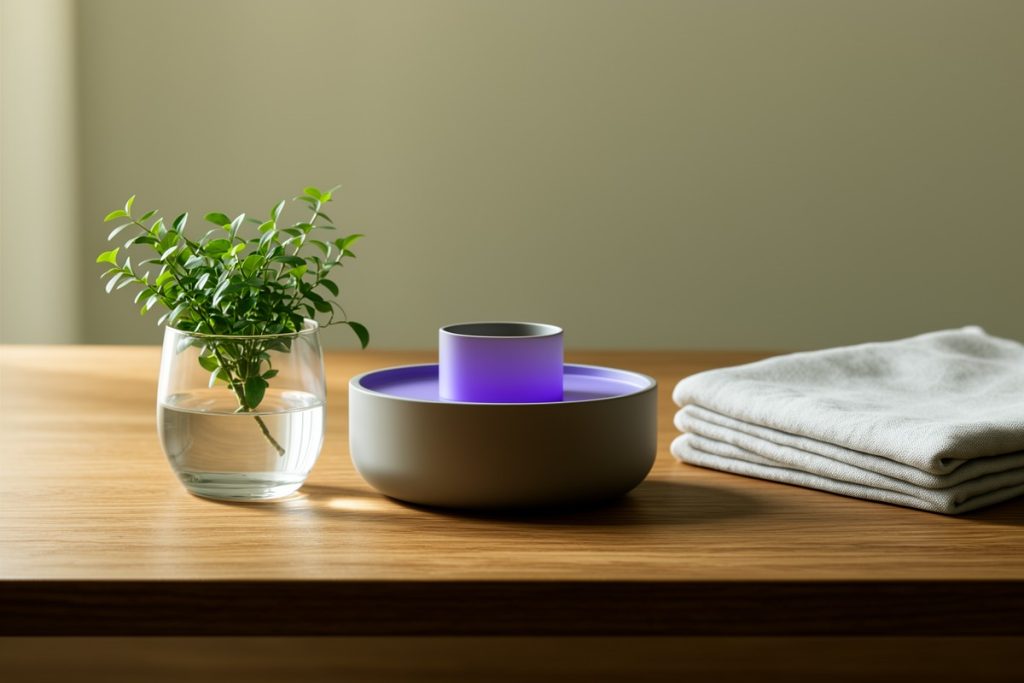
If you want a dedicated scent cue at home or in a private office, the ASAKUKI Essential Oil Diffuser for Home, 500ML Aromatherapy Humidifier lists a 500 mL reservoir, remote control, seven-color LED lighting, and cool-mist operation. Those are convenience features, not proof of a stress benefit. You can complete the entire reset with fresh air, water, and breathing alone.
Use only the amount and type of oil recommended by the device and product instructions. Keep essential oils away from your eyes, do not ingest them, and stop if you develop a headache, irritation, coughing, or breathing discomfort. Extra caution is sensible if you have asthma or allergies, are pregnant, or plan to use oils around children or animals. Ask an appropriate healthcare professional when unsure, and ventilate a small room.
When a short reset is not enough
A brief routine is suitable for an ordinary spike of workday tension. It is not a substitute for help when distress is persistent, worsening, or interfering with sleep, relationships, safety, or daily functioning. Contact a qualified mental-health professional or healthcare provider if you are struggling to cope. If you may hurt yourself or someone else, seek immediate emergency support in your location.
Adjust the routine to match the problem. If notifications are the trigger, protect the first minute by silencing them. If meetings leave you wired, use the reset before opening your inbox. If hunger or dehydration is driving irritability, address that practical need first.
If the same pressure returns every day, the most useful next step may be a workload conversation, a boundary, or a schedule change—not a better scented room. A wellness routine cannot compensate for an unsustainable situation indefinitely.
Make the routine easy to repeat
Choose one location, one comfortable breathing pattern, and one closing action. Repetition reduces the number of decisions required when you are already overloaded. Keep the setup visible but uncluttered: a glass of water, a comfortable chair, and perhaps one optional sensory cue.
Practice when stress is mild so the sequence feels familiar during a harder moment. The best workday reset is modest enough to use on an ordinary Tuesday. Step away, settle your breathing, relax your body, ground your attention, and take one clear action. If that sequence helps, keep it. If it does not, change the cue rather than blaming yourself.
Last reviewed: 2026-10-23