Quick answer
A power rack can make home strength training more consistent by giving you one organized station for squats, presses, pulls, and accessory work. The best plan starts with two or three full-body sessions each week, gradual progression, and sensible safety habits. Choose a rack only if you have enough ceiling height, floor space, and room to train without blocking walkways.
Key takeaways
- Train all major movement patterns instead of repeating the same lift.
- Begin with two or three full-body workouts weekly and leave recovery days between demanding sessions.
- Add repetitions or small amounts of resistance gradually, while keeping technique controlled.
- Check rack dimensions, available safety supports, pulley setup, and assembly requirements before buying.
Building a home gym can feel like a choice between expensive equipment and an endless collection of small gadgets. A power rack offers a more focused middle ground: one central station can support barbell work, bodyweight movements, and cable exercises without turning the room into a commercial gym.
The equipment is only useful, however, when it supports a realistic plan. You do not need to train every day or perform complicated routines. You need repeatable sessions, manageable resistance, and enough recovery to improve without constantly feeling worn down.
Why a power rack can solve a common home-gym problem
The biggest challenge with home training is often not motivation. It is friction. If every workout requires moving equipment, improvising exercises, or waiting for a machine, it becomes easier to skip. A rack creates a consistent training zone where the main movements are ready to organize around.
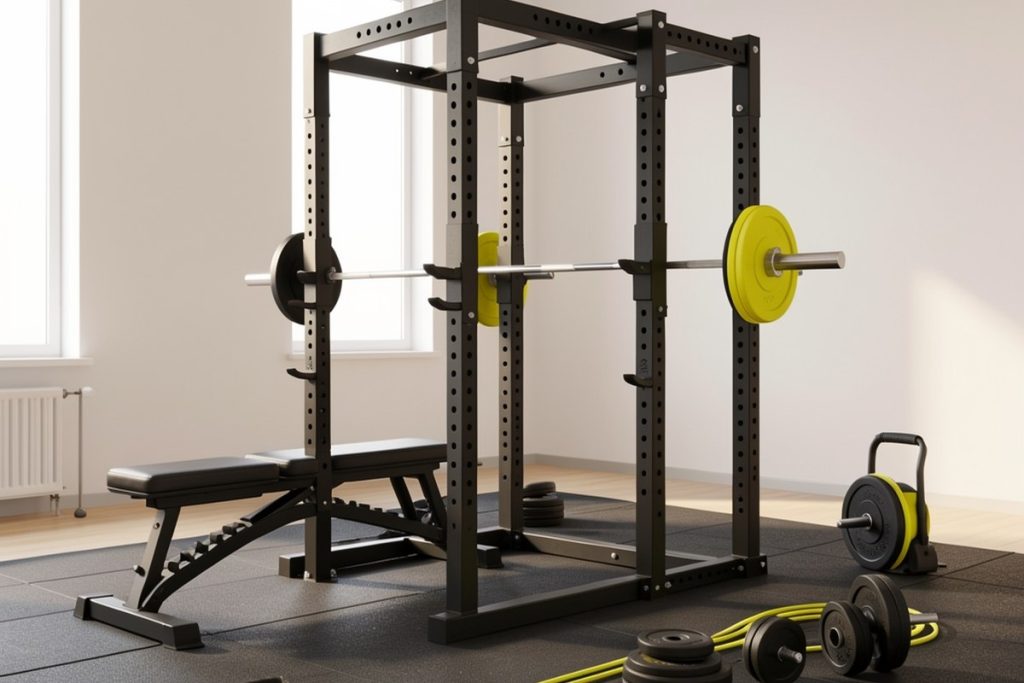
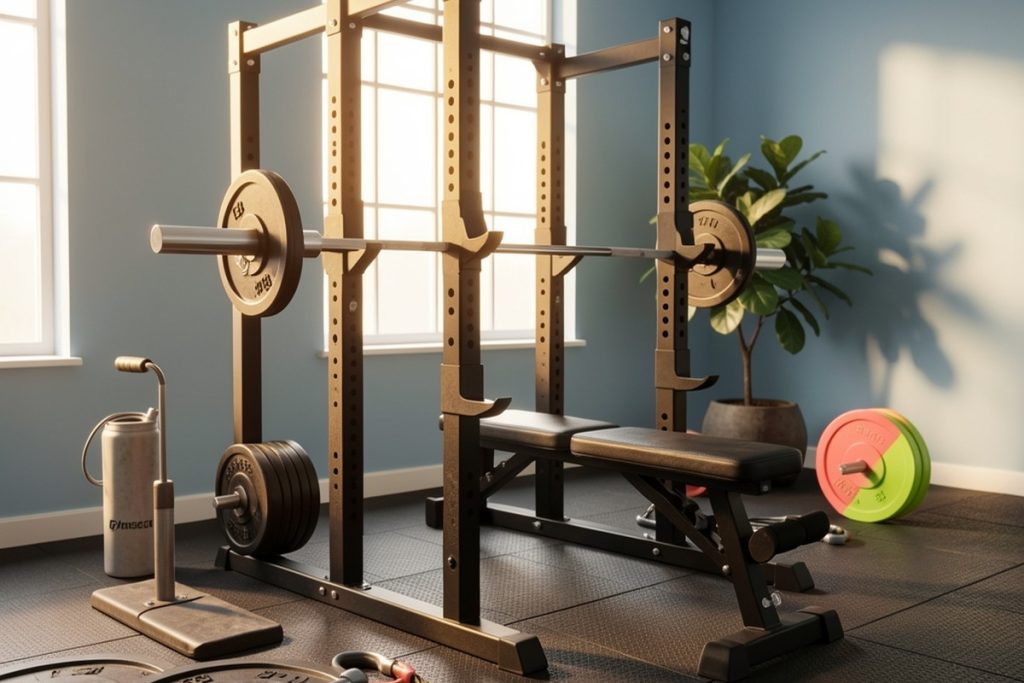
That matters for people who want to build strength with limited space. A rack with J hooks can support barbell setup for movements such as squats and presses, while a pulley and lat pulldown system can add pulling and accessory options. The result is more exercise variety than a pair of dumbbells alone, without requiring several separate machines.
The tradeoff is that a rack needs planning. Measure the room, ceiling height, doorways, and the space around the equipment. You also need a stable floor, adequate lighting, and enough clearance to load a bar safely. If the setup would force you to train beside furniture, shelving, or a busy walkway, it may create more problems than it solves.
A simple three-day full-body plan
For most beginners, two or three nonconsecutive sessions per week provide a practical starting point. Each workout should include a lower-body movement, a push, a pull, and a small amount of trunk or accessory work. This approach trains the major patterns regularly without making every session excessively long.
| Session | Main movements | Practical starting approach |
|---|---|---|
| A | Squat, bench press, lat pulldown, plank | 2–3 controlled sets per movement |
| B | Deadlift variation, overhead press, cable row, split squat | 2–3 controlled sets per movement |
| C | Front squat or light squat, incline press, pulldown or row, loaded carry | Use only if recovery is good |
Do not treat this table as a mandate to lift heavy immediately. Start with a load that lets you complete each repetition with stable posture and a smooth tempo. If you are learning a movement, practicing with an empty bar or lighter resistance is productive training, not wasted time.
Rest between sets long enough to regain control and concentration. Many people need roughly one to three minutes for moderate sets, and longer for demanding compound lifts. Your breathing, balance, and technique should be ready before the next set begins.
How to progress without rushing
Progression means gradually asking your body to do more work. That might mean adding one repetition, completing an additional set, increasing resistance slightly, or improving control with the same load. You do not need to increase everything at once.
Use a simple rule: keep the weight steady until you can complete the planned repetitions with consistent form and a little effort still in reserve. Then make the smallest sensible increase available. If your technique changes sharply, your range of motion shortens, or pain appears, reduce the load and reassess.
Track the date, exercise, sets, repetitions, and resistance in a notebook or phone app. The record is useful because it replaces guesswork with evidence. It also helps you notice when fatigue, poor sleep, or schedule changes are affecting performance.
General physical activity guidance recommends muscle-strengthening activity on at least two days each week for adults, alongside regular aerobic activity. A strength plan can contribute to that target, but it does not replace walking, cycling, sport, or other movement that raises your heart rate.
Safety habits that matter more than equipment features
Learn the adjustment points before loading a bar. Set the J hooks evenly, position safety supports below the lowest point of the lift, and make sure the bar can be reracked without twisting or reaching. For exercises where a failed repetition could trap you, use appropriate safety supports and train with a spotter when needed.
Keep plates secured, cables routed correctly, and the floor clear. Inspect bolts, pins, cables, and moving parts periodically. Follow the manufacturer’s assembly and maintenance instructions rather than assuming every rack is configured the same way.
A proper warm-up can be brief: five minutes of easy movement followed by a few lighter practice sets of the first exercise. The goal is to rehearse the movement and prepare gradually, not to exhaust yourself before the working sets begin.
What to check before buying a home power rack
- Room fit: Measure height, width, depth, doorways, and the clearance needed to load a bar.
- Training fit: Confirm that the included attachments match the exercises you actually plan to perform.
- Stability: Understand whether the unit should be anchored and whether your floor can support the setup.
- Safety setup: Check how the J hooks and safety supports adjust and whether they suit your bar and lifting height.
- Maintenance: Review assembly instructions, cable care, replacement parts, and warranty details before purchasing.
The SPORTSROYALS Power Rack is a reasonable option to investigate if you want a home station combining a power cage, J hooks, pulley system, and lat pulldown function. Treat those listed features as a starting point, not a guarantee that it fits your room or training style. Compare its dimensions, setup requirements, safety details, and included components with your actual needs before deciding.
When a rack is not the right choice
A power rack may be excessive if you mainly want short mobility sessions, travel frequently, or have no safe place to leave equipment assembled. Adjustable dumbbells, resistance bands, or bodyweight training can be more practical for a small apartment or a routine built around convenience.
It is also worth delaying a purchase if you are still unsure what you enjoy training. Try a basic full-body routine with equipment you already have for several weeks. If you consistently want heavier squats, presses, rows, and cable work, a rack may solve a real limitation. If not, buying more equipment may simply add cost and clutter.
A repeatable plan beats a crowded gym
The strongest home setup is not the one with the most attachments. It is the one that makes good training easy to repeat. Choose a manageable schedule, record your work, progress gradually, and protect your technique. With those habits in place, a well-fitted rack can become the foundation of a structured strength routine rather than an expensive object that collects dust.
Last reviewed: 2026-11-02
Sources
- Physical Activity Guidelines for Americans, 2nd edition — U.S. Department of Health and Human Services.
- Progression Models in Resistance Training for Healthy Adults — American College of Sports Medicine position stand, indexed by PubMed.