Quick answer
For most households, the best solar backup for a short outage is a plan built around essential loads—not an attempt to run the whole house. Start by listing watts and expected hours, then choose a battery with enough watt-hours and output capacity. A 576Wh, 1000W portable station can suit phones, lights, routers, and small electronics, but not central HVAC, electric heating, or most large appliances.
Key takeaways
- Separate power capacity, measured in watt-hours, from output capacity, measured in watts.
- Calculate your essential loads before shopping, including startup surges from motors and compressors.
- A portable station is useful for selected devices, but it is not automatically whole-home backup.
- Confirm solar-panel compatibility, charging input limits, outlets, safety features, and return or warranty terms.
By Sunny Patel, Solar Savings Optimist
Start with what you need to keep running
Choosing a backup battery becomes much easier when you stop thinking about “backup power” as one large category. During a short outage, you may care most about keeping a refrigerator cold, charging phones, running a Wi-Fi router, powering medical equipment, or keeping a few lights on. Each use has a different demand and priority.
Make two lists: devices that must run and devices that would simply be convenient. Record the wattage printed on each device or in its manual. If a device lists amps instead of watts, multiply volts by amps to estimate watts. For example, a 120-volt device rated at 2 amps uses about 240 watts while operating.
Then estimate how long each item needs to run. Electricity used over time is measured in watt-hours: a 50-watt device running for four hours requires roughly 200 watt-hours before accounting for conversion losses. The U.S. Energy Information Administration explains the distinction clearly: watts describe power at a moment, while watt-hours describe energy used over time.
Understand watts, watt-hours, and startup surge
Portable power stations are usually described with two numbers that answer different questions. The watt-hour rating describes how much energy the battery stores. The AC output rating describes how much power the inverter can deliver at once.
A battery with plenty of watt-hours can still fail to run an appliance if that appliance draws more watts than the inverter allows. Refrigerators, freezers, pumps, fans, and other motor-driven equipment can also require a brief startup surge above their normal running wattage. Check both the running and starting requirements rather than relying on the appliance’s average draw.
Remember that the rated battery capacity is not the same as guaranteed usable energy at an AC outlet. Inverter losses, battery-management limits, temperature, cable losses, and the condition of the battery all affect runtime. Treat capacity figures as planning information, not a promise that every watt-hour will reach your device.
Solar charging is useful, but it is not automatic
A portable power station stores electricity; it does not create it. To recharge from sunlight, you need a compatible solar panel and a charging input that accepts that panel’s voltage, current, connector, and power range. Never assume that any household solar panel can be connected safely.
Solar photovoltaic panels produce direct-current electricity. Portable stations may accept DC solar input directly, while household systems commonly use an inverter to provide alternating-current electricity for normal appliances. Before buying a panel, compare its electrical specifications with the station’s manual. Also check whether the station can charge from a wall outlet, a vehicle outlet, or multiple sources.
Solar charging will vary with cloud cover, panel angle, shade, season, and the available roof or ground space. A station may be valuable even when the weather is poor, but it should be charged ahead of a predicted storm rather than treated as an unlimited off-grid supply.
Portable station, home battery, or generator?
The right backup technology depends on the size of the problem you are trying to solve. A portable station is convenient for selected electronics and small appliances. A professionally installed home battery is better suited to planned circuits and longer-term integration with rooftop solar. A fuel generator can provide substantial output, but it requires fuel, ventilation, maintenance, and safe outdoor placement.
| Option | Best fit | Important limitation |
|---|---|---|
| Portable power station | Phones, lights, routers, laptops, and selected small appliances | Limited battery capacity and inverter output; not usually whole-home backup |
| Home battery system | Critical household circuits and integration with a solar installation | Higher cost, fixed installation, and possible permitting or electrical work |
| Fuel generator | Higher-demand loads when fuel and outdoor operation are practical | Noise, emissions, fuel storage, maintenance, and carbon-monoxide risk |
If you need a refrigerator, first confirm its startup surge. If you need medical equipment, follow the equipment manufacturer’s backup-power requirements and speak with a qualified professional. A general-purpose battery should not be treated as a medically approved power system.
Where the DARAN C1000L may fit
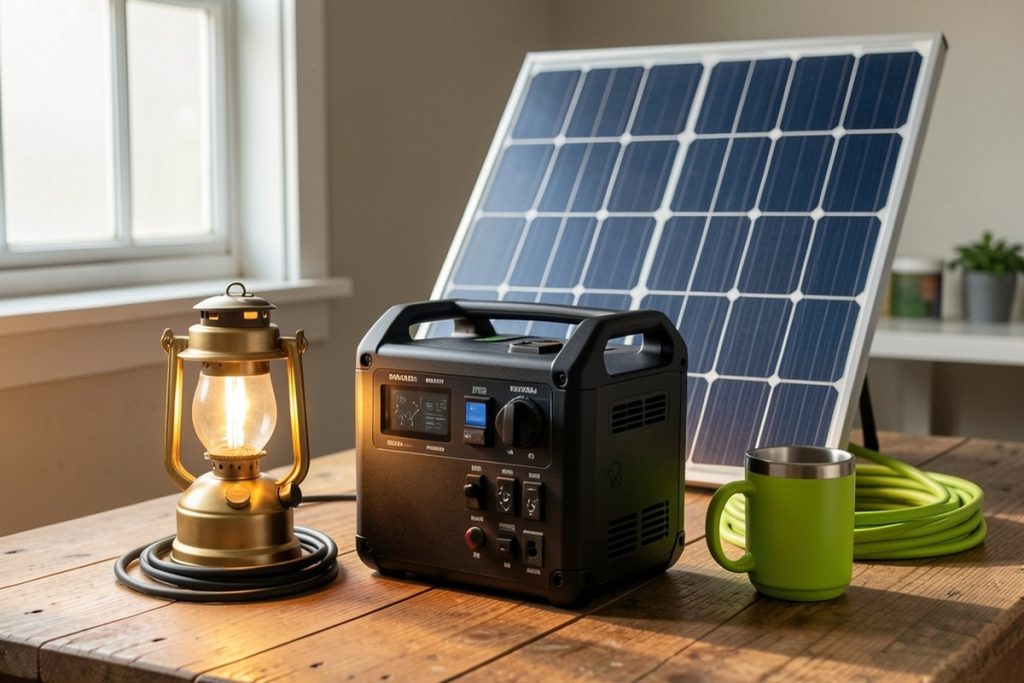
For readers who want a plug-in option for essential electronics, the DARAN Portable Power Station C1000L lists a 576Wh capacity, 1,000W AC output, 2,000W surge rating, a stated two-hour fast-charge feature, 100W USB-C output, and a LiFePO4 battery. Those listed figures make it a plausible match for outage basics such as communication devices, lighting, networking equipment, and some lower-demand appliances.
That does not mean it will run every appliance or deliver a predictable number of hours. Actual performance depends on the device load, surge behavior, inverter losses, battery reserve, temperature, and charging conditions. The 100W USB-C output may be especially useful for compatible laptops and other USB-C devices, but check your device’s charging requirement before relying on it.
Most importantly, verify the solar input specifications before pairing this station with a panel. The product’s battery capacity and AC output do not, by themselves, prove that a particular panel will charge it. Compare the station manual with the panel’s voltage, current, connector, and maximum output, and confirm whether a needed cable is included.
A five-minute buying checklist
- List essential devices: Include the wattage, expected runtime, and whether each device has a motor or compressor.
- Check simultaneous load: Add the watts of devices you may use at the same time and compare the total with the inverter’s continuous rating.
- Check surge capacity: Confirm that startup demands stay within the station’s surge rating.
- Confirm connections: Count AC outlets, USB ports, USB-C output, vehicle charging options, and the required solar connector.
- Plan placement: Keep the station dry, ventilated, accessible, and away from heat, moisture, and trip hazards.
- Test your plan: Charge the unit, connect the intended devices, and learn its controls before an outage occurs.
Use backup power safely
Keep portable batteries away from standing water and extreme heat, and follow the manufacturer’s charging, storage, and transport instructions. Do not modify cables or connect a portable station to household wiring through an improvised “backfeed” arrangement. Energizing a home circuit without an approved transfer method can endanger utility workers and damage equipment.
Never operate a gasoline, propane, or other fuel-burning generator inside a home, garage, basement, or enclosed porch. Carbon monoxide is invisible and odorless. Ready.gov recommends using generators outdoors and away from doors, windows, and vents. A battery station avoids combustion emissions during use, but it still needs proper charging and storage.
Bottom line
The best portable solar backup battery is the one that matches your actual essential loads, not the one with the most impressive headline number. Measure watts, estimate watt-hours, allow for startup surges and conversion losses, and confirm solar compatibility before buying. For a short outage affecting electronics and modest loads, a portable station can be a practical layer of resilience. For heating, cooling, pumps, or whole-home operation, compare professionally installed storage or a correctly sized generator instead.
Last reviewed: 2026-11-02