
Quick answer
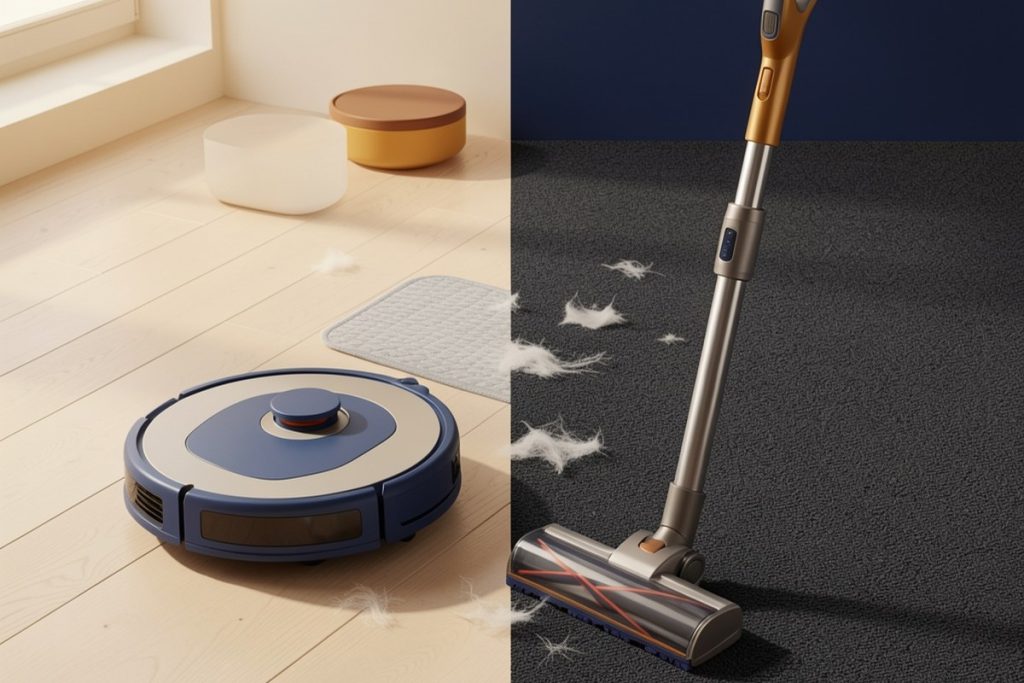
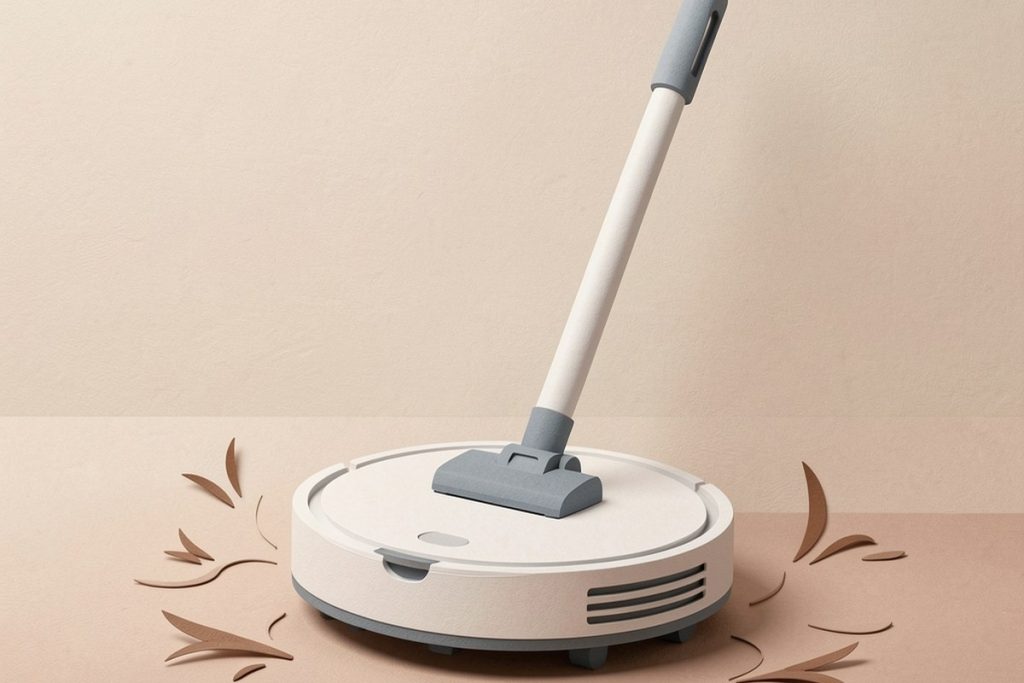
If you have hard floors and pets, a budget robot vacuum handles daily hair maintenance so you don’t have to, but an upright vacuum still wins for deep cleaning carpets and heavy debris. Most pet owners benefit from using both strategically rather than choosing one.
Key takeaways
- Upright vacuums deliver stronger suction and larger capacity, making them essential for deep carpet cleaning and heavy debris.
- Robot vacuums automate daily maintenance on hard floors and low-pile surfaces where pet hair gathers most.
- Tangle-free robot designs with extended runtimes can handle typical apartments and single-story layouts in a single session.
- The most effective pet-hair routine pairs a robot vacuum for frequent sweeps with an upright for weekly deep cleaning.
- Hard floors favor robot vacuums, while thick carpets and area rugs still demand the agitation and power of an upright.
Suction Power and Deep Cleaning
When pet hair works its way into carpet fibers, suction alone rarely dislodges it completely. Upright vacuums generally lead this category because they pair high-wattage motors with wide, motorized brush rolls designed to agitate the pile. That physical action lifts embedded hair, dander, and dirt from the base of the carpet up into the bin or bag. The larger dust capacity also means you can clean several rooms in one pass without pausing to empty a small container.
Budget robot vacuums take a different approach. They trade raw power for a low profile and quiet operation, which makes them ideal for daily tidying but less effective for extraction. On hard floors, hair sits on the surface, so moderate suction is sufficient. On medium or high-pile carpet, however, the smaller brush rolls and weaker motors struggle to pull hair from deep within the fibers. If your home has thick rugs or wall-to-wall carpeting, an upright vacuum remains the essential tool for periodic deep cleaning.
Daily Convenience and Automation
The strongest argument for a robot vacuum is consistency. Pet hair accumulates daily, and manually vacuuming every evening becomes exhausting. A robot vacuum can be scheduled to run while you are at work or asleep, handling the surface debris before it piles up in corners or under furniture. For busy households, that automation removes the mental load of maintaining a clean floor.
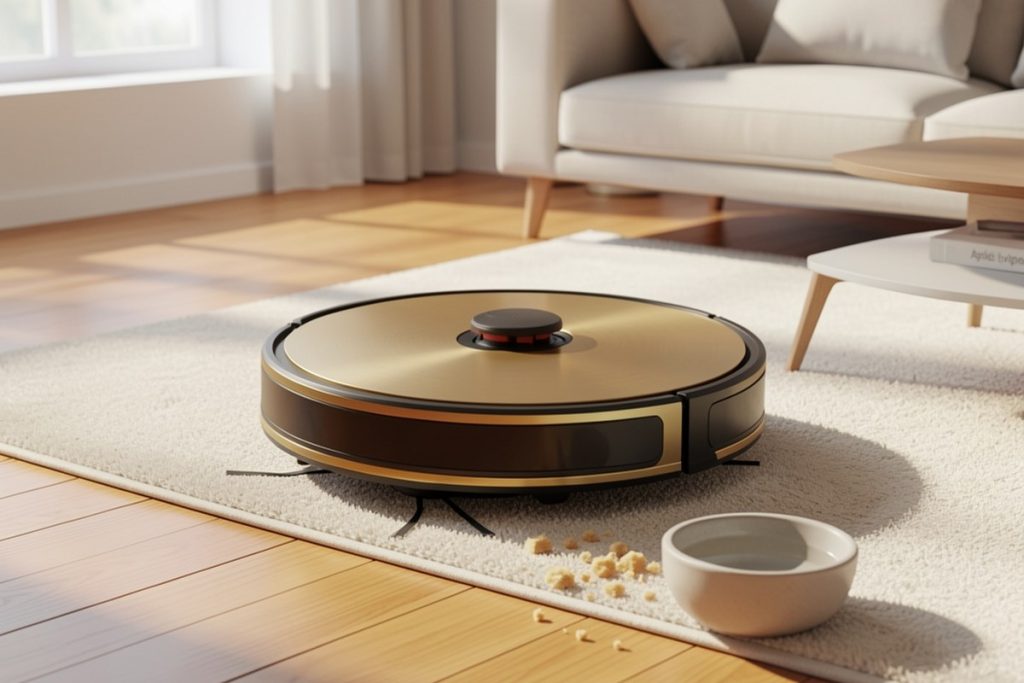
Entry-level models like the ILIFE V2 Robot Vacuum Cleaner focus on tangle-free suction and extended runtime—roughly 120 minutes—making them practical for apartments and single-story homes with hard floors. ILIFE V2 Robot Vacuum Cleaner on Amazon. Because it is slim and self-charging, it slides under sofas and beds where pet hair tends to gather, then returns to its dock when finished or when the battery runs low. It will not dig debris out of carpet, but it excels at the daily sweep that prevents hair from ever reaching that stage.
Surface Type and Obstacles
Your flooring determines which machine earns its keep. Hard surfaces—hardwood, laminate, tile, and vinyl—are the natural habitat for robot vacuums. Hair rests on top rather than embedding, so even modest suction can capture it. Low-pile rugs are usually manageable too, assuming the robot can climb the edge without trapping itself.
Thick carpets, shag rugs, and plush runners change the equation. The fibers trap hair and dander, and a robot’s compact wheels and limited ground clearance simply cannot generate the airflow or agitation needed to pull contaminants from deep within the pile. An upright vacuum with adjustable height settings and a broad cleaning path is the only practical way to extract hair from these surfaces. Additionally, transitions between rooms, stray cables, and small toys can trap or confuse budget robots, whereas a human operator can steer an upright around these obstacles instantly.
Side-by-Side Comparison
Use this table to weigh the two options against your specific household needs.
| Feature | Budget Robot Vacuum | Upright Vacuum |
|---|---|---|
| Best use case | Daily hair and dust on hard floors | Weekly deep cleaning, carpet and rugs |
| Suction strength | Moderate; surface-level debris | High; penetrates deep carpet pile |
| Automation | Scheduled runs, self-docking | Manual push operation |
| Dust capacity | Small bin; empty every 1–2 runs | Large bag or bin; empty weekly |
| Noise during operation | Quiet hum; tolerable for remote work | Louder motor; best for short sessions |
| Under-furniture reach | Low profile fits under most sofas | Requires attachments or moving furniture |
| Maintenance needs | Clean brushes, empty bin, wipe sensors | Replace filters and belts periodically |
| Upfront cost | Budget-friendly entry point | Mid-range to premium for quality models |
Cost and Long-Term Value
Price tags tell only part of the story. A budget robot vacuum typically costs less than a high-end upright, but its value depends entirely on whether it reduces your overall cleaning burden. If automating daily sweeps means you vacuum manually half as often, the convenience can justify the purchase even if you still own an upright for deeper sessions. However, if you expect an entry-level robot to replace a full-sized upright on thick carpet, you will be disappointed and will end up owning both anyway.
Durability also differs. Upright vacuums use simple, robust motors and often last a decade with basic maintenance like belt and filter replacements. Robot vacuums rely on lithium-ion batteries that degrade after a few years, along with sensors and small drive motors that can wear out with constant daily use. Replacement batteries and parts are available, but the total cost of ownership can climb. Think of a robot vacuum as a convenience appliance with a finite lifespan, and an upright as a long-term cleaning investment.
Which Should You Buy?
Your decision should start with an honest look at your floors and your tolerance for daily cleaning.
Choose a robot vacuum if your home is dominated by hard flooring, you live in an apartment or single-story layout, and you want to stop chasing pet hair every evening. It is a maintenance device that keeps surface debris under control so you can deep clean less frequently.
Choose an upright vacuum if wall-to-wall carpet, thick area rugs, or allergy concerns define your home. You need the suction, capacity, and brush agitation that only a full-sized machine delivers, especially if dander triggers respiratory symptoms.
If you have mixed flooring and pets, the most effective strategy is not either/or—it is both. Let a budget robot vacuum handle the daily hair accumulation on hard floors and low-pile rugs, then use an upright for a thorough weekly pass over carpets and high-traffic zones. This combination protects your indoor air quality, preserves your free time, and keeps your home consistently cleaner than either machine could manage alone.
Sources
Last reviewed: 2026-08-10