
Quick answer
AI translation earbuds can make short travel conversations easier, but they are not universal interpreters. The right pair should support the languages and conversation mode you need, explain whether an internet connection or companion app is required, protect voice data, and last through a realistic day. Treat language counts and battery figures as claims to verify, then test accuracy with a fallback plan before relying on them.
Key takeaways
- Language coverage matters less than support for your specific language pair, dialect, and conversation mode.
- Ask whether translation works offline, through a phone app, or only with an internet connection.
- Battery claims may include the charging case, so look for separate earbud and case estimates.
- Use translation earbuds for everyday conversations, not emergencies or high-stakes medical, legal, or financial discussions.
What AI translation earbuds actually do
Translation earbuds combine wireless audio hardware with software that listens to speech, converts it into text or meaning, translates it, and plays or displays the result in another language. In practice, the earbuds are often only one part of the system. A companion smartphone app, cloud service, microphone, and internet connection may all influence the experience.
That distinction matters when comparing products. “Real-time translation” can mean several different things: one person speaks and the translated audio plays in an earbud; both people take turns speaking through a phone; or the app shows a written translation after a pause. These modes are useful in different situations. A café order may work well with turn-taking, while a fast conversation at a train station may expose delays and recognition errors.
The quality also depends on conditions that a product title rarely explains. Background noise, accents, overlapping speech, poor connectivity, and unfamiliar names can all make automatic speech recognition less reliable. A large language count may sound impressive, but it does not tell you whether every language has the same features, voice quality, offline support, or translation accuracy.
Six questions to ask before buying
| What you need to know | Why it matters | What to verify |
|---|---|---|
| Does it support your exact language pair? | Some products list languages broadly but limit particular modes or directions. | Check both spoken languages, regional variants, and whether two-way conversation is supported. |
| Does it require an app or internet? | A Bluetooth connection does not automatically provide translation. | Look for the required app, phone operating systems, data connection, and offline capabilities. |
| How is audio handled? | Speech may be sensitive, especially during business or personal conversations. | Read the privacy policy and find out whether recordings are stored, shared, or processed remotely. |
| What does the battery figure include? | “80 hours” may refer to total use with a charging case rather than continuous earbud use. | Find separate playback, translation, standby, and case-charging estimates. |
| Can you understand the output? | Accurate words are not helpful if the speaker is too quiet or the fit is uncomfortable. | Check volume controls, ear-tip options, microphone placement, and return terms. |
| What happens when translation fails? | No speech system is perfect in every environment. | Plan to use the phone app, typed phrases, gestures, or a saved offline phrasebook as backup. |
Online versus offline translation
Online translation can provide broader language coverage and more frequent software improvements, but it depends on connectivity and sends some form of speech data through a service. That may be acceptable in a hotel or coworking space, yet frustrating on a flight, in a rural area, or when roaming data is expensive.
Offline translation can be more private and dependable when there is no signal, but it may support fewer languages or offer a narrower feature set. Do not assume that a device advertised for many languages can translate all of them without a connection. Confirm the offline language packs, how they are installed, and whether they work inside the earbuds or only in the companion app.
Privacy deserves the same attention as convenience. The NIST AI Risk Management Framework recommends considering reliability, transparency, privacy, and the context in which an AI system is used. For translation earbuds, that means understanding what the microphone captures, where processing occurs, how long data is retained, and whether you can delete an account or stored recordings.
How to judge battery life and comfort
Battery life is not just a number on a product page. Translation may use microphones, Bluetooth, a phone app, and network services at the same time, so actual use can differ from ordinary music playback. Ask whether the stated figure covers continuous listening, intermittent translation, or several recharges from the case.
Comfort is equally important. Earbuds that create pressure, loosen while walking, or block too much surrounding sound may be a poor travel choice even if their software is capable. For outdoor use, you should still be able to notice announcements, vehicles, and nearby people. A lightweight case, USB charging, replaceable ear tips, and straightforward controls are practical advantages, but confirm each feature rather than assuming it from a generic listing.
One product worth investigating cautiously
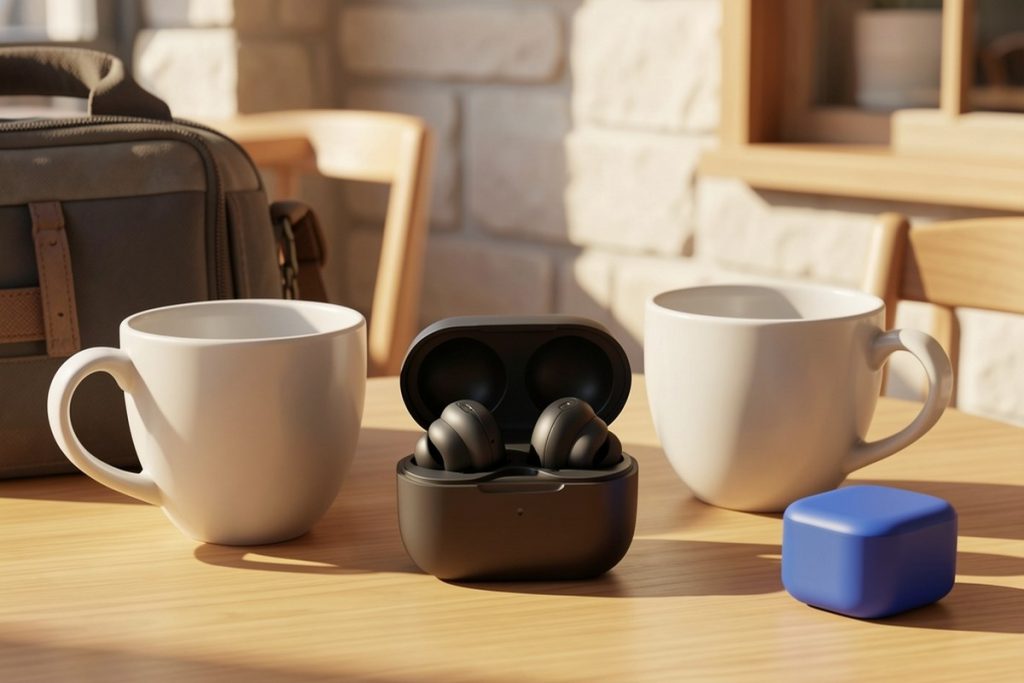
If you want to inspect one example in this category, the approved catalog candidate is AI Translation Earbuds Real Time 164 Languages 80H Playtime Translator Ear Buds Audifonos Traductores Inglés Español Wireless Earphones Bluetooth AI Headphone for Travel Meeting Learning K08 Jet Black.
The listing title advertises support for 164 languages and up to 80 hours of playtime. Those figures should be treated as claims to investigate, not proof that every language works equally well or that 80 hours means continuous translation from the earbuds alone. Before ordering, check the listing’s current specifications, required app, language-mode details, privacy information, charging explanation, customer support, and return policy. This is a product-selection note, not a hands-on review.
The product may make sense for a traveler who wants a compact way to experiment with assisted conversations and is comfortable carrying a phone as part of the setup. It is a weaker fit if you need guaranteed offline operation, certified interpretation, seamless group conversation, or dependable performance in noisy environments. A lower advertised language count with clearer documentation can be more useful than a larger headline number.
How to use translation earbuds responsibly
Test the complete setup before your trip. Install the companion app, sign in if required, download any language packs, pair the earbuds, and try the exact language direction you expect to use. Test in a quiet room first, then repeat with moderate background noise. Ask a bilingual friend to check whether the meaning—not just individual words—is preserved.
Keep a backup. Save important addresses and essential phrases in a trusted translation app or offline phrasebook, and carry a way to communicate without the earbuds. For allergies, medication, border questions, contracts, payments, or emergency instructions, confirm the meaning with a qualified person or official source. The Google Translate documentation describes speech and conversation tools, but an app feature should not be confused with professional interpretation or guaranteed accuracy.
During a real conversation, tell the other person that you are using a translation tool and pause between speakers. Short sentences, familiar words, and one person speaking at a time generally give speech-recognition systems a better chance of producing a useful result. If the output sounds strange, repeat the idea more simply rather than assuming the translation is correct.
The bottom line
AI translation earbuds are best viewed as a convenience layer between people, not a magic language barrier remover. They can help with routine travel exchanges when the language pair, app, connection, and listening conditions line up. Choose based on documented modes and privacy practices, verify battery and language claims, and carry a fallback. That approach gives you the benefit of the technology without making your trip depend on an uncertain automation.
Last reviewed: 2026-08-14
Sources
- AI Risk Management Framework — National Institute of Standards and Technology
- Translate by speech or text in the Google Translate app — Google Support