
Quick answer
Build a sustainable home strength routine by making it repeatable, not punishing: train the major movement patterns two or three days weekly, start with two manageable sets, and add reps or small amounts of load only when form stays solid. A power cage can reduce equipment friction, but it is optional; space, safety setup, and consistent use matter more than owning a large station.
Key takeaways
- Train your whole body two or three times per week instead of relying on occasional exhausting workouts.
- Use a simple progression rule: improve repetitions first, then add a small amount of resistance.
- Keep an easier version of every workout so busy weeks do not become skipped weeks.
- Choose equipment based on your available space, safety needs, and likely use—not its number of features.
By Coach Amy Lin, Sustainable Fitness Coach
Make consistency the goal, not maximum intensity
A sustainable strength routine should leave room for work, family, sleep, travel, and the occasional low-energy day. If every workout requires perfect motivation or leaves you too sore to move normally, the plan is asking too much.
For most beginners, three full-body sessions per week work well because they provide regular practice without requiring a daily gym commitment. Two sessions can also be effective. The important part is choosing a schedule you can repeat for several months, not just one ambitious week.
Keep your first month deliberately modest. Perform two working sets for most exercises, stop with roughly two or three controlled repetitions still available, and focus on smooth technique. You should finish feeling that you trained—not that you need to recover for several days.
Federal physical activity guidance recommends muscle-strengthening activity involving all major muscle groups on at least two days per week. That recommendation gives you a useful baseline, but your starting volume should reflect your experience, recovery, and schedule.
Build every workout around five movement patterns
You do not need a complicated exercise menu. A balanced home routine can be organized around five patterns:
- Squat: squat, goblet squat, or split squat for the thighs and hips.
- Hinge: Romanian deadlift, hip hinge, or hip thrust for the back of the body.
- Push: push-up, bench press, or overhead press for the chest, shoulders, and arms.
- Pull: row or pulldown for the upper back and arms.
- Carry or brace: farmer carry, plank, dead bug, or another controlled core exercise.
Choose one exercise from each category, but do not force all five into every session if that makes workouts too long. Alternating two routines is often easier to maintain than creating a different workout for every day.
A practical 3-day beginner routine
Start with a five- to eight-minute warm-up: walk, cycle, or gently move through the joints you will use. Then complete the following routine with a weight that allows controlled form. Rest for about one to two minutes between sets, or longer if your breathing has not settled.
| Session | Exercises | Starting dose |
|---|---|---|
| A | Squat, push-up or bench press, row, plank | 2 sets each; 6–12 reps, except plank |
| B | Romanian deadlift, overhead press, pulldown, split squat | 2 sets each; 6–12 reps |
| C | Goblet squat, incline push-up, hip thrust, row or pulldown, carry | 2 sets each; 8–12 reps, except carry |
Schedule the sessions with at least one rest day between them when possible—for example, Monday, Wednesday, and Friday. If you can train only twice, perform Sessions A and B one week, then B and C the next. This rotating approach keeps the routine balanced without requiring extra time.
Progress without turning every workout into a test
Progress does not have to mean lifting as heavy as possible. A simple double-progression method is easier to manage:
- Choose a repetition range, such as 8–12.
- Use the same resistance until you can complete the top end of the range with stable form on every set.
- Add the smallest practical increase in weight, or move to a slightly harder variation.
- Return to the lower end of the range and build back up.
For bodyweight exercises, progress by adding repetitions, slowing the lowering phase, increasing range of motion, or choosing a more challenging variation. For a loaded exercise, a small increase is enough. You do not need to add weight every workout.
Record the exercise, resistance, repetitions, and a brief note about how it felt. A record helps you make decisions based on evidence rather than assuming a workout was ineffective because it felt manageable.
Use a minimum version for busy weeks
The all-or-nothing mindset is one of the fastest ways to abandon a routine. Create a shorter version before you need it. On a busy day, complete one set each of a squat, push, pull, and hinge. That may take 15 to 20 minutes and preserves the habit.
You can also reduce the target from three sessions to two without restarting your program. The goal is to keep showing up while adjusting the dose. When your schedule returns to normal, resume the full plan rather than trying to compensate with an exhausting workout.
Recovery is part of the plan. Keep at least one easier day between demanding sessions, prioritize sleep where possible, and take a lighter week when your performance repeatedly drops or ordinary soreness does not settle. Persistent pain, unusual symptoms, or a known medical condition warrants individualized guidance from a qualified health professional.
When a power cage is worth considering
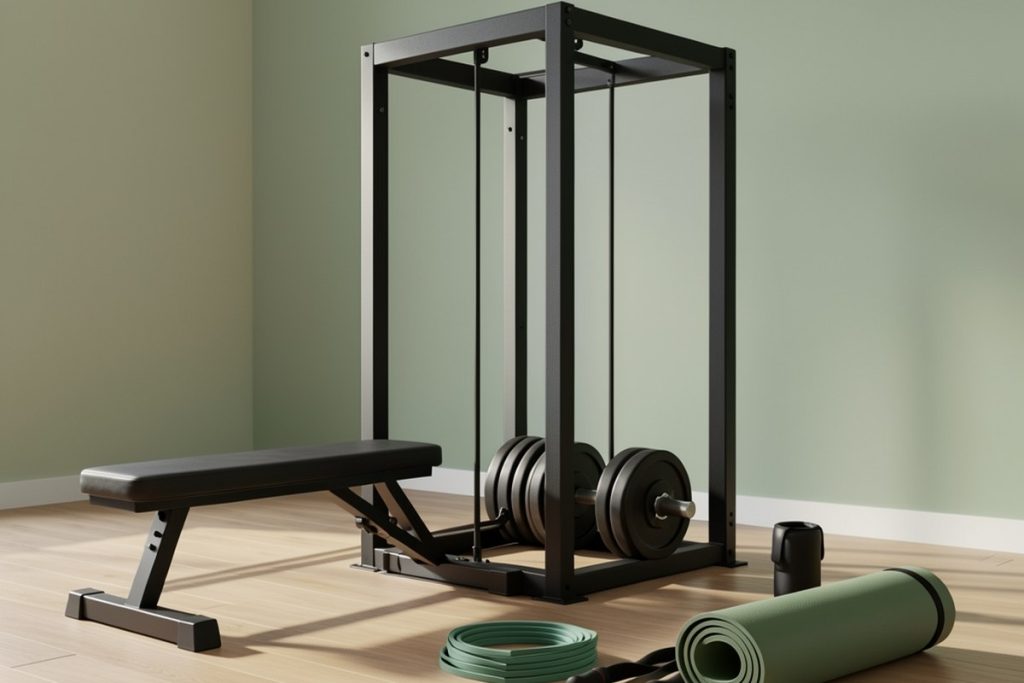
A rack becomes useful when your main obstacle is access to progressive strength exercises at home. It can provide a dedicated place for squats, presses, pulls, and other movements, while a pulley system may offer additional options for back and arm training. The larger benefit is often convenience: equipment that is ready in one room can remove the commute and scheduling barriers that make workouts easy to skip.
If you want one station for barbell work plus cable-style pulling, the approved S11 Power Cage, 2000LB Multi-Function Power Rack with LAT Pulldown, Squat Rack with Adjustable Pulley System and Training Attachments, Weight Rack for Home Gym listing describes a power cage with a lat pulldown, adjustable pulley system, and training attachments.
That does not automatically make it the right choice. A power cage needs meaningful floor space, sufficient ceiling clearance, careful assembly, and a safe training area. It may be unnecessary if you currently train well with bands, adjustable dumbbells, or bodyweight exercises. It is also not a substitute for learning technique or managing your training load.
Before ordering, measure the intended area and check the listing for the assembled dimensions, required clearance, anchoring instructions, included attachments, and whether weights or a bench are sold separately. Treat any headline capacity as product information to verify—not as a reason to attempt heavier lifting than your form and experience support.
Home gym setup checklist
- Mark the rack footprint and confirm there is room to walk around it safely.
- Check ceiling height, especially if you plan to press overhead or use a pull-up bar.
- Place rubber flooring beneath heavy equipment and confirm the floor is level.
- Keep collars, clips, bands, and small accessories in one visible storage area.
- Set the safety equipment according to the product instructions before lifting.
- Keep a lighter workout option ready for busy or low-energy days.
- Do not assume a bench, bar, plates, or attachments are included; verify the listing.
What sustainable progress looks like
Judge the routine by more than the weight on the bar. Useful signs include completing sessions consistently, using better control, recovering between workouts, and gradually doing more work at a similar effort. Your progress may be slower during stressful periods or faster when sleep and schedule improve. Both are normal.
A home strength plan works when it fits your actual life. Start with the smallest routine you can repeat, use equipment only when it solves a real access problem, and progress in small steps. Six months of steady training will usually be more valuable than one intense month followed by a long break.
Last reviewed: 2026-08-14
Sources
- Physical Activity Guidelines for Americans, 2nd edition — U.S. Department of Health and Human Services.
- Progression Models in Resistance Training for Healthy Adults — American College of Sports Medicine position stand, published in Medicine & Science in Sports & Exercise.