
Quick answer
To build a beginner home gym for strength training, start with a safe, adjustable setup that lets you train the major movement patterns: squat, hinge, push, pull, and carry or brace. A power cage with a barbell and cable attachments can cover more exercises than a bench-and-dumbbell setup, but only if you have enough room, proper clearance, and a plan for safe loading.
Key takeaways
- Build around movement patterns rather than collecting random equipment.
- Start with two or three full-body sessions per week and progress gradually.
- Measure floor space, ceiling height, storage space, and equipment clearance before buying a rack.
- Choose equipment with safety features and instructions you can follow consistently.
Last reviewed: 2026-08-17
What a beginner home gym actually needs
A useful home gym does not need to look like a commercial fitness center. It needs to make regular training convenient, safe, and varied enough that you can improve without constantly buying new equipment.
For strength training, organize your setup around five movement patterns:
- Squat: sitting down and standing up under control, such as a squat or split squat.
- Hinge: moving at the hips, such as a deadlift or Romanian deadlift.
- Push: pressing weight away from you with a bench press, overhead press, or push-up.
- Pull: bringing weight toward you with a row, pull-up, or pulldown.
- Brace or carry: resisting movement with exercises such as a plank, loaded carry, or controlled core variation.
This approach keeps your purchases tied to a training purpose. A beginner setup might start with adjustable dumbbells, a stable bench, resistance bands, and floor space. A barbell and rack make sense when you want heavier, more measurable progression and have a suitable room.
Choose equipment by the exercises you want to repeat
Before shopping, write down the exercises you expect to perform every week. If your list includes squats, presses, rows, pulldowns, and cable-based movements, a rack with multiple stations may be more practical than several separate pieces of equipment.
The trade-off is space and complexity. A power cage can support a broader routine, but it also requires a dedicated footprint, enough clearance to load the bar, and a consistent process for adjusting safeties and attachments. A pair of adjustable dumbbells occupies less space and may be the better choice if you live in a small apartment or need to store equipment after every workout.
| Priority | Better starting option | Why |
|---|---|---|
| Small space and simple storage | Adjustable dumbbells and a folding or compact bench | Supports many movements without a permanent rack footprint. |
| Barbell progression | Power cage, barbell, plates, and bench | Creates a stable base for squats and pressing movements. |
| More pulling variety | Rack with cable or pulldown attachments | Adds options for rows, pulldowns, and accessory work. |
When a power cage is worth considering
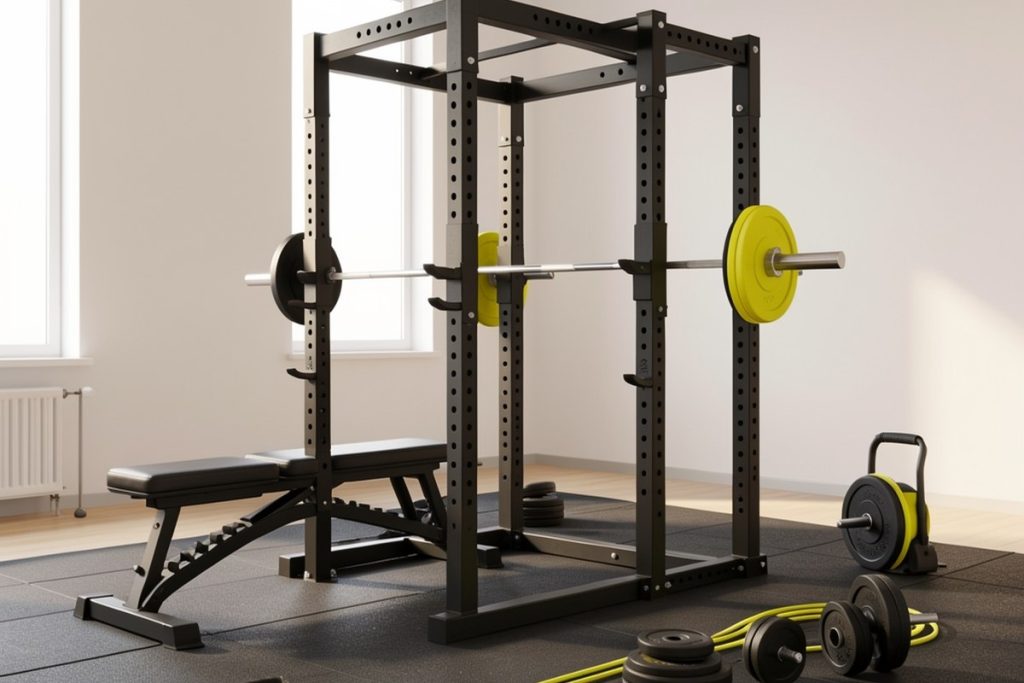
A power cage is most useful for someone who wants one central strength station instead of assembling several independent tools. The approved product listing for the Mikolo Power Cage, Power Rack with Cable Crossover System, 1500LBS Squat Rack with LAT Pull Down System, Workout Cage with Pulley System for Fitness Home Gym describes a rack that combines a power cage with cable crossover and lat-pulldown systems.
That combination could suit a home lifter who wants to train both compound lifts and cable exercises in one area. It is not automatically the right choice for every beginner, however. Check the product page and manufacturer instructions for exact dimensions, assembly requirements, included components, anchoring guidance, and weight limits for each part. The headline capacity should not be treated as proof that every attachment supports the same load.
Also measure your room before ordering. Account for the rack’s footprint, barbell length, plate storage, doorways, ceiling height, and the space needed to move safely around the equipment. A rack that blocks a door or leaves too little room to re-rack a bar creates friction and may make workouts less safe.
A simple three-day beginner strength plan
You do not need a different workout for every day of the week. Begin with two or three nonconsecutive full-body sessions. Each workout can include one lower-body exercise, one push, one pull, and one core or carry movement.
For example, rotate these sessions:
- Workout A: squat, bench press or push-up, cable row, and plank.
- Workout B: Romanian deadlift, overhead press, lat pulldown or assisted pull-up, and loaded carry.
- Workout C: split squat, incline press, one-arm row, and dead bug.
Start with a load that lets you complete every repetition with controlled technique and a few good repetitions still available. A common beginner range is one to three sets of roughly eight to twelve repetitions for many exercises, but the right amount depends on the movement, your experience, and your recovery. The goal is not to make the first session exhausting; it is to create a repeatable starting point.
When you can complete the top end of your planned repetitions with steady form, increase the challenge slightly. That might mean adding a small amount of weight, performing one more repetition, or improving control. Change only one variable at a time so you can tell what is working.
Use this home gym setup checklist
- Measure the available floor area and ceiling height.
- Leave clear space for loading plates and moving around the rack.
- Use appropriate flooring to protect the surface and reduce slipping.
- Confirm that safeties, hooks, collars, and attachments are installed correctly.
- Keep the training area bright, dry, and free from loose objects.
- Practice unracking and re-racking with a light load before progressing.
- Use a spotter or suitable safety equipment for lifts where failure could trap you.
If you train alone, safety planning matters more than chasing a heavier number. Set the rack’s safety arms or straps so they can catch the bar if needed, but do not assume a safety feature replaces correct setup. Read the instructions, inspect bolts and cables regularly, and stop if equipment feels unstable, damaged, or unusually noisy.
How often should beginners train at home?
Consistency matters more than an ambitious schedule. Two full-body strength sessions each week can establish the habit, while three sessions may provide more practice if you recover well. Leave at least a day between demanding sessions that use the same muscles heavily.
Strength work is only one part of a balanced routine. The Centers for Disease Control and Prevention recommends that adults combine muscle-strengthening activity with regular moderate or vigorous aerobic activity. You can add brisk walking, cycling, or another enjoyable cardio option without turning every workout into a long gym session.
Pay attention to sleep, soreness, energy, and technique. Mild muscle fatigue is normal, but sharp pain, dizziness, chest pain, or unusual shortness of breath is a reason to stop and seek appropriate medical advice. If you have a health condition, an injury, or have been inactive for a long time, ask a qualified clinician how to begin safely.
Make the purchase serve the plan
The best home gym is the one you can use regularly. A power cage with cable functionality can be a strong fit when you want a permanent strength-training station, have enough room, and are prepared to learn the setup. It is a poor fit if storage, ceiling clearance, budget, or installation makes the equipment inconvenient.
Choose your first setup based on the exercises you will actually perform, not the number of attachments included. Start with manageable sessions, track repetitions and loads, and improve gradually. That combination will do more for your strength than an expensive room full of equipment that rarely gets used.
Sources
- Physical Activity Guidelines for Adults — Centers for Disease Control and Prevention
- Physical Activity Guidelines for Americans, 2nd edition — U.S. Department of Health and Human Services
- Progression Models in Resistance Training for Healthy Adults — American College of Sports Medicine position stand