
Quick answer
To organize reusable water bottles for back-to-school season, keep only the bottles your household uses, group them by size or owner, and store them upright where everyone can reach them. A stackable organizer can turn a deep cabinet into separate vertical slots, but measure your bottles, shelf height, and tumbler handles first. Leave lids loosely placed until bottles are fully dry.
Key takeaways
- Declutter before buying storage: keep the bottles that fit your routines, backpacks, and dishwasher.
- Measure both the bottle body and its widest parts, including handles, lids, and straws.
- Use vertical compartments to prevent bottles from rolling into a cabinet pile.
- Dry bottles and lids completely before storing them closed or nested together.
- Choose a setup children can use without moving heavy items or climbing for access.
Why water-bottle storage becomes a back-to-school problem
Summer often leaves behind a collection of half-used bottles, travel tumblers, sports flasks, and spare lids. Once school mornings begin, that collection becomes a daily obstacle. The bottle someone needs is usually at the back of the cabinet, a lid is separated from its matching container, or several tumblers are balanced on top of one another.
The problem is not simply a lack of cabinet space. It is a lack of clear retrieval. A good system should let a person identify the right bottle, remove it without an avalanche, and return it after washing. That matters most on rushed mornings, when storage has to support the routine rather than create another decision.
For most households, the simplest solution is a small “working set”: the bottles used regularly during the week, plus perhaps one or two backups. Seasonal storage can hold oversized insulated bottles or special-use containers elsewhere.
Start with a five-minute bottle audit
Empty one cabinet or drawer and place every reusable bottle, tumbler, lid, straw, and cleaning brush on the counter. Match each lid to its container before deciding what stays. This exposes duplicates and prevents the common mistake of organizing a collection that is already larger than the household needs.
Sort the bottles into three groups:
- Daily use: containers used for school, work, commuting, or regular activities.
- Occasional use: larger bottles, guest cups, travel mugs, and seasonal items.
- Let go or repair: cracked containers, missing-lid bottles, damaged seals, and items that are difficult to clean.
Keep the daily-use group near the front of the cabinet. Move occasional items higher or farther back, but do not create a storage area so inconvenient that family members abandon it. If a bottle repeatedly comes home untouched, ask whether its size, weight, leak resistance, or cleaning requirements make it impractical.
Measure before choosing a bottle organizer
Reusable drinkware is rarely uniform. A narrow bottle may fit neatly beside a wide insulated tumbler, while a handled cup can require more width than its base suggests. Measure the widest point of each bottle, the height with its lid attached, and the clearance needed to lift it out.
Then measure the cabinet’s usable interior rather than relying on its outside dimensions. Check the opening, shelf height, depth, and any hinges or plumbing that reduce the available space. For a stackable organizer, confirm that the upper level will not block the bottle below or prevent the cabinet door from closing.
Do not assume that a product described for a particular tumbler size will fit every version of that tumbler. Product dimensions and bottle shapes vary. Treat compatibility as something to verify against the listing and your own measurements, not as a guarantee based on a category name.
When a stackable organizer makes sense
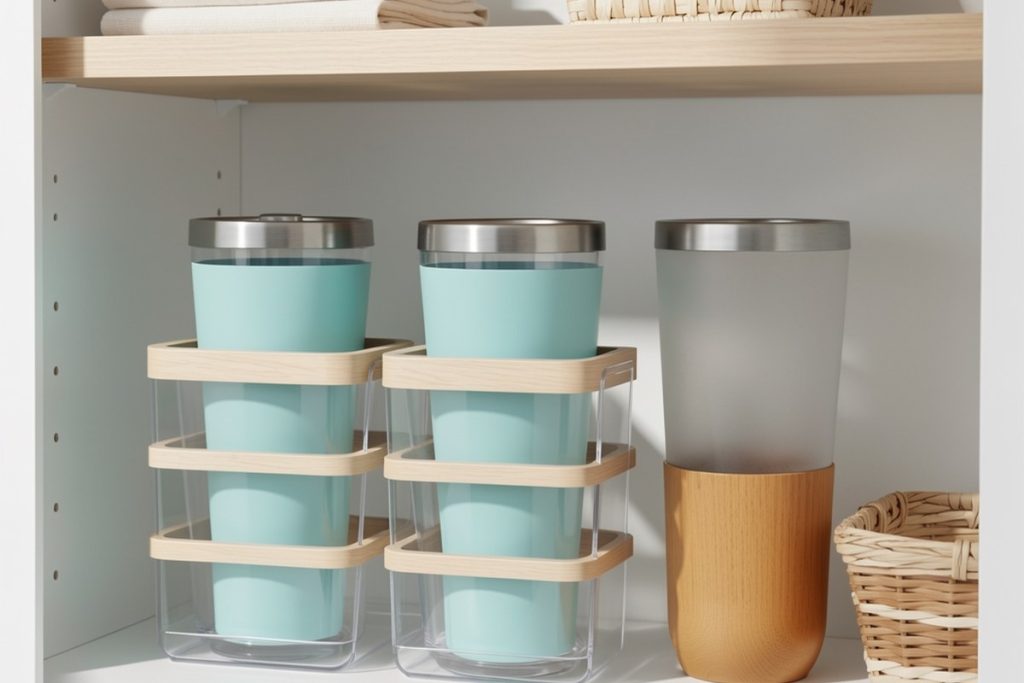
A stackable bottle organizer is most useful when the cabinet has vertical space but poor visibility. Separate slots can keep containers upright and make it easier to pull out one bottle without disturbing the others. This is especially helpful for households using several similarly shaped tumblers.
The Spospo Stackable Water Bottle Organizer is listed as a three-pack intended for cabinet, pantry, and kitchen storage. As an Amazon Associate, GetWitty may earn from qualifying purchases. It may be a practical option for a household that needs multiple compartments, but this is a fit-based recommendation rather than a hands-on test. Before purchasing, compare the organizer’s listed dimensions with your bottles, inspect how the pieces are intended to stack, and confirm that the finished arrangement leaves enough clearance for everyday use.
There are also situations where a different solution is better. A deep drawer may work better with horizontal dividers. A very narrow cabinet may need one open bin rather than stacked compartments. If the household uses only two bottles, a dedicated organizer could add unnecessary complexity. The goal is not to maximize storage capacity; it is to make the regular routine easier.
A practical setup for school mornings
Place the most frequently used bottles in the easiest-to-reach section. Give each person a consistent spot, or group bottles by function if that is more intuitive: school, work, exercise, and travel. Keep lids with their matching bottles whenever possible, but allow clean, fully dry lids to rest loosely rather than sealing moisture inside.
If children will retrieve their own bottles, prioritize stability and reach. Store heavier insulated tumblers on a lower shelf, keep fragile items away from the edge, and avoid stacking anything that requires force to separate. A storage system that looks efficient but needs an adult to reset every day will not remain efficient for long.
Use a small nearby area for the parts that commonly disappear, such as reusable straws and cleaning brushes. It does not need to be elaborate. A washable container or shallow tray can keep accessories visible without mixing them into the bottle compartments.
Weekly maintenance checklist
- Return: Put clean bottles back in the same slots after they are completely dry.
- Inspect: Check lids, gaskets, straws, and handles for buildup, cracks, or odors.
- Reset: Remove bottles that have migrated onto counters or into unrelated cabinets.
- Reduce: If several bottles remain unused, move them to occasional storage or donation consideration.
- Review: Recheck the setup when school schedules, sports, or weather-related routines change.
Cleaning instructions vary by material and manufacturer, so follow the care guidance for each bottle rather than applying one method to every container. The U.S. Department of Agriculture’s FoodKeeper resource is useful for broader food and beverage storage guidance, while the Centers for Disease Control and Prevention explains when cleaning is appropriate and how to clean household items safely.
Choose the system that removes the most friction
The best back-to-school bottle setup is not the one with the most compartments. It is the one that matches the household’s actual collection and makes the next action obvious. A small, open arrangement may beat a sophisticated system if everyone can use it. A stackable organizer is worth considering when bottles are crowding a cabinet and vertical space is available.
Make the decision after measuring, not before. Keep the daily set accessible, store occasional drinkware separately, and build drying time into the routine. That combination solves the underlying problem: fewer misplaced lids, fewer cabinet avalanches, and less searching before the school day begins.
Last reviewed: 2026-08-17