
Quick answer
Choose an AI companion gadget by starting with the moment you want to improve: a playful break, a conversation starter, a collectible, or a small daily ritual. Then check how it connects, what data it may use, how it is powered, and whether its personality suits the recipient. Treat companion robots as entertainment and interaction tools, not replacements for professional advice or human support.
Key takeaways
- Define the use case before comparing features or appearances.
- Confirm connectivity, microphone behavior, app requirements, charging, and data practices before buying.
- A wearable companion charm can suit playful, portable interaction better than productivity-focused AI tools.
- Do not assume an AI gadget is private, always available, or factually reliable without checking its documentation.
AI gadgets are moving beyond laptops and voice assistants. Small companion devices now aim to make artificial intelligence feel more personal, playful, and present in everyday life. That can be appealing if you want something more tangible than an app, but the category is still broad. “AI companion” might describe a conversational device, a character-focused collectible, a smart speaker, or an app with an animated personality.
The best choice depends less on how futuristic a gadget looks and more on whether it fits a real routine. Before buying, identify what you want the device to do, what information it needs, and how much interaction you actually expect.
Start with the problem, not the novelty
A companion gadget can solve a small, specific problem well. It may give you a lighthearted conversation during a break, add personality to a desk, serve as a memorable gift, or provide a physical reminder to pause during a busy day. Those are reasonable expectations.
Problems begin when a product is expected to do something its design does not clearly support. A character gadget may not be a productivity assistant. A conversational device may not provide dependable research. A cute wearable may not be suitable for private conversations in public. If you need calendar automation, accurate technical answers, accessibility features, or offline operation, compare those requirements separately instead of assuming they come with an AI label.
Write down one primary use and one “nice to have.” For example:
- Primary use: a portable, playful conversation companion.
- Nice to have: a collectible design that feels appropriate on a bag, desk, or shelf.
This simple distinction helps prevent an attractive gadget from becoming an expensive answer to the wrong question.
Compare AI companion formats before you buy
| Format | Best suited to | Questions to ask |
|---|---|---|
| Wearable companion charm | Portability, collecting, playful interaction, gifting | How does it connect, and is a phone or app required? |
| Desk companion robot | A visible home or workspace presence | What happens when it is idle, charging, or disconnected? |
| AI chatbot app | Text-based questions and flexible access | What personal data does the app retain or use? |
| Smart speaker | Hands-free household commands | How are recordings, wake words, and account controls managed? |
These categories can overlap, but the table highlights an important trade-off: physical personality is not the same as broad utility. A tiny robot may be more engaging than a chat window, while an app may be more convenient for writing or research. Choose the format that matches the interaction you want most often.
Where a tiny companion robot can fit
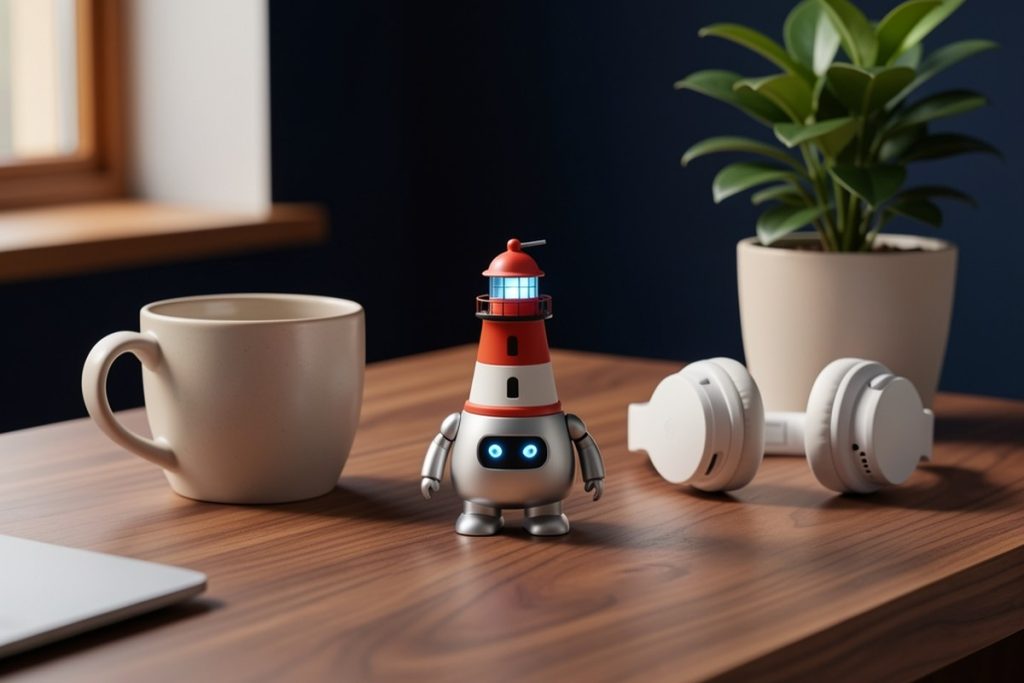
Eiliko – Your Tiny Companion Robot is listed as a wearable collectible charm focused on AI conversations, expressive faces, living personalities, and interactive gifting. Based on that positioning, it may be a natural fit for someone who wants a small character-like object to carry, display, or share with a partner or friend.
That is a narrower use case than buying a general-purpose AI assistant. The product may be worth considering when personality, portability, and gift appeal matter more than advanced work features. It is less obviously suitable if your priority is silent operation, deep automation, detailed factual research, or a clearly documented offline mode.
The available catalog context does not establish every technical detail, so verify the current product listing before ordering. In particular, look for information about companion apps, phone compatibility, Bluetooth or internet requirements, microphones, charging, age guidance, and data handling. Those details determine whether the gadget will be convenient in daily use or become another device that needs troubleshooting.
Check privacy and reliability expectations
Any connected AI gadget deserves the same basic questions you would ask of an app or smart home device. Does it send conversations to a cloud service? Can the device function without an account? What permissions does its app request? Is there a way to delete account data? Who can access the device if it is shared?
You do not need to understand every machine-learning technique to make a sensible decision. The National Institute of Standards and Technology’s AI Risk Management Framework is useful because it treats trustworthy AI as a matter of managing risks, including privacy, security, transparency, and reliability. It is a framework for evaluating and managing risk, not a certification that any particular gadget is safe.
Also keep conversational limits in mind. AI-generated responses can sound confident without being correct. Do not use a companion gadget as the sole source for medical, legal, financial, emergency, or sensitive personal guidance. If children will use it, review the age guidance and supervision needs rather than treating its friendly personality as a safety feature.
A practical pre-purchase checklist
- Purpose: Can you describe the main use in one sentence?
- Interaction: Is the experience primarily conversational, expressive, collectible, or task-oriented?
- Connectivity: Does it require a phone, app, account, Bluetooth, or internet access?
- Privacy: Are microphones, recordings, permissions, retention, and deletion controls explained?
- Power: Is charging or battery information clear enough for your routine?
- Physical fit: Will the size, attachment method, and materials work on a bag, desk, or shelf?
- Expectations: Would you still value it if the AI conversation were occasional rather than constant?
The final question is especially useful. Companion products often create value through atmosphere and personality, not just utility. If the physical object, character, or gifting experience is meaningful, occasional interaction may be enough. If you need frequent, dependable results, a conventional software tool may be a better match.
Bottom line: buy for fit, not the AI label
AI companion gadgets are most compelling when they make interaction feel tangible and approachable. They can add a bit of personality to a routine or create a distinctive gift, but they should be evaluated as consumer electronics with software dependencies—not as magical friends or universal assistants.
For a small wearable robot, focus on portability, personality, connectivity, privacy, and the recipient’s actual habits. Read the current specifications, identify what is not documented, and decide whether the product’s main experience matches your goal. That approach makes room for fun without confusing novelty with usefulness.
Last reviewed: 2026-08-28
Sources
- AI Risk Management Framework — National Institute of Standards and Technology
- OECD AI Principles — Organisation for Economic Co-operation and Development