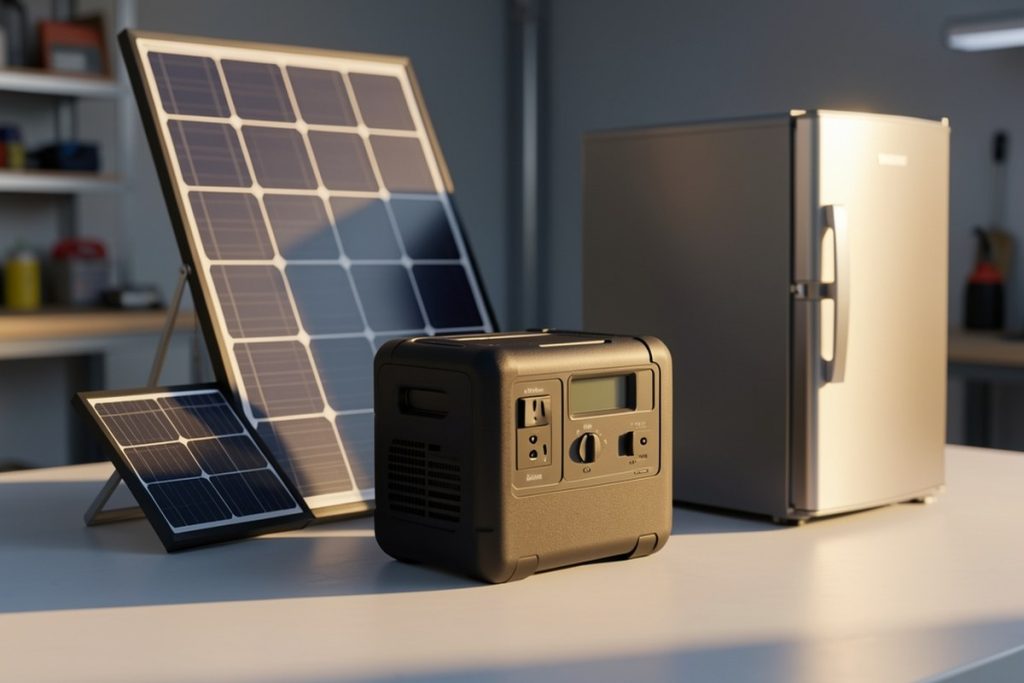

Yes, a solar generator can power your whole house during a blackout, but only if it is properly sized for your home’s electrical demands. Most portable power stations are designed for camping, tailgating, or charging small electronics. To keep essential appliances like your refrigerator, lights, and HVAC running, you need a high-capacity system with sufficient continuous output and surge capacity. Understanding your actual power needs is the difference between seamless backup and a frustrating mid-outage shutdown.
What “Whole-House” Backup Actually Means
In the backup power world, “whole-house” rarely means running every circuit at full load simultaneously. For most homeowners, practical backup means maintaining comfort and safety by powering a carefully chosen set of essentials. During an outage, you typically need to keep the refrigerator cold, run a furnace fan or a window air conditioner, charge phones and laptops, and keep some lights on. High-draw appliances like electric dryers, water heaters, and central AC systems can overwhelm smaller units.
The bigger challenge is not just running watts, but starting watts. Motor-driven appliances such as refrigerators, sump pumps, and AC compressors demand a brief surge of power—often two to three times their normal operating load—to start up. If your solar generator cannot deliver that surge, the appliance will stall and the system may shut down to protect itself. This is why capacity ratings alone do not tell the full story.
How to Size a Solar Generator for Home Backup
Before you invest in any system, you need to calculate your peak load and your desired runtime. Start by listing the devices you absolutely need during an outage. Check each appliance’s nameplate or user manual for its running watts, and note whether it has a high startup surge. Common culprits include refrigerators, which might draw 200 watts running but 1,200 watts or more on startup, and sump pumps, which can surge even higher. Add the running watts together, then identify the single largest surge wattage in your list. Your generator’s continuous output should exceed your total running watts, and its surge rating must exceed that highest startup demand.
Next, consider runtime. A 5,000 watt-hour battery running a 500-watt load will theoretically last about ten hours, but real-world efficiency losses and inverter consumption usually reduce that by 10 to 15 percent. If you want multi-day backup without sunshine, you need either a larger battery bank or a way to recharge via solar panels during daylight hours. A 1,000-watt solar array can often replenish several thousand watt-hours on a sunny day, effectively extending your reserve indefinitely during prolonged outages. Many homeowners size their systems for one full day of autonomy, using solar input to bridge the gap until grid power returns.
Solar Generator vs. Gas Generator for Home Backup
Many people default to a gas generator because of lower upfront costs, but solar generators offer distinct advantages for home backup. Here is how the two compare across the factors that matter most during an emergency.
| Feature | Solar Generator (LiFePO4) | Gas Generator |
|---|---|---|
| Fuel Source | Sunlight and stored battery | Gasoline, propane, or diesel |
| Runtime | Hours to days; extendable with solar recharge | Limited by fuel supply; refueling required |
| Noise Level | Nearly silent operation | 65–85 dB or louder |
| Indoor Safety | Safe to operate indoors | Carbon monoxide hazard; outdoor only |
| Maintenance | Minimal; no fluids or filters | Oil changes, fuel stabilization, spark plugs |
| Startup | Instant, push-button power | Manual or electric start; choke may be needed |
| Upfront Cost | Higher initial investment | Lower initial cost |
The trade-off is clear. Gas generators win on upfront price and indefinite runtime if you have fuel, but they require active maintenance, fuel storage, and safe outdoor operation. Solar generators cost more initially and depend on sunlight for extended runtime, but they operate silently, safely indoors, and start instantly. For homeowners who want a set-it-and-forget-it solution, the solar route reduces long-term headaches.
What High-Capacity Solar Generators Offer
If you are serious about whole-house backup, look for systems that offer at least 4,000 to 5,000 watt-hours of battery capacity, 7,000 watts or more of continuous output, and native 240V support. The 240V capability is critical because many central appliances—well pumps, electric stoves, and large AC units—run on split-phase power. Without it, you are limited to 120V devices.
LiFePO4 battery chemistry has become the standard for large solar generators because it offers longer cycle life and better thermal stability than older lithium-ion formulations. These systems are also heavy. A large home backup unit can weigh over 100 pounds, so mobility matters less than installation location and integration with a transfer switch. Some homeowners pair their solar generator with a manual transfer switch or interlock kit to safely power hardwired circuits without extension cords running through windows.
One example of a system designed for this use case is the Jackery Solar Generator 5000 Plus with 500W Panels. As an Amazon Associate, GetWitty may earn from qualifying purchases. It features a 5040Wh LiFePO4 battery, 7200W output, and dual 120V/240V capability, which places it in the category of units built for substantial home backup rather than weekend camping trips.
Installation and Safety Considerations
A solar generator is only as useful as its connection method. Running extension cords to individual appliances works in a pinch, but it is not a practical whole-house solution and creates trip hazards. If you want to power hardwired circuits like overhead lights, well pumps, or your kitchen refrigerator outlet, hire a licensed electrician to install a manual transfer switch or generator interlock. This device routes power from the generator to selected circuits in your main panel safely and prevents dangerous backfeeding onto utility lines, which can injure line workers.
Placement matters too. Even though solar generators produce no exhaust, they need ventilation to prevent overheating. Keep the unit in a dry, temperature-controlled space like a garage, utility room, or basement, away from direct sunlight and moisture. If you are using solar panels to recharge, they need secure outdoor mounting or ground placement with clear sun exposure and a stable frame to withstand wind. Avoid daisy-chaining multiple power strips or overloading individual outlets, and verify that your generator’s total output can handle the combined load of everything you plan to run simultaneously.
When a Solar Generator Makes Sense for Your Home
A solar generator is a strong fit if you live in an area with frequent grid instability, want indoor-safe backup power, or prefer to avoid storing flammable fuels. It is also ideal for homeowners who already have some solar awareness and want a plug-and-play option without the complexity of permanent battery wall installation. However, if your home relies on electric resistance heating, a large central AC system, or multiple high-draw appliances, even a large solar generator may struggle to power everything at once without careful load management. In those cases, you may need to either downsize your backup expectations to essential circuits, or invest in a permanently installed battery system tied to rooftop solar.
Cost is another factor. Whole-house solar generators represent a significant upfront investment compared to portable gas units. You should weigh the price against your local outage frequency, the value of refrigerated goods, medical device dependence, and simple peace of mind. For many households, the ability to run critical loads silently and safely indoors—without fumes, fuel runs, or pull-starts—justifies the premium over conventional generators. The right choice depends on your specific loads, your budget, and how much maintenance you are willing to manage when the grid goes down.
Last reviewed: 2026-08-05