
By Jax Morrison
Quick answer
For a full-body home routine, train two or three nonconsecutive days each week and cover a squat or leg-press pattern, a push, a pull, and trunk work. Start with manageable loads, 2–3 sets of 8–12 controlled reps, and progress only when your form stays solid. A multifunctional station can reduce setup time, but it should match your space, goals, and safe exercise options.
Key takeaways
- Build each workout around major movement patterns rather than random exercises.
- Start with two weekly sessions, then add a third only when recovery is reliable.
- Increase repetitions before increasing resistance, and never sacrifice control for a heavier setting.
- Check a home gym station’s footprint, adjustment range, instructions, and support before buying.
What a one-machine home gym can actually solve
The best home workout equipment is not the machine with the longest feature list. It is the equipment that removes the reason you keep skipping training. If your main barriers are driving to a gym, waiting for equipment, or setting up several loose pieces of gear, a multifunctional station may make strength training easier to repeat.
One machine can provide a stable place to practice resistance exercises and make loading more straightforward. It does not automatically replace every movement, however. A complete routine still needs a sensible balance of lower-body work, upper-body pushing and pulling, hip-hinge training, and core stability. Some of those patterns may require bodyweight exercises, bands, or dumbbells alongside the station.
Adults should perform muscle-strengthening activity on at least two days each week, according to the U.S. Physical Activity Guidelines. For a beginner, that recommendation is a useful floor—not a command to train hard every day. Two consistent sessions beat an ambitious plan that becomes too tiring to maintain.
Choose exercises by movement pattern
Think in patterns first. This keeps your program balanced even when your equipment or schedule changes. The table below gives a simple framework. For any machine exercise, use only the movements and adjustments supported by the manufacturer’s instructions.
| Pattern | What it trains | Practical starting option | Progress cue |
|---|---|---|---|
| Squat or press | Quads and glutes | Supported leg press or split squat | Use a steady tempo and comfortable depth |
| Push | Chest, shoulders, and triceps | Approved machine press or incline push-up | Stop before your shoulders or back compensate |
| Pull | Upper back and arms | Approved machine pull or resistance-band row | Pause briefly when your shoulder blades move together |
| Hinge | Hamstrings and glutes | Hip hinge or Romanian deadlift with suitable equipment | Keep the load close and your spine controlled |
| Core | Trunk stability | Plank or dead bug | Build control before adding duration |
A simple three-day full-body plan
Begin with two sessions per week, such as Monday and Thursday. After two or three weeks, add a third session if your joints feel good, your sleep is normal, and you are not carrying excessive soreness into the next workout. Leave at least one day between strength sessions.
Workout A
- Leg press or another supported lower-body press: 3 sets of 8–12 reps
- One approved pushing exercise or incline push-up: 3 sets of 8–12 reps
- One approved pulling exercise or row: 3 sets of 8–12 reps
- Plank: 2 sets of 20–40 seconds
Workout B
- Split squat or controlled squat variation: 3 sets of 8–10 reps per side
- Hip hinge or Romanian deadlift: 2–3 sets of 8–10 reps
- Push-up variation: 2–3 sets, stopping with about two good reps left
- Band or dumbbell row: 3 sets of 10–12 reps
- Dead bug: 2 sets of 8 reps per side
Workout C
- Repeat a lower-body pattern for 2–3 sets of 10–15 reps
- Repeat one push and one pull for 2–3 sets of 8–12 reps
- Add a light carry, side plank, or another stable core exercise for 2–3 rounds
Rest for roughly one to two minutes between most sets, using more time if your breathing or technique has not settled. Before lifting, spend five to ten minutes warming up with easy movement and a few rehearsal reps. The goal is to feel prepared, not exhausted.
How to progress without rushing
Choose a resistance that lets you complete every repetition with consistent range of motion. When you can reach the top of your chosen rep range on every set without grinding or changing technique, increase resistance by the smallest sensible amount. If the machine does not allow a small increase, add one repetition per set or slow the lowering phase slightly.
Keep one to three repetitions in reserve on most sets. Training to absolute failure is not required for steady progress, especially when you are learning the equipment. Log the exercise, resistance setting, repetitions, and how difficult the final set felt. That simple record makes progression more objective than guessing from workout to workout.
Where a multifunctional station fits
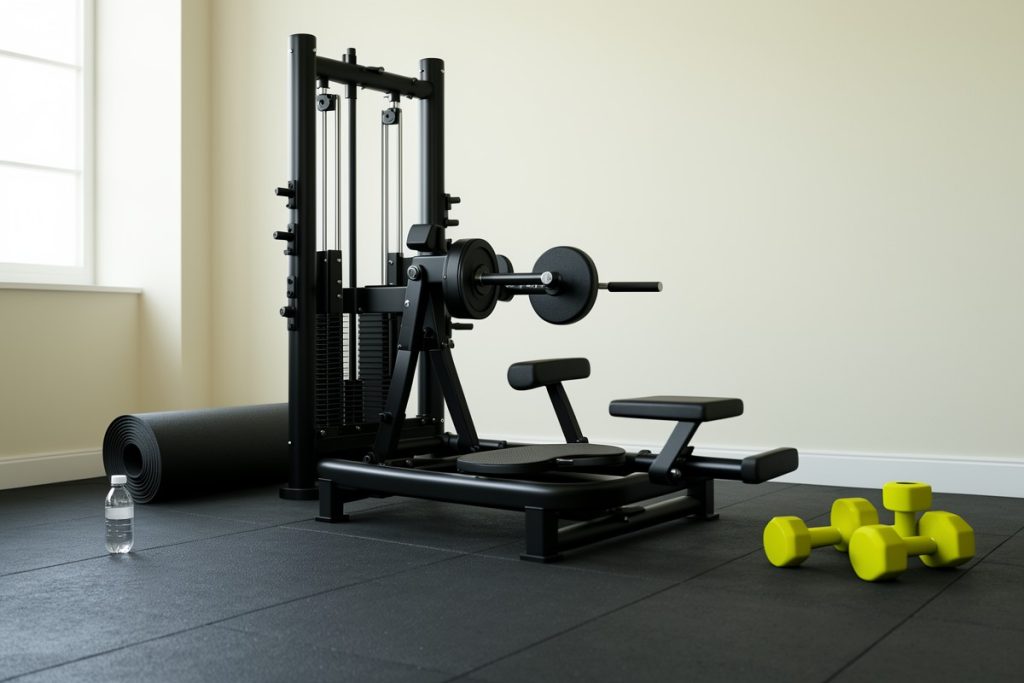
If limited space and setup friction are your biggest obstacles, the SPORTSROYALS Home Gym, Multifunctional Workout Station with Leg Press | 150LBS Weight Stack Full Body Workout Equipment for Home Exercise Fitness Strength Training is a candidate worth investigating. Its listing identifies a multifunctional home station with a leg press and a 150LBS weight stack, which may suit someone who wants a more structured resistance-training setup at home.
That description alone does not prove it is the right choice for you. Before ordering, confirm the assembled footprint, ceiling clearance, adjustment range, included attachments, resistance increments, assembly requirements, warranty, replacement-part support, and the exercise instructions. Also consider whether you can move around the station safely and whether other household members need access to the room.
A station may be a poor fit if you travel often, have very little floor space, or mainly want short workouts built around walking, running, mobility, or bodyweight circuits. Adjustable dumbbells, bands, or a pair of kettlebells may offer more flexibility in those cases. The right purchase is the one you will use consistently and can operate with confidence.
Home gym setup checklist
- Measure the machine’s footprint and leave clear space for entry, movement, and adjustments.
- Read the supported-exercise and safety instructions before planning your routine.
- Start with a light setting while learning each adjustment and movement.
- Keep a training log so you can progress gradually.
- Stop for sharp pain, sudden instability, or equipment that does not feel secure.
Build the habit first, then chase bigger numbers. A dependable full-body routine does not need to be complicated: train the major patterns, use controlled repetitions, recover between sessions, and choose equipment that makes showing up easier.
Last reviewed: 2026-08-28
Sources
- Physical Activity Guidelines for Americans, 2nd edition — U.S. Department of Health and Human Services
- Progression Models in Resistance Training for Healthy Adults — American College of Sports Medicine position stand