
Quick answer
The best kitchen shears for poultry should cut cleanly, feel secure in the hand, resist corrosion, and lock safely when stored. A multifunction pair can also help with herbs, packaging, bottle caps, or fish preparation, but extra features should not replace strong blades and easy cleaning. Before buying, check the handle design, safety mechanism, care instructions, and whether the tool suits your cooking habits.
Key takeaways
- Prioritize sharp, sturdy stainless-steel blades and a handle that remains comfortable during controlled cutting.
- A safety lock is useful for storage, especially in busy drawers or kitchens shared with children.
- Multifunction features can save drawer space, but they should be treated as conveniences rather than proof of better cutting performance.
- Use separate, clean preparation practices for raw poultry and never rely on cutting tools to determine whether meat is safely cooked.
By Zara Ahmed (Deep Research Reviewer)
Last reviewed: 2026-09-28
Why kitchen shears are useful for poultry and more
Kitchen shears solve a problem that ordinary scissors and many chef’s knives handle poorly: controlled cutting through awkward food shapes. Poultry can be slippery, joints can be difficult to reach, and trimming a whole bird with a knife may require more force or space than a home cook wants to use.
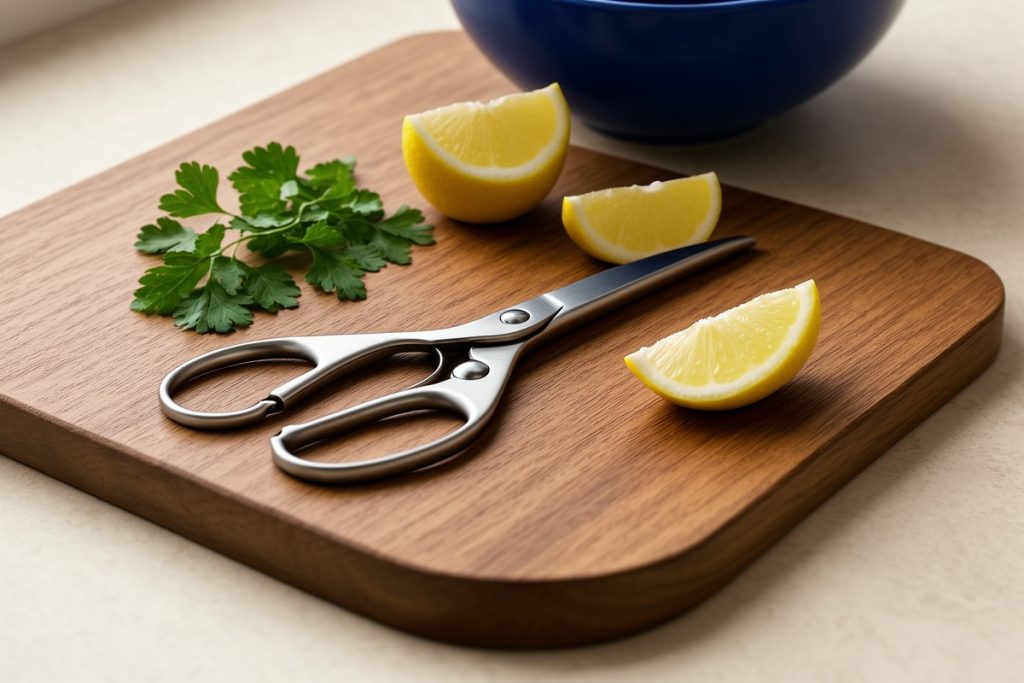
A dedicated pair of kitchen shears can help with tasks such as trimming skin, cutting through small joints, snipping herbs, opening food packaging, and portioning flat foods. The benefit is not that one tool magically replaces every utensil. It is that a sturdy pair can make short, precise cuts while keeping the food stable on a cutting board.
For everyday cooking, versatility matters most when it reduces clutter without making the primary job harder. If a pair includes a bottle opener or fish scaler, those additions may be useful occasionally. However, the core test remains simple: can the blades open and close smoothly, grip food without excessive slipping, and clean up properly afterward?
Features that matter when choosing kitchen shears
Blade strength and cutting control
Look for blades made from stainless steel or a comparable food-contact material. Stainless steel is commonly selected for kitchen tools because it offers useful corrosion resistance, although it is not stain-proof and still needs proper care. The blades should meet evenly and move without wobbling at the pivot.
For poultry, sturdy blades are more important than an especially delicate edge. You want enough rigidity for controlled trimming, but not a tool that feels so heavy or stiff that it encourages excessive force. A comfortable cutting motion is a practical safety feature because it helps reduce slips and awkward angles.
Handle comfort and grip
Handles should provide a secure grip with enough room for the fingers. Smooth metal may be durable, but its feel can vary during wet or greasy preparation. If possible, compare the handle shape with the way you naturally hold scissors. A well-designed handle should allow repeated opening and closing without sharp pressure points.
Ergonomics matter even more if you prepare large batches of poultry or regularly use shears for herbs, vegetables, and packaging. A tool that is technically strong but uncomfortable may end up unused in a drawer.
Safety lock and storage
A lock keeps the blades closed when the shears are stored. It does not make the tool risk-free, but it can reduce accidental exposure in a crowded utensil drawer. Check whether the lock is easy for an adult to operate deliberately and whether it stays engaged when the shears are moved.
Store kitchen shears in a dry location where the blades cannot catch on other utensils. If the design has a protective cover, follow the care instructions rather than assuming every cover is suitable for long-term damp storage.
Extra functions
Multifunction shears may include tools for opening bottles, scaling fish, cracking small items, or gripping objects. These features can be convenient when you want fewer gadgets, but they add surfaces and edges that may require more careful cleaning.
Ask whether you will genuinely use the extras. If you mainly need poultry shears, a reliable cutting action should carry more weight than a long feature list. If you cook in a small kitchen, however, combining several occasional tools may make sense.
How the main features compare
| Feature | Useful for | What to check |
|---|---|---|
| Stainless-steel blades | Poultry trimming, herbs, and general prep | Stiff construction, smooth pivot, clean blade alignment |
| Ergonomic handle | Repeated cutting and better control | Comfortable finger space and secure grip |
| Safety lock | Drawer storage and safer handling | Lock engages firmly and releases intentionally |
| Built-in accessories | Occasional bottle or fish preparation | Useful to your routine and easy to clean |
A practical option for a multifunction kitchen tool
The Heavy Duty Kitchen Scissors Stainless Steel Poultry Shears with Safety Lock and Multifunctional Features is a reasonable candidate for cooks who want one pair aimed at poultry preparation while also covering bottle opening and fish-scaling tasks. Its listed feature set includes stainless-steel construction, an ergonomic metal handle, a safety lock, and functions for bone cutting.
That combination makes the product relevant to a busy kitchen, but the listing alone does not establish how comfortable it will be for every hand, how easily the blades will sharpen over time, or whether it is dishwasher-safe. Those are important details to verify before purchase. It is also worth checking the seller’s current care instructions and examining how the blades, pivot, and locking mechanism are described.
The product is best viewed as a space-saving, multifunction option rather than an automatic replacement for every kitchen tool. Someone who only trims herbs may prefer lighter kitchen scissors. Someone who frequently prepares poultry or wants built-in accessories may value the heavier design more.
Safe ways to use shears with raw poultry
Raw poultry can spread harmful bacteria to hands, utensils, cutting boards, and nearby foods. Keep poultry preparation separate from ingredients that will be eaten without cooking, and clean work surfaces and tools after contact. The U.S. Department of Agriculture recommends using a food thermometer and cooking poultry to an internal temperature of 165°F, measured in the thickest parts.
Shears should not be used to judge doneness. Their job is cutting, trimming, or portioning before cooking. After use, follow the product’s cleaning instructions, paying attention to the pivot and the area where food residue can collect. Dry the tool fully before storage, and avoid leaving it submerged if the care guidance does not permit that.
Buying checklist for kitchen shears
- Can the blades cut poultry cleanly without forcing the handles?
- Does the handle feel secure and comfortable for your grip?
- Is the safety lock easy to engage before storage?
- Are the extra functions genuinely useful in your kitchen?
- Are cleaning, drying, and dishwasher instructions clearly provided?
- Will the shears be stored where the closed blades are protected?
Final verdict
For a home cook preparing poultry regularly, the right kitchen shears should be sturdy, controlled, comfortable, and straightforward to clean. Multifunction features are a useful bonus when they match your routine, but they should not distract from blade quality or safe handling.
The candidate product fits the long-tail need for heavy-duty poultry shears with added kitchen functions, particularly for shoppers who prefer one tool over several separate gadgets. Make the final decision by confirming care instructions, assessing the handle and lock design, and matching the tool’s weight and features to the way you actually cook.