
Quick answer
Organize hair accessories for fall and winter by removing damaged pieces, grouping items by how often you use them, and keeping everyday clips separate from seasonal or occasion accessories. Store everything dry and visible. A clear five-drawer organizer can work well for small items, but check its drawer size before buying if your collection includes oversized headbands or claw clips.
Key takeaways
- Use the change in your wardrobe or local weather as the signal for a seasonal reset.
- Sort accessories into keep, clean or repair, donate, and discard groups before reorganizing.
- Store daily-use items separately from cold-weather, formal, and backup accessories.
- Choose storage that keeps small pieces visible without forcing larger accessories into crowded drawers.
Why a seasonal hair-accessory reset helps
Hair accessories rarely become disorganized all at once. A few elastics land beside the bathroom sink, clips collect in a bowl, and a headband gets tucked behind skincare products. By the time the weather changes, finding one useful accessory can take longer than styling your hair.
Fall and winter are a natural point to reset because your routine often changes with your clothes. Sweaters, coats, scarves, and hats may call for different clips, ties, and headbands than summer outfits. A seasonal system also gives you a chance to remove pieces that pinch, snag hair, slip out, or have simply stopped earning space.
You do not need to reorganize on a fixed calendar date. Use the first sustained change in local weather or the point when you rotate your wardrobe. NOAA explains the difference between meteorological and astronomical seasons, but for home organization, the practical trigger is when your daily routine actually changes.
Sort everything before buying storage
Start by taking every hair accessory out of drawers, baskets, countertops, travel bags, and coat pockets. Seeing the full collection prevents you from organizing duplicates while forgetting what is already stored elsewhere.
Make four groups:
- Keep: Items you use, like, and can still wear comfortably.
- Clean or repair: Pieces with surface residue, loose parts, or minor tangles that can realistically be fixed.
- Donate: Clean, usable items you no longer reach for, subject to local donation rules.
- Discard: Cracked clips, exposed sharp edges, stretched elastics, and anything that catches or pulls hair.
Be honest about “backup” pieces. A backup is useful only if you would choose it when your favorite item is unavailable. If an accessory has been ignored through several seasons because it is uncomfortable or difficult to use, keeping it usually creates clutter rather than security.
For sentimental items, create one small keepsake category. This lets you preserve meaningful pieces without allowing the entire collection to become too precious to edit.
Group accessories by the decision you make
Color sorting can look attractive, but function usually makes a morning routine faster. Organize accessories according to the decision you are likely to make when getting dressed.
- Daily basics: Keep your most-used elastics, neutral clips, bobby pins, and simple headbands together.
- Thick-hair or high-hold pieces: Separate larger claw clips, strong ties, and accessories designed for heavier hair.
- Soft and delicate items: Store fabric-covered bands, satin-style accessories, and soft scrunchies away from rough edges or exposed pins.
- Cold-weather rotation: Place pieces that work with hats, scarves, sweaters, and winter outfits together.
- Occasion and travel: Keep polished barrettes, spare accessories, and compact travel items out of the daily zone.
One category per drawer is a useful starting point, but it is not a rule. Combine categories when one group takes up very little space, and split a category when you have to dig through it to find anything.
Choose storage that fits the collection
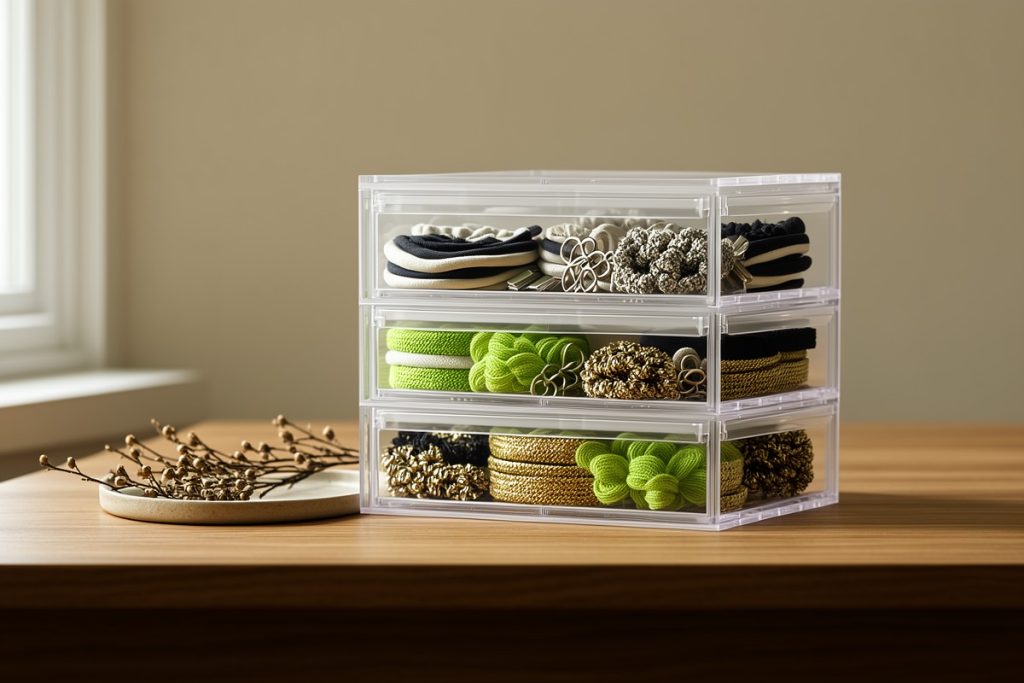
Clear, shallow drawers are useful for small accessories because they let you scan the contents instead of emptying a container. The Prsildan Hair Accessories Organizer Acrylic Drawer with 5 Small Drawers is one option to consider if you want separated compartments for items such as clips, ties, pins, and jewelry-sized accessories.
It is not automatically the best choice for every collection. Five small drawers may be practical for small pieces but less suitable for oversized headbands, wide wraps, or large claw clips. Before choosing it, compare the listed drawer dimensions with your largest accessories and consider how much open space you need to remove items comfortably.
Placement matters as much as the container. A vanity, bedroom shelf, or dry section of a bathroom counter can work better than a splash-prone area beside the sink. If you keep storage in the bathroom, make sure accessories are completely dry before putting them away. A container that looks tidy but traps moisture can make maintenance harder.
Also consider how the system feels to use. If you must lift several containers or open multiple lids to reach a daily clip, the arrangement will probably deteriorate. Choose visibility and easy access over a decorative setup that requires extra steps.
Five-minute seasonal organization checklist
Use this short reset at the start of fall, winter, or any major wardrobe change:
- Remove every accessory from its current storage location.
- Discard broken, sharp, stretched, or hair-snags-on-it pieces.
- Clean washable surfaces according to the material and care guidance.
- Let accessories dry completely before returning them to a drawer.
- Put daily-use items in the easiest-to-reach location.
- Move seasonal, formal, and backup pieces behind the daily rotation.
- Leave some empty space so the system can absorb small additions.
Do not automatically wash every accessory. Plastic, fabric, metal, and coated materials may require different care, and some pieces can be damaged by soaking or harsh cleaners. When an accessory has maker-provided care instructions, follow those instructions first. The Federal Trade Commission explains how care information is communicated on covered textile products, which is especially relevant to fabric-covered headbands and other textile accessories.
Keep the organizer useful through the season
A good reset should reduce future effort, not create another household project. Return accessories to their assigned location as soon as you finish using them. If you are short on time, place them temporarily in one small “return” dish and empty it once a day or every few days.
Keep a small repair envelope or discard cup nearby. This stops stretched elastics and damaged clips from drifting back into the main collection. Once a week, remove obvious duplicates and move anything you have not used into the backup or occasion area.
Reassess after the first genuinely cold stretch rather than assuming your original layout is perfect. You may discover that a soft headband needs to be more accessible than expected, or that your usual claw clips do not work well with heavier layers and hats. Move the categories before buying more storage.
The goal is not a perfectly styled vanity. It is a visible, low-effort system that helps you find comfortable accessories quickly, protects the pieces worth keeping, and makes the seasonal transition feel simpler.
Last reviewed: 2026-09-28