
Quick answer
After a long break, restart strength training with two nonconsecutive sessions per week, light-to-moderate loads, and controlled repetitions. Spend the first two weeks rebuilding movement quality rather than chasing fatigue. Add volume or resistance gradually only when your technique stays consistent and normal soreness does not interfere with daily life. Stop for sharp pain and seek medical guidance when needed.
Key takeaways
- Begin with two weekly strength sessions, separated by at least one rest day.
- Use a load that leaves several controlled repetitions in reserve.
- Progress one variable at a time: repetitions, sets, or resistance.
- Track how you feel the next day, not just what you lifted.
Returning to strength training is less about proving what you used to do and more about making your body comfortable with regular training again. A sensible restart plan gives your joints, connective tissues, coordination, and recovery habits time to catch up.
Why your old routine is not the right starting point
Strength can feel familiar before your work capacity has fully returned. You may remember the exercises, the weights, and the pace you used months or years ago, but your tolerance for repeated effort may be lower now. Jumping straight back into an old program can leave you excessively sore, discouraged, or unable to train consistently.
The goal of the first month is repeatability. A session that feels almost too manageable is often more useful than one that forces several days of recovery. The U.S. Department of Health and Human Services recommends muscle-strengthening activity on at least two days each week for adults, but that does not mean every returner should immediately perform a high-volume program. Start below your perceived maximum and build from there.
A practical four-week return-to-strength plan
Use this framework with exercises you already know or can learn safely. Keep at least one rest day between strength sessions. If you have a current injury, significant joint pain, chest pain, dizziness, or a medical condition affected by exercise, ask a qualified clinician how to modify your plan.
| Week | Sessions | Training focus | Progress rule |
|---|---|---|---|
| 1 | 2 | One easy set of each planned movement; rehearse smooth technique. | Finish every set feeling that you could do several more repetitions. |
| 2 | 2 | Repeat the same movements with slightly more control or one extra set where appropriate. | Add work only if soreness is mild and short-lived. |
| 3 | 2 | Use two controlled sets for most movements, with steady breathing and full available range. | Increase repetitions before making a large jump in resistance. |
| 4 | 2-3 | Settle into a repeatable weekly schedule rather than testing your limit. | Keep the load steady if form or recovery is deteriorating. |
This is a starting framework, not a contest. Some people will need to repeat a week, particularly after illness, injury, major stress, or a very long period away from training. Consistency matters more than completing the four weeks on schedule.
How hard should your first workouts feel?
Choose a resistance that lets you perform the target movement without holding your breath, rushing the lowering phase, or changing your posture to finish. A useful starting point is to stop with roughly two to four controlled repetitions still available. That reserve is not a precise measurement; it is a way to avoid turning every set into a test.
Use three checks during a set:
- Technique: Can you maintain the same basic position from the first repetition to the last?
- Breathing: Can you breathe rhythmically instead of straining through every repetition?
- Joint feedback: Do you feel muscular effort rather than sharp, catching, or escalating joint pain?
Normal post-training soreness can happen when you return to exercise, especially if the movements are unfamiliar. It should not be your target, and it should not prevent normal movement for several days. If pain is sharp, one-sided, worsening, or accompanied by swelling, stop the exercise and get appropriate advice.
Progress without rushing the process
Progressive overload does not require adding weight every workout. It means gradually asking your body to do a little more while preserving good execution. Start by making the same resistance feel smoother. Then add one or two repetitions, an additional set, or a small amount of resistance—not all three at once.
A simple training log can record the date, exercise, resistance, repetitions, and a short recovery note. For example, “slept well, mild soreness” tells you more than a number alone. If your performance drops for two sessions, your sleep is poor, or soreness remains disruptive, hold your current workload or reduce it temporarily.
When a home station can make restarting easier
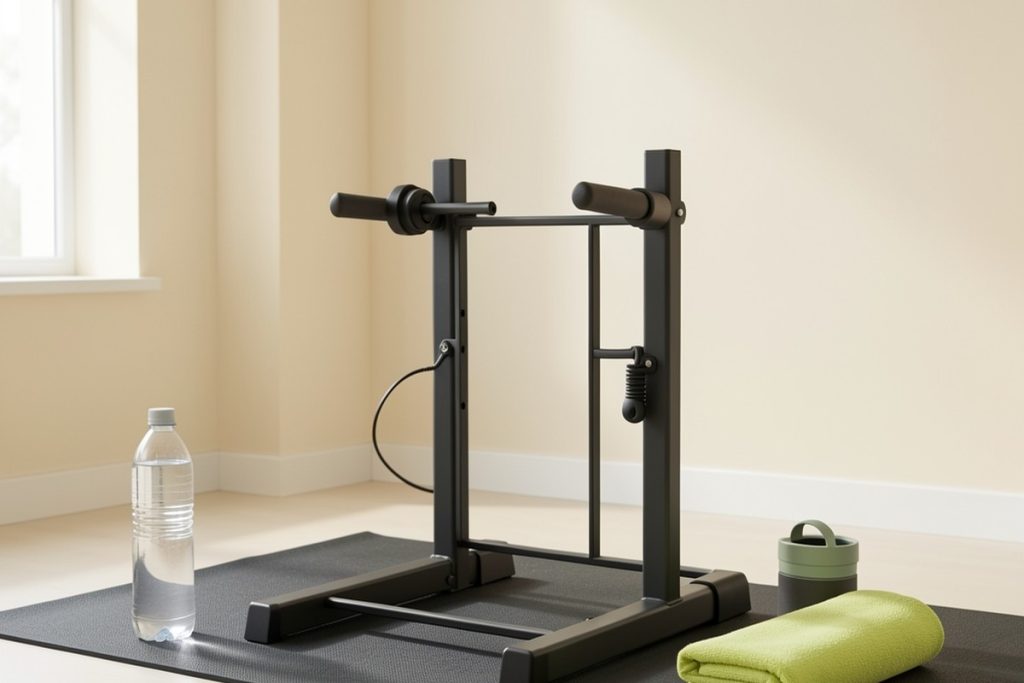
Equipment can help when the main obstacle is access. A fixed home station may remove travel time and make a regular schedule easier, but it is not required for effective strength training. Your best setup is the one you can use safely, store comfortably, and maintain over time.
The Mikolo Home Gym Workout Station lists a 152-pound weight stack and a multifunctional design, so it may suit someone who wants one dedicated resistance-training station at home. That does not make it automatically right for every returner. Before buying, check the machine’s dimensions, ceiling clearance, assembly requirements, adjustment options, and the space needed to move safely around it. If your current goal is simply to rebuild consistency, bodyweight exercises, resistance bands, or adjustable dumbbells may be a lower-commitment starting point.
A five-minute pre-session checklist
- Choose the two days you will train and protect them on your calendar.
- Clear enough space to move without bumping furniture or equipment.
- Perform several minutes of easy movement, then practice the first exercise with little or no resistance.
- Decide your stopping point before the session begins.
- Write down one recovery note afterward: energy, soreness, sleep, or pain.
Common mistakes when returning to exercise
Trying to make up for lost time: You cannot compress months of progress into one hard week. A moderate plan gives you more chances to train.
Changing everything at once: New exercises, a new diet, daily cardio, and heavy lifting make it difficult to identify what is causing fatigue. Keep the first month simple.
Using soreness as proof of quality: A productive session can leave you feeling capable of training again. Soreness is feedback, not a score.
Ignoring ordinary life stress: Training load should reflect sleep, work demands, illness, and other activities. Adjusting your session is responsible programming, not failure.
Last reviewed: 2026-10-23
Sources
- Physical Activity Guidelines for Americans, 2nd edition — U.S. Department of Health and Human Services
- Progression Models in Resistance Training for Healthy Adults — American College of Sports Medicine position stand
- Adult Activity: An Overview — Centers for Disease Control and Prevention