Quick answer
For a small kitchen, choose shears that cut common foods, lock closed, come apart for cleaning, and fit in an existing drawer. Prioritize stainless steel, comfortable handles, a visible safety mechanism, and care instructions you can follow. A built-in board can save counter space, but only if it is stable and easy to wash.
Key takeaways
- Removable blades make it easier to clean the hinge and cutting surfaces thoroughly.
- A safety lock is useful when shears share a drawer with other utensils.
- Dishwasher-safe claims should be checked against the care instructions for each component.
- A cutting-board attachment is most useful when it replaces, rather than crowds, another prep tool.
Why kitchen shears can be useful in a small kitchen
Small kitchens benefit from tools that perform several clearly defined jobs without creating more clutter. Kitchen shears can trim herbs, open food packaging, cut poultry joints, portion leafy greens, and handle small preparation tasks that might otherwise require a knife and a larger cutting board.
That does not mean every multipurpose tool is a good buy. A tool that is difficult to clean, awkward to store, or vague about its intended uses can become drawer clutter. The better question is not “How many features does it have?” but “Will I use those features often enough to justify the space?”
For apartment kitchens, RV kitchens, dorms, and compact meal-prep areas, the most useful design usually combines four things: dependable cutting surfaces, controlled storage, straightforward cleaning, and a footprint that suits the available counter space.
What to look for before buying
1. Stainless-steel cutting surfaces
Stainless steel is a practical choice for food-preparation shears because it is durable, nonporous, and generally easy to wipe clean. Look for blades that meet evenly and feel aligned when opening and closing. A blade that looks sharp but flexes noticeably may be frustrating for thicker ingredients.
Also consider whether the blades are smooth or partly serrated. Serrations can help grip slippery foods, while smooth edges may be easier to clean and sharpen. Neither option is automatically better; the right choice depends on what you plan to cut most often.
2. A hinge that can be cleaned
The hinge is often the hardest part of kitchen shears to clean because food residue can collect where the blades meet. Detachable blades can make that area more accessible, but they also introduce another assembly step. Before buying, check whether the blades separate intuitively and whether they can be reattached securely.
Do not treat a removable design as permission to leave the tool disassembled in a drawer. Dry the parts fully, keep the cutting edges protected, and confirm that the blades lock together properly before storage.
3. A safety lock that is easy to understand
A lock is especially helpful when sharp utensils are stored in a crowded drawer. It should hold the blades closed without requiring excessive force or a complicated sequence. A lock that is difficult to operate may be ignored, which defeats its purpose.
Check whether the lock engages automatically, manually, or only when the handles are fully closed. The product instructions should make this clear. If children can access the kitchen, store the shears in a secured location regardless of the locking mechanism.
4. Handles that match the actual job
Large handles can make heavier cutting more comfortable, but they may also take up more drawer space. Small handles can be easier to store yet less comfortable during repetitive preparation. If possible, think about the longest task you expect to perform rather than the occasional quick snip.
Look for rounded handle openings, a surface that is easy to clean, and enough room for a controlled grip. Avoid choosing based only on appearance. A sleek handle is not useful if it feels slippery when your hands are wet.
Compare the features that matter most
| Feature | Why it matters | What to verify |
|---|---|---|
| Detachable blades | Improves access to the hinge and cutting edges | How the blades separate and reattach |
| Safety lock | Helps keep sharp edges closed during storage | Whether it is simple and secure to use |
| Dishwasher-safe construction | May reduce cleanup effort | Which parts are covered by the claim |
| Integrated cutting surface | Can reduce the number of separate prep tools | Stability, size, and cleaning requirements |
| Stainless-steel blades | Offers a durable, food-preparation-friendly material | Blade alignment and edge design |
When a built-in cutting board makes sense
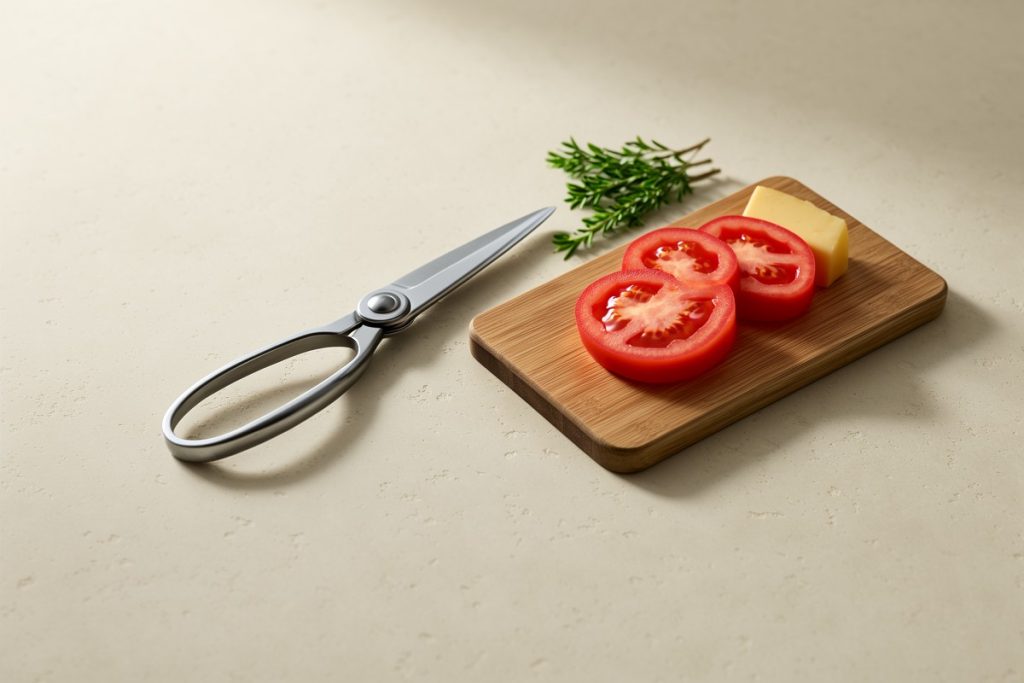
A cutting-board attachment is most useful for quick, contained jobs: trimming herbs, slicing a tomato, portioning fruit, or cutting a small amount of cheese. It can be convenient when you want to avoid setting out a full-size board for a minor task.
It is less compelling if the board is too small for your usual ingredients, slides during use, or creates a difficult-to-clean gap around the attachment. Look for a firm base and enough room to keep food away from the edges while cutting. The board should support the shears rather than make them harder to control.
The 2 in 1 Kitchen Scissors for Food with Cutting Board is one example of this format. Its listing describes a safety lock, detachable 9.5-inch blade, dishwasher-safe construction, and a cutting-board design intended for foods such as vegetables, fruit, and cheese. Those features make it worth considering for a compact prep area, but shoppers should still confirm the care instructions, dimensions, and component details before ordering.
How to use and clean kitchen shears safely
Use food-preparation shears only for tasks appropriate to their design. Avoid cutting bones, hard shells, metal, or other materials unless the manufacturer specifically says the tool is intended for them. For raw meat, clean and sanitize the shears before using them with ready-to-eat foods.
After use, remove visible food residue promptly. If the blades detach, separate them according to the instructions and wash around the hinge. Dishwasher-safe does not necessarily mean every part should go through every cycle, so check whether the claim applies to the blades, board, handles, or accessories individually.
The USDA recommends cleaning hands, surfaces, and utensils to help prevent cross-contamination during food preparation. The FDA Food Code also provides widely used food-safety guidance for equipment, utensils, and food-contact surfaces. In practical terms, that means keeping the shears clean, dry, and separated from dirty tools between tasks.
A practical small-kitchen buying checklist
- Measure the drawer or storage area before choosing oversized shears.
- Confirm what foods the manufacturer says the tool can cut.
- Check whether the blades detach and whether the lock closes securely.
- Read the cleaning instructions for every removable component.
- Assess whether the included board replaces a tool you already own.
- Choose a return-friendly seller if the fit or handling cannot be evaluated beforehand.
Bottom line
The best kitchen shears for a small kitchen are not necessarily the ones with the longest feature list. They should make everyday prep faster while remaining easy to store, wash, and use safely. Prioritize blade alignment, a cleanable hinge, a reliable lock, and a size that fits your kitchen. A built-in cutting board can be a genuine space saver when it is stable and large enough for the small jobs you actually perform.
Last reviewed: 2026-11-16