Quick answer
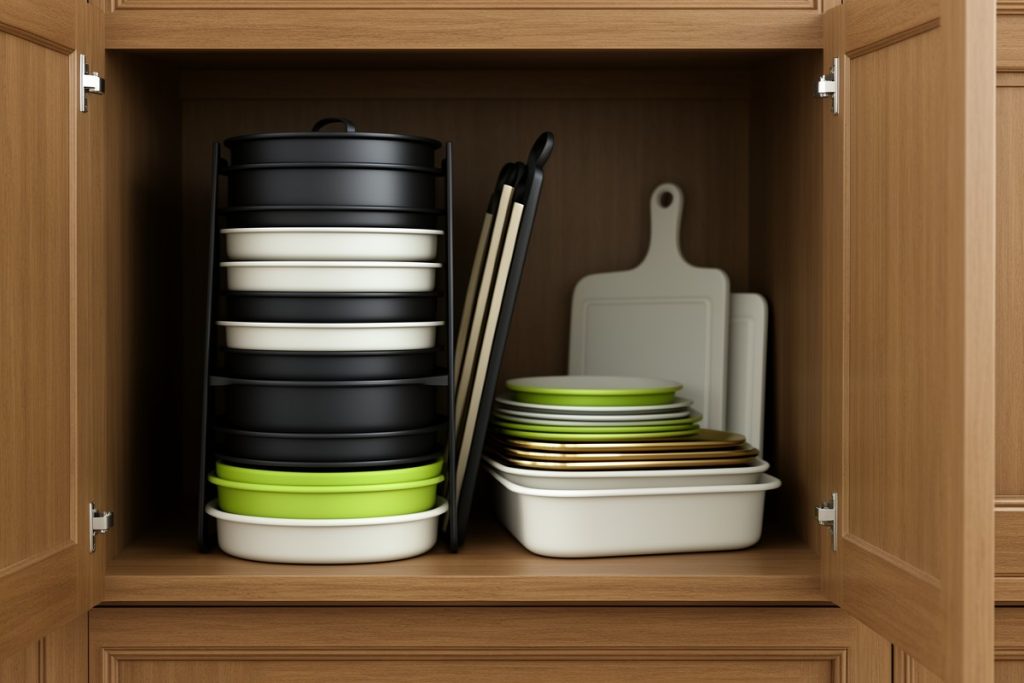
To organize seasonal cookware in a small cabinet, remove pieces you will not use this season, then group lids, cutting boards, bakeware, and serving pans by shape and frequency. Store flat items vertically where possible, keep everyday cookware easiest to reach, and leave clearance for handles. A divider organizer can create useful lanes, but measure the cabinet before buying anything.
Key takeaways
- Sort cookware by seasonal use before changing the cabinet layout.
- Use vertical storage for lids, boards, trays, and narrow bakeware.
- Keep daily-use pans in the easiest-to-reach zone.
- Measure cabinet width, depth, height, and door clearance before adding an organizer.
- Leave heat-producing appliances and flammable materials away from the cooking area.
Start with a seasonal cookware edit
A small cabinet becomes difficult to use when every item is treated as an everyday essential. Before rearranging anything, take out the cookware, serving pieces, and accessories that share the space. Wipe the shelf and inspect each item as you go.
Make three groups:
- Use this season: roasting pans, pie plates, soup pots, serving platters, or specialty tools you expect to reach for soon.
- Use occasionally: items that belong in the kitchen but do not need prime cabinet space.
- Relocate or release: duplicates, damaged pieces, and cookware that no longer suits your cooking habits.
This is not a recommendation to discard useful equipment simply because it is seasonal. The goal is to move the right items into the right zone. A large roasting pan may be worth keeping, but it does not need to sit in front of the saucepan you use every night.
Measure the cabinet before choosing a layout
Small cabinets often lose usable space because of hinges, uneven shelves, deep corners, or doors that do not open fully. Measure the interior width at the front and back, the usable depth, and the height from the shelf to the lowest obstruction. Also measure the widest cookware item you plan to store vertically.
Use the measurements to choose a storage method rather than forcing the cabinet to fit an accessory. The following layout works for many compact kitchens:
| Cookware type | Best storage position | Practical reason |
|---|---|---|
| Lids and cutting boards | Vertical lanes | They are easier to lift out individually than from a flat stack. |
| Shallow baking sheets | Vertical or edge-supported | It reduces the need to remove several trays to reach one. |
| Heavy pots and Dutch ovens | Low shelf or base cabinet | The weight is easier to manage close to the floor. |
| Frequently used pans | Front or middle zone | Daily items should not be blocked by seasonal pieces. |
Create vertical lanes for flat cookware
Lids, trays, cutting boards, and shallow bakeware are usually the biggest source of cabinet friction. When they are stacked horizontally, the item you need may be at the bottom. Vertical storage turns each piece into a separate slot, making it easier to see and remove without disturbing the rest.
A divider is most useful when the cabinet has enough depth for the items to stand securely and enough height for them to clear the shelf. One possible option is the MUDEELA Expandable Pot Pan Lid Organizers inside Cabinet, 10 Divider-Black, which is listed with adjustable dividers and an expandable width of 11.8 to 22.9 inches. It may suit a cabinet that needs flexible lanes for lids, boards, or bakeware, but it will not create more cabinet capacity. Check the measurements and the weight of your cookware before choosing it.
Place wider or heavier pieces in the most stable lanes. Keep smaller lids toward the front, where they can be lifted without catching on neighboring items. If a piece leans, rattles, or presses against the door, change the spacing rather than forcing it into place.
Separate everyday cooking from seasonal entertaining
Seasonal storage works best when it reflects how you actually use the kitchen. Keep the cookware needed for regular meals in the front half of the cabinet or on the most accessible shelf. Move holiday-specific or occasional pieces behind or below it, provided they remain safe to lift.
For example, a compact cabinet might be divided into four zones:
- Front left: everyday lids and pans.
- Front right: cutting boards and frequently used trays.
- Back left: roasting equipment and specialty bakeware.
- Back right: seasonal serving pieces that are used only a few times each year.
Do not place a heavy cast-iron piece where you must stretch, twist, or lift it over your head. A low shelf is usually more practical. Fragile glass or ceramic bakeware should have enough room to be removed without scraping against metal edges or being knocked by a neighboring item.
Make the seasonal reset easy to repeat
The best organization system is one you can reset without starting over. Keep related pieces together, but avoid creating categories so narrow that they become hard to maintain. “Roasting,” “baking,” and “daily cooking” are usually more useful than separate categories for every pan size.
Use a simple return rule: clean and dry each item, return it to the same lane, and place the next seasonal group behind the everyday cookware. If you notice that one item repeatedly ends up on the counter, that is useful information. It may need a more accessible location, or it may not deserve cabinet space at all.
Check the cabinet after the first busy cooking day. Doors should close without pressure, shelves should remain level, and no cookware should shift when another item is removed. Keep towels, paper goods, and other combustible materials away from hot surfaces and cooking areas. The National Fire Protection Association’s cooking safety guidance also recommends staying attentive while cooking and keeping the cooking area clear.
A five-minute seasonal cabinet checklist
- Remove cookware that does not belong to the current season.
- Discard or relocate damaged, duplicate, or rarely useful items.
- Measure the cabinet and check door and hinge clearance.
- Stand lids, boards, and trays vertically where they can remain stable.
- Put daily cookware in front and heavy items low.
- Open and close the cabinet once everything is loaded.
- Schedule the next reset when the season changes.
A small cabinet does not need to hold less to feel more spacious. It needs a layout that matches reach, weight, and frequency of use. By editing first and adding storage only where the measurements support it, you can make seasonal cookware easier to find without sacrificing the tools you genuinely use.
Last reviewed: 2026-11-16
Sources
- Cooking Safety — National Fire Protection Association
- Cooking Fire Safety — U.S. Fire Administration