
Quick answer
A weighted vest can make walking and simple strength exercises more challenging without requiring a large home gym. For sustainable progress, start with a light, secure load, use it only for familiar movements, and increase either time, repetitions, or weight—not all three together. A vest is an optional progression tool, not a requirement for meeting your weekly activity goals.
Key takeaways
- Begin with the lightest comfortable load and test it during walking before using it for strength exercises.
- Keep your posture, breathing, and movement quality unchanged; these matter more than the vest’s maximum capacity.
- Progress one variable at a time: duration, repetitions, or load.
- Use a vest only when it makes your routine more repeatable, not when it creates soreness that interrupts training.
Why a weighted vest can work for sustainable fitness
Home workouts often become difficult to maintain for one of two reasons: they are too easy to feel worthwhile, or they become so demanding that recovery takes too long. A weighted vest can sit between those extremes. It adds resistance to familiar activities such as walking, squats, step-ups, and incline push-ups while keeping your equipment needs relatively simple.
The goal is not to carry the heaviest load possible. The goal is to create a manageable training challenge that you can recover from and repeat next week. The Physical Activity Guidelines for Americans recommend that adults work toward 150 to 300 minutes of moderate-intensity aerobic activity each week, along with muscle-strengthening activity on at least two days. A vest may support those activities, but it does not replace regular movement or strength training.
Choose a safe starting weight
The heaviest setting on a vest is not a starting recommendation. Choose a load that lets you walk normally, breathe steadily, and complete your planned repetitions without leaning, rushing, or holding your breath. If you are new to loaded exercise, begin with the lightest available setting—or train without added weight until the movement feels controlled.
A lower load is particularly sensible for walking, stairs, and step-ups because the extra weight is carried through many repeated steps. Strength exercises may allow more flexibility, but only if your technique remains consistent from the first repetition to the last.
Use this decision rule during training:
- Your movement changes: Remove weight or stop. A shortened stride, rounded back, loss of balance, or knee collapsing inward is a signal to reduce the challenge.
- Your form stays steady but the session feels easy: Add a few minutes or repetitions during a later workout rather than immediately adding a large amount of weight.
- Your form stays steady for several sessions: Make one small progression and keep the other variables unchanged while you assess your recovery.
A simple three-day weighted-vest routine
This framework is suitable for someone who already performs the movements comfortably without added resistance. Keep at least one easier day between more demanding sessions, and remove the vest whenever it interferes with balance or technique.
- Day 1: Brisk walk. Walk for 20 to 30 minutes at a purposeful but controlled pace. Begin unweighted or with a light load, and choose a flat route for the first few sessions.
- Day 2: Basic strength circuit. Complete two controlled rounds of squats or sit-to-stands, incline push-ups against a sturdy surface, reverse lunges or split squats, and glute bridges. Perform six to 10 quality repetitions per exercise.
- Day 3: Easy conditioning. Take a relaxed walk for 15 to 25 minutes or perform gentle step-ups. Keep this session easier than Day 1 so it supports consistency rather than exhaustion.
On the remaining days, ordinary walking and daily activity still count. When the routine feels manageable, progress one variable at a time. You might add five minutes to a walk, one or two repetitions to an exercise, or a small amount of weight. Avoid changing all three in the same week.
Where the MVRK weighted vest may fit
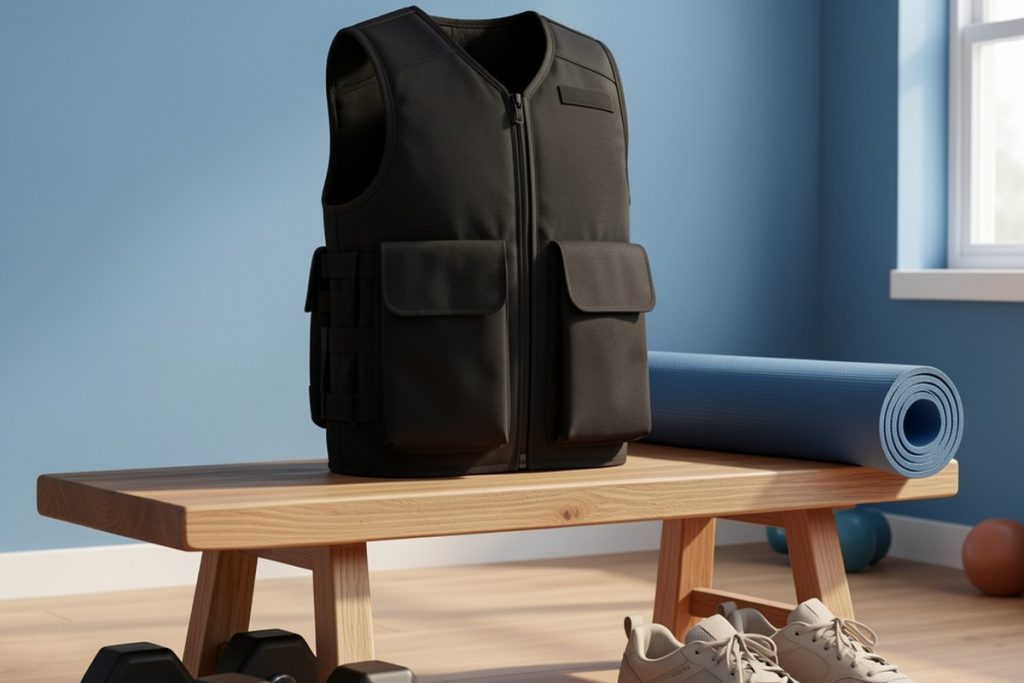
The MVRK Weighted Vest is listed with removable iron weights and load options ranging from 15 to 100 pounds. That adjustability may suit someone who wants one vest to cover different training stages, but the broad range should not be treated as a goal. For a beginner, the lowest available setting may be enough for walking and controlled bodyweight movements.
Before choosing it, check that the vest sits securely without restricting your breathing or rubbing your shoulders. A vest is not a good fit for a session if it shifts, causes you to brace constantly, or makes you alter your stride. It is also not automatically appropriate for running, jumping, or high-impact intervals. First become comfortable with those movements without extra load, then decide whether added resistance provides a clear benefit.
Weighted vest readiness checklist
- Can you perform the planned movement without a vest and with controlled range of motion?
- Does the vest remain snug and balanced while you walk?
- Have you chosen only one progression for this workout?
- Can you breathe normally and maintain a steady pace?
- Will you stop if you experience sharp pain, dizziness, numbness, or a change in gait?
This checklist is a practical training guide, not medical clearance. If you have an injury, balance concerns, osteoporosis, are pregnant or recently postpartum, or manage a condition affected by exercise, ask a qualified health professional how to modify loaded training.
Common mistakes that make progress unsustainable
Starting with the maximum load: A vest’s capacity describes what it can hold, not what your body should carry. Begin conservatively and earn the next step through consistent sessions.
Adding weight and distance together: When both change at once, it becomes harder to identify what caused excessive fatigue or soreness. Change one variable, then observe how you recover.
Wearing it for every activity: More resistance is not automatically better. Use the vest for a defined portion of a workout and remove it for warm-ups, skill practice, or recovery work when appropriate.
Using soreness as the success measure: A sustainable workout should leave you able to move normally and return to training. Track completed sessions, improved control, and consistent activity—not just how tired you feel.
Make the vest optional, not the whole plan
The strongest home-fitness routine is one you can complete during busy weeks. Keep bodyweight squats, walks, mobility work, and simple strength exercises available for days when a vest is inconvenient. Added load should be a gradual tool for progression, not proof that every workout must become harder.
Start light, repeat the basics, and give your body time to adapt. If a weighted vest makes familiar training more challenging without disrupting your recovery, it can have a useful place in your routine. If it changes your movement or makes consistency harder, set it aside and keep training another way.
Last reviewed: 2026-08-24
Sources
- Physical Activity Guidelines for Americans, 2nd edition — U.S. Department of Health and Human Services.
- Adult Activity: An Overview — Centers for Disease Control and Prevention.