
Quick answer
Start indoor cycling at home with three 20-minute rides per week, using an effort that lets you speak in short sentences. Spend five minutes warming up, pedal steadily, then cool down for five minutes. Add time before resistance, keep at least one recovery day between harder sessions, and adjust the bike carefully so your knees, hips, and back stay comfortable.
Key takeaways
- Ride three times weekly before adding harder intervals.
- Use the talk test to control beginner intensity.
- Adjust saddle height and handlebar position before your first full workout.
- Change only one training variable at a time.
- Choose equipment based on comfort, space, safety, and features you will actually use.
By Jax Morrison, High-Energy Motivator
Why indoor cycling is a practical home workout
The best home workout is not the one that looks hardest. It is the one you can repeat without dreading the next session. Indoor cycling removes several common obstacles, including bad weather, traffic, gym travel, and limited daylight. You can start quickly, control the resistance, and finish a useful cardio session in a predictable amount of time.
The Centers for Disease Control and Prevention recommends that adults work toward at least 150 minutes of moderate-intensity aerobic activity each week, along with muscle-strengthening activity on two days. That is a useful direction, not a demand to hit immediately. If you are starting from zero, three 20-minute rides give you 60 minutes while you build the habit.
Use the talk test instead of obsessing over a number on a console. At moderate intensity, you should be able to talk but not sing comfortably. If you can only say a few words, reduce the resistance or slow your cadence. If you can hold a full conversation with no noticeable change in breathing, increase the challenge slightly only if your form remains controlled.
A simple four-week beginner indoor-cycling plan
This plan is designed for a healthy beginner who can exercise without medical restriction. Keep the early sessions manageable. Soreness is not proof that a workout worked, and exhaustion is not a requirement for progress.
Week 1: Build the routine
Complete three 20-minute rides. Pedal easily for five minutes, ride at a comfortable conversational effort for 10 minutes, then cool down for five minutes. Focus on smooth pedaling, relaxed shoulders, and learning how the bike feels.
Week 2: Add a little variety
Ride three times for 25 minutes. After warming up, complete three one-minute periods of slightly quicker pedaling. Follow each with two easy minutes. The rest of the middle section should remain steady and controlled.
Week 3: Introduce structured effort
Complete three rides lasting 25 to 30 minutes. Make one ride easy and steady, one ride include four two-minute moderate efforts with two easy minutes between them, and one ride relaxed. Do not make every session an interval workout.
Week 4: Extend consistency
Ride three or four times for 30 minutes. Keep two rides easy. On one ride, repeat five two-minute moderate efforts with two minutes of easy pedaling between them. Add a fourth ride only if your energy, sleep, and recovery remain good.
If a week feels too demanding, repeat it. Progress can mean adding five minutes, finishing with better control, or recovering more comfortably. It does not have to mean turning the resistance knob higher every time.
Set up your bike for a more comfortable ride
A poor setup can make a short workout feel unnecessarily difficult. With one pedal at its lowest point, your knee should remain slightly bent rather than locked. Your hips should stay level as you pedal. If they rock from side to side, the saddle may be too high. Keep your shoulders relaxed, elbows soft, and hands light on the handlebars.
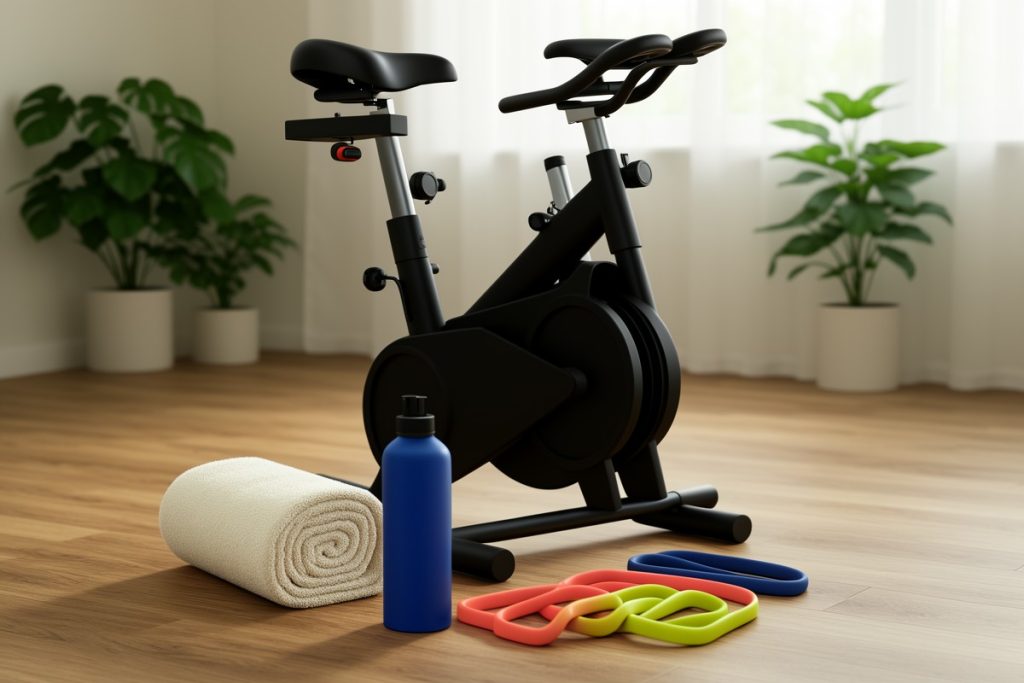
Place the bike on a stable, level surface with enough room to mount and dismount safely. Check that the pedals, seat, and adjustment points are secure before each ride. Supportive footwear, a fan, water, and a towel can improve comfort. Keep the bike accessible, but do not place it where it blocks a doorway or creates a trip hazard.
Begin every session with about five minutes of easy pedaling. Finish with several minutes of gradually slower movement. You do not need an aggressive stretching routine after every ride; gentle movement and normal hydration are generally more practical than forcing a deep stretch while tired.
How to improve without burning out
Change one variable at a time: duration, frequency, resistance, or intensity. For example, add five minutes to one weekly ride while leaving the other two unchanged. The following week, you could add a short moderate interval instead of increasing both time and resistance.
Track three simple signals: total minutes, perceived effort from 1 to 10, and how you feel the next day. Most beginner rides should feel manageable, often around 4 to 6 out of 10. Persistent joint pain, sharp pain, dizziness, chest pressure, or unusual shortness of breath is a reason to stop and seek appropriate medical guidance.
Strength training still matters. Cycling trains the muscles used in pedaling, but a balanced routine should also include movements such as pushing, pulling, squatting, hinging, and carrying. Two brief full-body strength sessions each week can complement your rides and support the broader activity recommendations for adults.
When a home exercise bike is worth considering
A stationary bike is a strong fit if you want low-impact cardio, prefer exercising indoors, or need a workout that fits a predictable schedule. It may be a poor fit if you dislike repetitive motion, rely on outdoor variety for motivation, or lack a stable place to store and use the equipment.
The MERACH Exercise Bike, Magnetic Friction Stationary Bike for Home is worth comparing if you want a setup listed with magnetic friction, a tablet mount, an app, fitness courses, and a stated 300-pound weight capacity. Those are listed product details, so check the current product page for dimensions, adjustment range, warranty, return terms, and compatibility before buying. A simpler bike may be the better choice if you only need basic pedaling.
Measure your available floor space and ceiling clearance first. Consider whether app-based courses will genuinely help you ride consistently or simply add a feature you will not use. Comfort, easy adjustment, and convenient access may matter more than having the longest feature list.
Pre-ride checklist
- Place the bike on a level, unobstructed surface.
- Set the saddle so your knee has a slight bend at the bottom of the pedal stroke.
- Secure the pedals, seat, and handlebars.
- Keep water, a towel, and a fan within reach without creating a hazard.
- Choose one goal for the session: easy riding, steady riding, or short intervals.
Make consistency the main goal
Indoor cycling works best when it becomes ordinary: a scheduled ride, a comfortable setup, and gradual progress. Begin below your maximum, protect recovery days, and let repetition build your fitness. Once three weekly rides feel normal, you can decide whether to add longer steady sessions, structured intervals, strength training, or outdoor activity.
That is the real advantage of a home cycling plan. You do not need to win every workout. You need a routine you can start again next week.
Last reviewed: 2026-09-21