
Quick answer
A vibration plate can be a convenient tool for a short mobility and movement break, especially after prolonged sitting or standing. Use it as an optional platform for gentle calf raises, supported squats, and balance practice—not as a replacement for walking, strength training, or medical care. Begin with low intensity, hold a stable support, and stop if you feel pain, dizziness, or unusual discomfort.
Key takeaways
- Use a vibration plate to make short movement breaks easier to start, not to chase dramatic calorie or lymphatic-drainage claims.
- Keep your knees softly bent and begin with five to ten minutes at a comfortable setting.
- Hold a countertop or sturdy rail for balance; do not stand rigidly with locked knees.
- Pair the device with regular walking, resistance training, and everyday movement.
By Coach Amy Lin, Sustainable Fitness Coach
Last reviewed: 2026-10-09
What a vibration plate is actually useful for
Vibration plates are often marketed for calorie burning, lymphatic drainage, balance, recovery, and faster fitness results. Those promises can make a simple piece of equipment sound like a complete training plan. It is not. The more realistic use is as a compact prompt for brief, low-complexity movement at home.
That matters if your problem is not a lack of exercise ideas, but difficulty getting started. A platform beside your desk can remind you to move after a long meeting. A short standing sequence may feel more engaging than simply stretching on the floor. The device can also give you a consistent place to practice controlled balance and lower-body movements.
However, vibration does not automatically make an exercise effective, and a calorie display should not be treated as a precise measurement. The strongest foundation remains regular aerobic activity, muscle strengthening, and less uninterrupted sitting. Current physical activity guidance emphasizes those categories rather than any particular machine.
A practical 10-minute mobility routine
Use this sequence when you want to loosen up after desk work, travel, or a long period on your feet. Keep the setting low enough that you can breathe normally and maintain control. Wear supportive shoes if barefoot balance feels uncertain.
| Time | Movement | How to perform it |
|---|---|---|
| 2 minutes | Supported standing | Stand with feet comfortably apart, knees relaxed, and one hand lightly touching a stable support. Breathe slowly and notice whether you are gripping your toes or shoulders. |
| 2 minutes | Calf raises | Rise onto the balls of your feet, pause briefly, and lower with control. Use the support for balance rather than pulling yourself upward. |
| 2 minutes | Small supported squats | Send your hips slightly back, bend your knees only as far as comfortable, then stand tall. Keep your weight evenly distributed through both feet. |
| 2 minutes | Weight shifts | Move gently from left to right without twisting your torso or allowing your knees to collapse inward. |
| 2 minutes | Step off and walk | Finish with a slow walk around the room. This transition helps turn a stationary break into ordinary daily movement. |
This is not a test of endurance. You should finish feeling more alert and mobile, not exhausted. If the vibration makes it difficult to speak comfortably, control your knees, or maintain your footing, reduce the intensity or step off the platform.
How to use the equipment without overcomplicating it
Place the plate on a level, hard surface with clear space around it. Before starting, decide where your balance support will be. A sturdy countertop or fixed rail is preferable to a lightweight chair that could slide. Step on and off slowly, and avoid turning quickly while the machine is operating.
Keep a slight bend in your knees. Locked joints can make the movement feel harsh and reduce your ability to absorb motion. Your posture should be tall but relaxed: ribs stacked over your pelvis, shoulders down, and gaze forward. There is no advantage to forcing a deep squat or adding resistance before you can control the basic position.
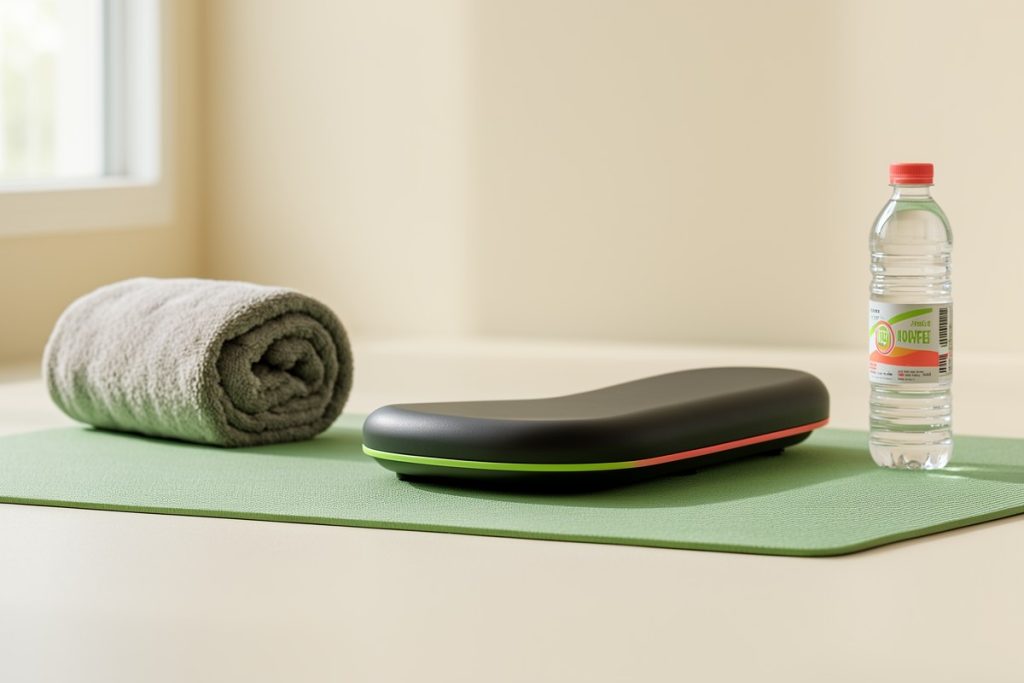
If you want to try a home model, the Merach CV30 Curved Vibration Plate Exercise Machine may be considered as an optional setup for this type of brief routine. Its included resistance band and display may make the equipment more versatile, but those features do not guarantee better fitness results. Check the instructions, dimensions, weight limits, and return terms before buying, and choose based on safe setup rather than advertised outcomes.
What it cannot replace
A vibration plate is not a substitute for progressive strength training. To build strength, muscles generally need a manageable challenge that increases over time, such as resistance bands, weights, or harder bodyweight variations. It is also not a substitute for brisk walking, cycling, swimming, or another activity that raises your heart rate for a sustained period.
Think of the plate as a bridge between inactivity and movement. On a busy day, five minutes of controlled movement is a useful interruption to sitting. On a consistent training day, it can serve as a warm-up or a short balance practice. The best result is not doing more on the machine; it is making movement easier to repeat throughout the week.
Who should use extra caution
Ask a qualified healthcare professional before using a vibration plate if you are pregnant, recovering from surgery or an acute injury, have significant balance problems, experience unexplained dizziness, or have a medical condition or implanted device that could be affected by vibration. Follow the product manual and your clinician’s advice rather than relying on general fitness guidance.
Stop immediately if you develop sharp pain, chest discomfort, faintness, severe headache, numbness, or unusual shortness of breath. Mild effort is acceptable; symptoms are not something to push through. If standing on the plate is uncomfortable, you can get the same habit-building benefit from a short walk, seated mobility sequence, or gentle bodyweight routine.
How to make the habit sustainable
Attach the routine to an existing cue: after shutting down your computer, before your shower, or when you return from work. Keep the session short enough that you can complete it on an ordinary day. Track consistency by noting whether you moved, not by chasing the highest setting or a number on the display.
A sustainable weekly plan might include several brief mobility breaks, regular walks, and two sessions of full-body strengthening. That combination supports general fitness more reliably than depending on one device. Use the vibration plate when it helps you take the next sensible step, and skip it when another form of movement is more comfortable or practical.
Sources
- Physical Activity Guidelines for Americans, 2nd Edition — U.S. Department of Health and Human Services.
- WHO Guidelines on Physical Activity and Sedentary Behaviour — World Health Organization.
- Exercise and Physical Activity — National Institute on Aging.