Quick answer
Yes—you can build an effective full-body workout at home with a suspension trainer, provided the anchor is secure and you control the movement. Start with squat, row, chest press, hip hinge, plank, and split-squat patterns for two or three nonconsecutive sessions weekly. Use slow repetitions, stop with good form, and make exercises harder by changing your body angle rather than chasing speed.
Key takeaways
- Inspect the anchor, straps, handles, and floor space before every session.
- Begin with two rounds of six fundamental movements, using controlled repetitions.
- Change body angle or range of motion gradually instead of rushing to advanced variations.
- Leave at least one recovery day between challenging full-body sessions.
By Jax Morrison, High-Energy Motivator
Why suspension training works well at home
A suspension trainer is useful when you want strength work without filling a room with equipment. The straps create resistance through your own body weight, while the anchor gives you a stable point for pulling, pressing, squatting, and bracing movements.
The important word is control. Unlike a fixed machine, the straps can move in several directions. That freedom makes the exercises adaptable, but it also means you need to manage your body position. A more upright angle usually makes an exercise easier. Leaning farther away from the anchor generally increases the challenge.
This makes the system practical for different starting points. A beginner can shorten the range of motion and use a shallow angle. Someone with more experience can extend the range, slow the lowering phase, or add a pause. The goal is not to make every exercise spectacular. The goal is to perform repeatable work with a position you can control.
A simple 30-minute full-body workout
Complete the following circuit for two rounds to start. If your form remains consistent and you finish without rushing, build toward three rounds. Rest about 30 to 60 seconds between exercises, and take a longer break between rounds when needed.
| Exercise | Starting dose | What to focus on |
|---|---|---|
| Assisted squat | 8–12 reps | Keep your knees tracking in line with your feet as you sit down and stand tall. |
| Suspension row | 6–12 reps | Keep your ribs down and pull your elbows toward your sides. |
| Chest press | 6–10 reps | Maintain a straight line from shoulders to ankles and avoid dropping your hips. |
| Hip hinge | 8–12 reps | Move from the hips while keeping your back long and your weight balanced. |
| Plank hold | 15–30 seconds | Squeeze your glutes and keep your shoulders away from your ears. |
| Assisted split squat | 6–10 per side | Use the straps for balance, not to pull yourself upward. |
Move slowly enough that each repetition looks similar to the last. If you cannot maintain the listed position, make the exercise easier before adding repetitions. Quality gives you a better training signal than simply completing a longer circuit.
How to perform the key movements
Suspension row: Stand facing the anchor, hold the handles, and lean back with your body in one straight line. Pull your chest toward your hands, then lower yourself under control. Keep your neck relaxed and avoid thrusting your chin forward.
Chest press: Face away from the anchor and hold the handles near your chest. Lean forward slightly, bend your elbows, and lower your body as one unit. Press the handles away without locking your elbows aggressively. A shorter lean and smaller range of motion are sensible starting points.
Hip hinge: Hold the straps lightly while standing tall. Push your hips behind you, keeping a soft bend in your knees, then drive through your feet to return to standing. This is a useful way to practice moving from the hips without turning the exercise into a squat.
Plank: Place your feet in the foot cradles only when you can already brace comfortably on the floor. Start with a short hold. Keep your lower back from sagging, and end the set when you can no longer maintain a steady trunk position.
How to adjust difficulty without guesswork
Use these progression rules one at a time:
- Change your angle: Stand more upright for easier rows and presses; lean farther for more resistance.
- Slow the lowering phase: Take three seconds to return to the starting position.
- Add a pause: Hold the hardest position briefly without losing alignment.
- Increase repetitions: Add one or two repetitions only when every repetition is controlled.
- Increase range: Move through a slightly deeper, comfortable range before attempting a more advanced variation.
Do not change all five variables at once. If you lean farther, slow the tempo, and add repetitions in the same workout, it becomes difficult to tell what your body can actually handle. A small, trackable progression is easier to repeat and easier to recover from.
Choosing and setting up a home suspension trainer
The equipment matters less than the anchor and the space around it. Before training, confirm that the attachment point is designed to handle the load and that the straps are not rubbing against a sharp edge. Check every connection, look for visible damage, and make sure the floor is dry and free of furniture that could catch your feet.
For readers who want one ready-made option, the TRX All-In-One Home Gym System – Complete Suspension Training Kit for Strength Training, HIIT & Full-Body Workouts at Home or Outdoors, Includes Indoor & Outdoor Anchors is listed with indoor and outdoor anchors. That may suit someone who wants flexibility in where to train. It is not automatically the right choice for every home, though. Check whether the intended anchor locations are compatible, whether you have enough clearance, and whether you prefer a compact strap system over free weights or resistance bands.
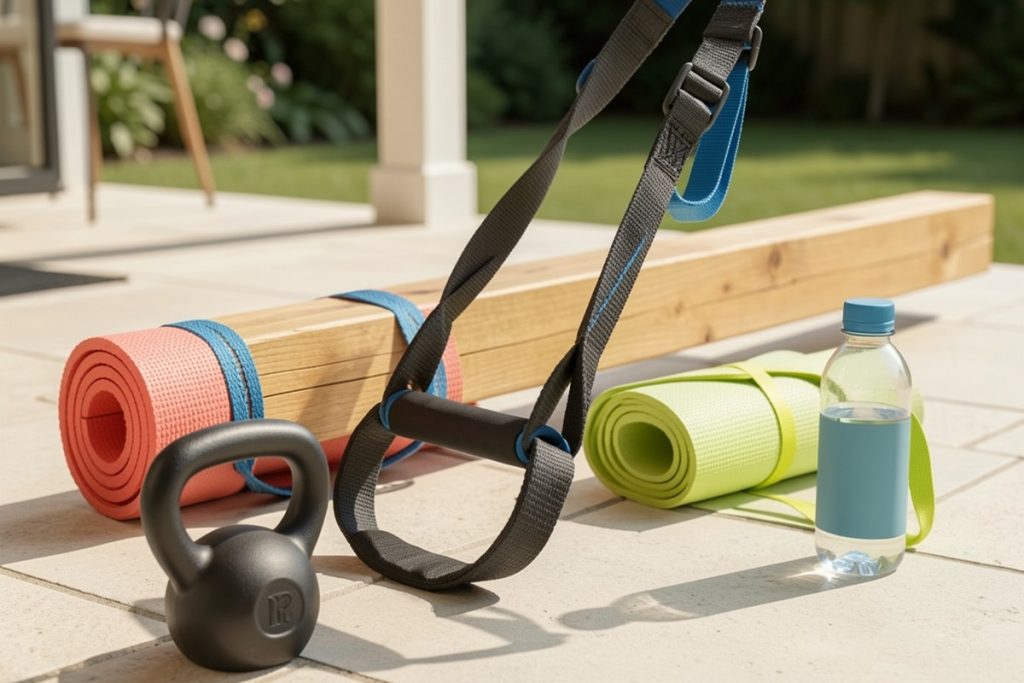
Outdoor use also requires judgment. Avoid wet surfaces, unstable branches, damaged fixtures, and locations where another person could walk into the straps. A sunny patio is convenient only when the attachment point and floor are genuinely secure.
A realistic weekly plan
Start with two full-body sessions on nonconsecutive days, such as Monday and Thursday. If you recover well and your technique stays consistent, add a third session on Saturday. On other days, use easy walking, mobility work, or complete rest rather than turning every day into a hard workout.
Write down the exercise, number of repetitions, and the adjustment you used. For example, record “rows, 8 reps, upright angle.” When you can complete all rounds with stable form and still feel you could perform another controlled repetition or two, make one small progression in the next session.
General activity targets are useful context, but they do not require every workout to be intense. Strength sessions can complement regular moderate physical activity, and your ideal schedule should account for sleep, work demands, previous injuries, and current fitness. If you are returning after a long break or managing a medical condition, ask a qualified professional how to begin.
Safety checks before every session
- Test the anchor with light pressure before committing your full body weight.
- Keep the straps clear of doors, sharp corners, and moving equipment.
- Wear footwear that gives you dependable traction.
- Stop for sharp pain, dizziness, unusual shortness of breath, or loss of control.
- Choose an easier angle when your shoulders, back, knees, or wrists cannot stay aligned.
A strong home workout is not the one that leaves you wrecked. It is the one you can perform safely, repeat consistently, and progress without guessing. Start with the six basic patterns, keep the setup simple, and let better control—not ego—drive the next step.
Last reviewed: 2026-11-13
Sources
- Adult Activity: An Overview — Centers for Disease Control and Prevention
- Progression Models in Resistance Training for Healthy Adults — American College of Sports Medicine position stand
- WHO Guidelines on Physical Activity and Sedentary Behaviour — World Health Organization