Quick answer
Build forearm strength at home with two or three short sessions per week using controlled wrist curls, reverse curls, gripping holds, and gradual resistance increases. Start with a load you can move smoothly, stop before sharp pain, and allow recovery between sessions. A compact adjustable forearm trainer can add resistance, but it should support—not replace—a balanced strength routine.
Key takeaways
- Train your grip and forearms two or three times weekly, leaving at least a day between harder sessions.
- Use slow, controlled repetitions rather than swinging or forcing a heavy resistance.
- Train both wrist flexion and extension, plus sustained gripping, for more balanced development.
- Increase resistance only when your technique remains steady through the final repetitions.
Why forearm strength matters at home
Forearm strength supports more than obvious grip exercises. Your hands and wrists help you carry groceries, open stubborn lids, hold dumbbells, use resistance bands, and maintain control during rows, deadlifts, and other pulling movements. When your grip gives out before the larger muscles you are trying to train, a workout can become limited by endurance rather than the target exercise.
You do not need a commercial gym to work on this area. Forearm training responds well to simple, repeatable challenges: squeezing, holding, curling, extending, and resisting movement. The most useful plan is one you can perform consistently with equipment that is easy to store and simple to adjust.
Forearm work should complement full-body training, not become your entire program. U.S. physical activity guidance recommends muscle-strengthening activity for all major muscle groups, so include movements for your legs, hips, back, abdomen, chest, shoulders, and arms as well.
A simple three-part forearm workout
Begin with five minutes of easy movement, such as brisk walking, shoulder circles, and gentle wrist rotations. Then complete the following sequence two or three times per week. Keep the effort challenging but controlled, and rest about 60 to 90 seconds between sets.
- Wrist flexion: Sit with your forearm supported on your thigh or a bench, palm facing upward. Move the wrist through a comfortable range while keeping the forearm still. Complete 2 sets of 10 to 15 repetitions per side.
- Wrist extension: Use the same supported position with the palm facing downward. Lift the back of the hand slowly, then lower it without dropping the weight. Complete 2 sets of 10 to 15 repetitions per side.
- Grip hold: Hold a suitable object, such as a dumbbell, kettlebell, or loaded bag, with your arm relaxed at your side. Stand tall and maintain an even grip for 20 to 40 seconds. Complete 2 or 3 holds per side.
Choose a resistance that allows you to finish the prescribed repetitions with a neutral wrist and no jerking. If the final few repetitions feel exactly the same as the first, the challenge may be too light. If your shoulder rises, your wrist bends sharply, or you need momentum, reduce the resistance.
How to progress without overdoing it
Progress does not have to mean adding weight every workout. First, make your movement consistent. Then increase one variable at a time: add two repetitions, extend a hold by five seconds, add a set, or select the next resistance level. Keep a brief record of the exercise, resistance, repetitions, and how your wrist felt afterward.
A useful rule is to finish with one or two technically sound repetitions still available. This leaves room to build gradually and makes it easier to distinguish productive effort from irritation. Forearm muscles can feel tired quickly, but fatigue is not a reason to continue through sharp, burning, tingling, or radiating pain.
Give your hands and forearms recovery time. If gripping affects your work, sleep, or ability to perform the next session, reduce volume or take additional rest. Strength gains come from the combination of training and recovery, not from repeatedly exhausting the same small joints and tissues.
Choosing the right home equipment
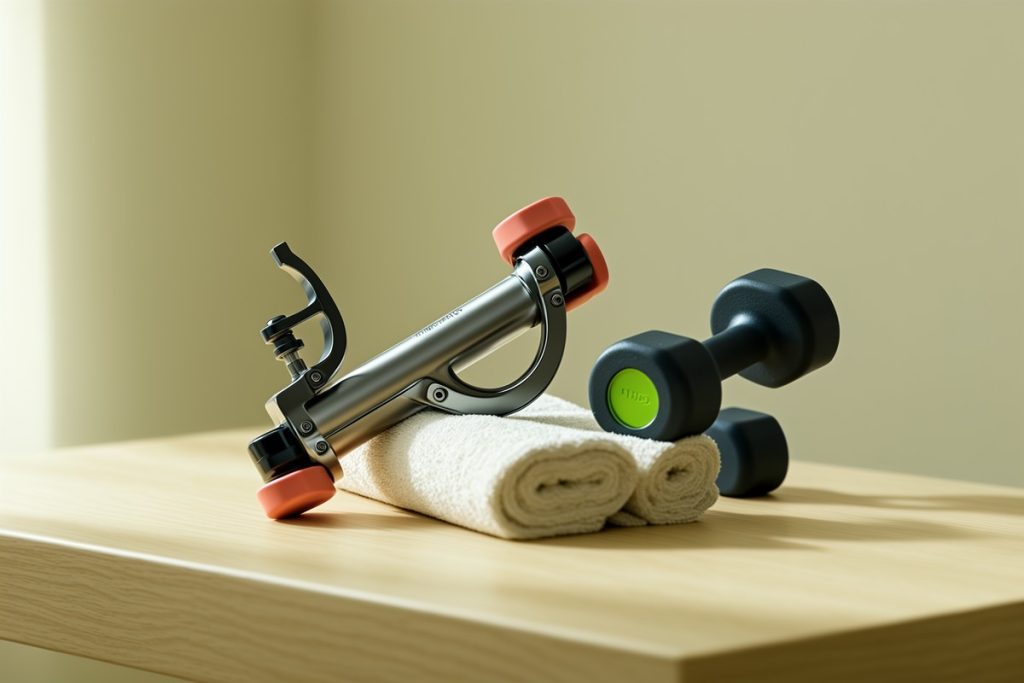
You can begin with no specialized equipment, but a small tool may make progression more convenient. The Merach Twister Arm Trainer is listed as an adjustable hydraulic forearm and arm-strengthening device. It may suit someone who wants a compact, guided resistance option at home. Treat its listed resistance range as a starting point for selection rather than a promise of results, and use only a setting you can control through the full movement.
An adjustable trainer is not automatically better than a dumbbell, resistance band, or household load. Look for a comfortable grip, stable positioning, smooth movement, and a resistance level that lets you use good form. If the device causes wrist discomfort, slips, or encourages you to twist your body to complete a repetition, it is not the right choice for that exercise or setting.
| Option | Best use | What to watch |
|---|---|---|
| Household object | Starting grip holds | Choose a secure, non-breakable object with a manageable weight. |
| Dumbbell or kettlebell | Wrist curls and carries | Keep the wrist aligned and avoid swinging. |
| Resistance band | Light wrist extension work | Check the band for damage and keep tension controlled. |
| Adjustable forearm trainer | Compact, repeatable resistance | Begin conservatively and stop if the mechanism or grip feels unstable. |
Form and safety checklist
- Warm up your wrists, elbows, and shoulders with gentle movement.
- Keep the working forearm supported when performing wrist curls.
- Move slowly in both directions; the lowering phase still counts.
- Train both sides, even if one hand feels stronger.
- Stop for sharp pain, numbness, tingling, unusual swelling, or pain that changes your normal movement.
- Seek advice from a qualified health professional after an injury or if symptoms persist.
People returning after a hand, wrist, elbow, or shoulder injury should get individualized guidance before adding loaded forearm work. A coach can help adjust the range of motion and resistance, but a clinician should assess persistent or concerning symptoms.
How this fits into a weekly routine
For a beginner, add the workout after two nonconsecutive full-body sessions, or place it at the end of two short home workouts. Avoid doing demanding grip work immediately before exercises where you need a strong hold, such as rows, carries, or deadlifts. You can instead use light wrist mobility or easy grip practice as a warm-up, provided it does not create fatigue.
After four weeks, review your notes. Are you using more resistance with the same control? Can you hold the same load longer without wrist collapse? Do everyday tasks feel easier? Those practical markers are more useful than chasing a specific number. If progress has stalled, first check sleep, recovery, exercise consistency, and technique before adding more volume.
Last reviewed: 2026-11-16
Sources
- Physical Activity Guidelines for Americans, 2nd edition — U.S. Department of Health and Human Services.
- Adult Activity: An Overview — Centers for Disease Control and Prevention.