
Quick answer
To build a full-body resistance-band workout at home, train two or three nonconsecutive days weekly and cover a squat, hinge, push, pull, lunge, and core movement. Start with a band that lets you complete 8–15 controlled reps while keeping two or three good reps in reserve. Progress by adding reps, slowing the lowering phase, increasing tension, or moving to a stronger band without sacrificing form.
Key takeaways
- A useful home routine needs movement variety, not a large equipment collection.
- Resistance-band load changes as the band stretches, so the same label will not feel identical to a dumbbell.
- Use two or three weekly sessions, with at least one rest day between demanding workouts for the same muscles.
- Progress gradually and inspect bands, handles, and anchors before every session.
By Coach Amy Lin, Sustainable Fitness Coach
Why resistance bands work well at home
Resistance bands solve a practical problem: they provide adjustable resistance without requiring a rack of heavy weights. They are quiet, easy to store, and useful for people who have limited space or want to train while traveling. A complete workout can fit beside a desk, in a spare room, or on a patio.
They also create a different resistance curve from free weights. A band usually becomes harder to pull as it lengthens, so the most challenging part of an exercise may occur near the end of the movement. That can make a band squat, row, or press feel easier at the start and harder at lockout. Band labels are helpful for choosing equipment, but they are not a perfect one-to-one comparison with dumbbell weight.
The goal is not to make every exercise exhausting. The goal is to challenge the target muscles with controlled movement, repeatable technique, and enough recovery to improve over time.
Choose a practical band setup
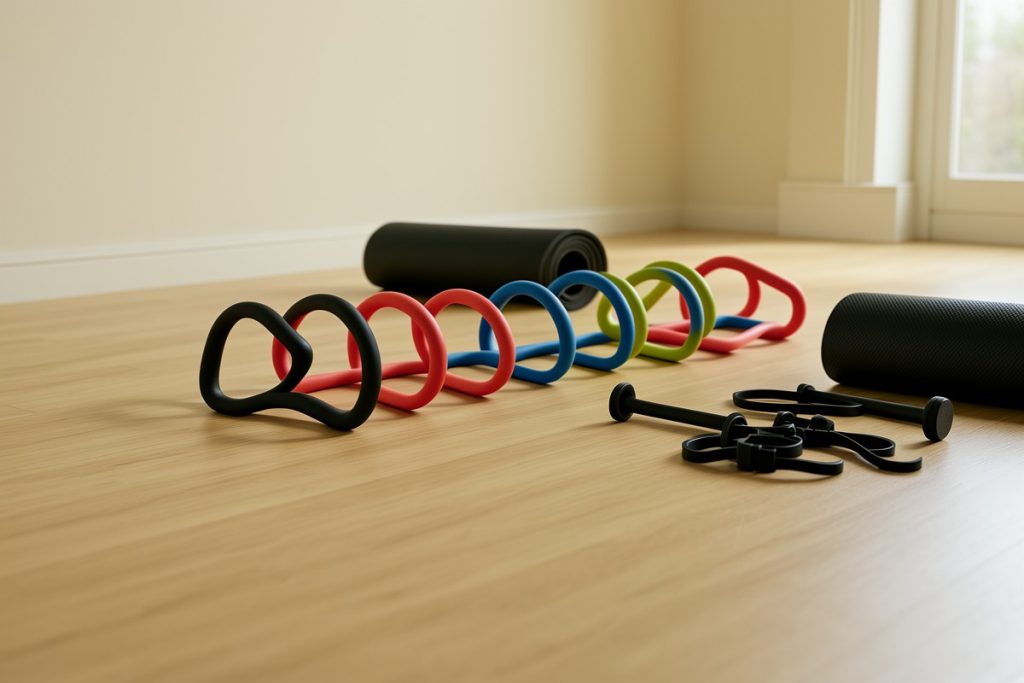
If you want a ready-made option, the WHATAFIT Resistance Bands with Handles, 5-Level Exercise Bands for Workout listing describes natural-latex bands labeled from 10 to 50 pounds, stackable to 150 pounds, with handles, ankle straps, a door anchor, and a guide. That combination can cover several home exercises without buying separate bars or dumbbells.
Those figures should be treated as product labeling rather than a direct substitute for a particular dumbbell. Actual difficulty depends on how far the band is stretched, your position, and whether bands are combined. Before using a door anchor, follow the manufacturer’s instructions and check that the door, anchor, and attachment point are secure. A kit is useful only if it fits your space and you can store it safely.
| Training need | Simple setup | Form check |
|---|---|---|
| Lower body | Stand on the band and hold the handles | Keep your feet stable and knees tracking in line with your toes |
| Upper-body pull | Use a secure anchor for rows or pulldowns | Move your shoulder blades deliberately instead of shrugging |
| Upper-body push | Use a chest-height anchor for presses | Keep ribs stacked over your pelvis and avoid leaning into the band |
| Core stability | Use a side-facing anchor for a Pallof press | Resist rotation rather than twisting toward the anchor |
A simple full-body resistance-band workout
Begin with five minutes of easy movement: march in place, circle your shoulders, perform unweighted squats, and practice a few slow hip hinges. The warm-up should prepare the joints and rehearse the patterns you will use, not leave you tired.
Then complete two rounds of the following routine. Rest for about 45–90 seconds between exercises, or longer if your breathing and technique have not settled. Start with 8–12 repetitions unless otherwise noted.
- Band squat: Stand on the middle of the band, hold the handles near your shoulders, and sit down under control. Drive through the floor to stand tall.
- Romanian deadlift: Stand on the band with feet about hip-width apart. Push your hips back while keeping your spine neutral, then squeeze your glutes to return upright.
- Standing chest press: Secure the band behind you at chest height. Step forward enough to create light tension and press the handles away without flaring your ribs.
- Standing row: Face the anchor, hold the handles, and pull toward your lower ribs. Pause briefly before allowing your arms to straighten.
- Split squat: Take a staggered stance and lower your back knee toward the floor. Hold the handles or use a lighter setup until your balance is reliable. Perform 6–10 repetitions per side.
- Pallof press: Stand sideways to the anchor, hold the band at your chest, and press your hands forward. Hold for one or two seconds, then bring them back without rotating.
Move slowly enough to control both directions. If a band snaps your hands back, pulls you off balance, or changes your posture, reduce the tension or shorten the range of motion. A smoother, lighter set is more useful than a heavier set performed with compensation.
How to progress without adding heavy weights
Use one change at a time. First, build consistency with two rounds and a manageable band. When you can complete the top of your chosen rep range with steady technique, use one of these progressions:
- Add one or two repetitions per set.
- Add a third round.
- Slow the lowering phase to about three seconds.
- Pause briefly at the hardest position.
- Increase the band tension or combine bands if the setup remains secure.
- Choose a more demanding variation, such as a split squat instead of a regular squat.
Keep roughly two or three technically sound repetitions in reserve during most sets. This gives you a clear challenge without requiring every workout to become a maximum-effort test. Record the exercise, band setup, repetitions, and how difficult the final repetitions felt. That simple log makes gradual progress easier to see.
How often should you do this workout?
For general fitness, two or three sessions per week is a practical starting point. Leave at least one day between hard full-body sessions, especially if you are new to resistance training or notice lingering soreness. On other days, walk, cycle gently, stretch, or perform easy mobility work.
Adults should also aim for regular aerobic activity and muscle-strengthening activity each week. The exact amount depends on your health, schedule, and starting point, so a short session that you can repeat consistently is a better foundation than an ambitious plan you abandon after two weeks.
Safety checks before every session
- Inspect the band for cuts, cracks, thinning, or unusual stickiness. Replace damaged equipment.
- Check that handles, clips, ankle straps, and the door anchor are fully connected.
- Keep the band away from sharp edges, heat, and rough surfaces that can damage latex.
- Stay clear of the band’s line of pull, and do not aim an anchored band toward your face.
- Stop for sharp pain, numbness, dizziness, or loss of control. Ordinary muscular effort is different from joint pain.
- If you have an injury, are pregnant, or have a medical condition that affects exercise, ask a qualified health professional how to modify the routine.
A resistance-band workout does not need to look complicated to be effective. Six well-chosen movements, sensible tension, and a repeatable schedule can train your major movement patterns at home. Start with the lightest setup that lets you learn the positions, then progress only when your technique stays dependable.
Last reviewed: 2026-09-14