
Quick answer
To make walking workouts harder without adding time, change one variable at a time: walk faster in short intervals, choose gentle hills, reduce rest between bouts, or add a small amount of external load. Keep most sessions comfortable, use the talk test, and progress only when your joints and recovery feel good. Consistency matters more than turning every walk into a hard workout.
Key takeaways
- Progress walking by changing pace, terrain, frequency, or load—not all four at once.
- Use short brisk intervals while keeping enough recovery to maintain good posture and a natural stride.
- Increase only one training variable after at least a week of comfortable recovery.
- A weighted vest is optional equipment, not a requirement for improving fitness or supporting weight-management goals.
Why progress walking without simply adding time?
Walking is valuable partly because it is repeatable. You can fit it around work, family, and recovery without treating every session like a test. The challenge is that repeating the same route at the same pace eventually gives your body less reason to adapt.
If longer walks are inconvenient—or if they make your feet, knees, or lower back complain—you can create a new training stimulus in other ways. A slightly faster pace, a few controlled hills, or more frequent walks can make a familiar session more useful without turning it into an exhausting event.
The Physical Activity Guidelines for Americans recommend regular moderate physical activity while emphasizing that activity can be accumulated in manageable amounts. That supports a practical approach: build a routine you can repeat, then adjust it gradually.
Four ways to make a walking workout more challenging
| Progression lever | How to use it | Best fit |
|---|---|---|
| Pace | Add brief brisk intervals while keeping your stride controlled. | Flat routes and limited time |
| Terrain | Include gentle inclines or rolling paths. | Walkers who enjoy outdoor variety |
| Frequency | Add one short, easy walk during the week. | People who recover well but lack consistency |
| External load | Use light resistance only after regular walking feels comfortable. | Experienced walkers without joint symptoms |
1. Add brisk intervals
Interval walking does not require sprinting. After an easy warm-up, walk briskly for 30 to 90 seconds, then return to an easy pace for one or two minutes. Repeat several times and finish with a relaxed cooldown.
A useful intensity check is conversation. At a moderate effort, you should be able to talk, although speaking may feel less effortless than during an easy stroll. If you can only get out a few words, slow down. The goal is controlled work, not breathless discomfort.
Begin with four brisk intervals in a 20- to 30-minute walk. When that feels manageable for two or three sessions, add one interval or make each brisk segment slightly longer. Avoid increasing both at once.
2. Use gentle hills strategically
Inclines raise the challenge without requiring a faster pace. Choose a route with one manageable hill, walk up it at a steady effort, and recover on flatter ground. Keep your steps shorter as the slope increases instead of leaning heavily from the waist.
Hills can be demanding on the calves and Achilles tendon, so treat them as a progression rather than a default for every walk. Start with one or two uphill sections per week. If your calves remain unusually sore or your stride changes, return to flatter ground until you recover.
3. Increase frequency before duration
If you currently walk three days per week, adding a short fourth walk may be more sustainable than extending every existing session. The extra walk can be easy. Its purpose is to make movement a more regular part of your week, not to create another demanding workout.
This approach is especially useful for people who sit for long periods. A 10- or 15-minute walk after a meal, before work, or during an afternoon break can be easier to protect than a single long session. Keep the route simple enough that preparation does not become a barrier.
A simple four-week progression
Use this outline only if your current walking routine feels comfortable. If you are starting from zero, begin with easy walks and repeat each week as needed.
- Week 1: Keep your usual walks and identify a pace that feels purposeful but sustainable.
- Week 2: Add four 30-second brisk intervals to one walk, with easy walking between them.
- Week 3: Add a second interval session or one gentle hill route, but not both if recovery is uncertain.
- Week 4: Repeat the option that felt best, adding only one interval or one short incline section.
After each session, note three things: how hard it felt, whether your walking form stayed natural, and how you felt the next morning. If fatigue or soreness is accumulating, hold the same level for another week or reduce the challenge.
When a weighted vest may—and may not—make sense
External load can make walking more demanding, but it also increases the work required from your feet, ankles, knees, hips, and back. It should not be the first progression for someone still building a regular walking habit, managing joint pain, or recovering from an injury.
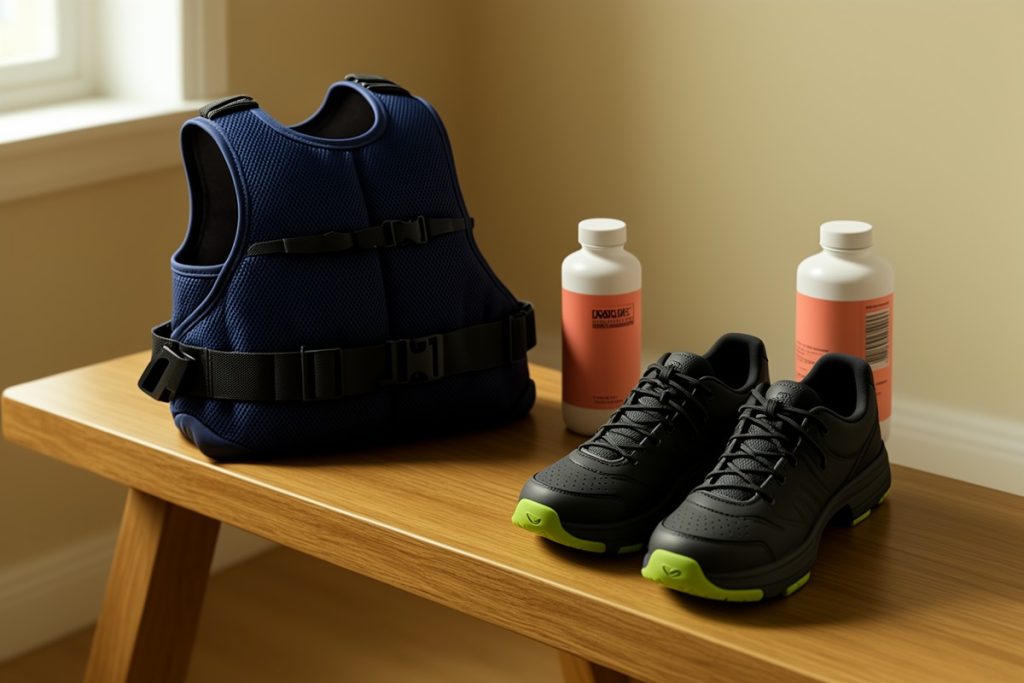
If you already walk consistently with a comfortable stride, a light vest may be an optional way to add resistance on a short, flat walk. The ZELUS Weighted Vest is listed in several weight options, from 6 to 30 pounds, and includes a reflective stripe. Start with the lightest practical setting, use it for a short session, and stop if you notice rubbing, altered posture, pain, or unusual breathing difficulty. You do not need a vest to improve walking fitness.
Practical checklist before increasing difficulty
- Can you complete your current walks without pain during or afterward?
- Has your normal pace and stride felt stable for at least several sessions?
- Are you changing only one variable this week?
- Do you have an easy recovery day afterward?
- Can you still maintain relaxed shoulders and controlled steps?
Progress should make your routine more capable, not more fragile. If discomfort is sharp, persistent, worsening, or associated with swelling, dizziness, chest pain, or unusual shortness of breath, stop exercising and seek appropriate medical advice. People with a chronic condition or a recent injury should ask a qualified clinician how to modify activity safely.
How to know the plan is working
Fitness progress is not limited to walking faster. You may notice that hills feel less intimidating, brisk intervals recover more quickly, or your usual route requires less concentration. You may also find that walking fits more naturally into your week.
Track one or two simple measures, such as the number of comfortable walks completed, how many brisk intervals you managed, or your perceived effort on the same route. Avoid judging progress from a single day. Weather, sleep, stress, and footwear can all change how a walk feels.
The CDC’s adult physical activity guidance emphasizes regular aerobic activity and muscle-strengthening work across the week. Walking can be a strong foundation, while other forms of movement can fill gaps that walking alone does not address. The most sustainable plan is the one that leaves you ready to do it again.
Last reviewed: 2026-11-20
Sources
- Adult Activity: An Overview — Centers for Disease Control and Prevention
- WHO Guidelines on Physical Activity and Sedentary Behaviour — World Health Organization