Quick answer
A home stair stepper can build beginner cardio fitness without requiring much floor space. Start with 15 to 20 minutes, keep the pace easy enough to speak in short sentences, and focus on smooth, controlled steps. Train two or three days per week, increase only one variable at a time, and stop if you feel pain, dizziness, chest discomfort, or unusual shortness of breath.
Key takeaways
- Begin with a five-minute warm-up and a manageable pace rather than chasing maximum resistance or speed.
- Keep your whole foot connected to each pedal, stand tall, and avoid hanging your body weight on the handles or nearby furniture.
- Progress by adding a few minutes or one short brisk interval—not everything at once.
- A stepper is useful for compact cardio, but it should complement walking and other movement rather than become your only activity.
By Jax Morrison, High-Energy Motivator
Why a stair stepper works for beginner cardio
Stair climbing is familiar, measurable, and easy to scale. A home stepper turns that pattern into a repeatable workout while taking up less room than many treadmills or ellipticals. Each controlled step challenges the muscles that extend your hips and knees, while your breathing and heart rate rise as the session continues.
The important word is controlled. A stair stepper is not automatically an easy workout because it is compact. The movement can feel demanding quickly, especially for someone returning to exercise. That makes it a good tool for learning pacing: you can slow down, pause, or end the session without needing to travel home from a gym.
Think of the stepper as one option for accumulating moderate aerobic activity. Current U.S. guidance encourages adults to work toward at least 150 minutes of moderate-intensity activity each week, plus muscle-strengthening activity on two days. You do not need to reach that target in your first week, and every session does not need to happen on the stepper.
Set your beginner intensity before you start
Use the talk test instead of guessing from a machine display. At a moderate effort, you should be able to speak in short sentences, although singing would feel difficult. If you can barely get out a few words, reduce the pace or take a recovery break. If the session feels almost effortless after several minutes, add a little speed while keeping your steps smooth.
You can also rate effort from 1 to 10. For a first session, aim roughly for a 4 or 5: purposeful, warm, and challenging, but not a test of willpower. The goal is to finish feeling that you could have done a little more. That reserve gives your joints, muscles, and cardiovascular system room to adapt.
A simple 20-minute stair-stepper workout
Use this session after checking the equipment, clearing the floor, and putting on stable athletic shoes. If 20 minutes feels too long, complete the warm-up, one or two work blocks, and a cooldown.
| Time | What to do | Target feeling |
|---|---|---|
| 4 minutes | Very easy stepping | Comfortable; gradually warm up |
| 6 minutes | Steady, moderate pace | You can speak in short sentences |
| 6 minutes | Three rounds of 1 brisk minute and 1 easy minute | Brisk but controlled; recover during easy minutes |
| 4 minutes | Slow cooldown | Breathing settles gradually |
Keep the first two or three workouts even simpler if necessary: five minutes easy, five minutes steady, then a slow cooldown. A workout that you can repeat consistently is more valuable than an ambitious session that leaves you too sore or discouraged to exercise again.
Use form that keeps the movement useful
Place your whole foot on each pedal and press through the foot rather than bouncing on your toes. Keep your knees tracking in the same general direction as your toes. Stand tall with your ribs stacked over your hips, relax your shoulders, and look forward instead of folding over the machine.
If your stepper has handles, use them for balance rather than pulling yourself upward. If you need to hold a wall or piece of furniture, make sure it is genuinely stable and cannot slide or tip. Do not turn the workout into an arm exercise by supporting most of your body weight with your upper body.
Your pace should look repeatable. Choppy, rushed steps, locked knees, or a deep forward lean are signs to slow down. Smooth movement is a better marker of readiness than a high step count.
How to progress without overdoing it
For the first two weeks, try two or three sessions on nonconsecutive days. Keep at least one easier day between challenging sessions, especially if your legs feel unusually tired. Add walking, mobility work, or simple strength training on other days so your routine does not depend on one movement pattern.
Progress with one change at a time:
- First: Add two to five minutes to the total session while keeping the same pace.
- Next: Add one additional short brisk interval, followed by an easy recovery.
- Later: Increase weekly frequency if you are recovering well.
- Always: Return to the previous level if soreness changes your walking, sleep, or normal activities.
Do not use sweat, calories, or a displayed step count as your only measure of improvement. Better control, steadier breathing, a longer comfortable session, and consistent attendance are meaningful progress markers.
Is a compact home stepper worth considering?
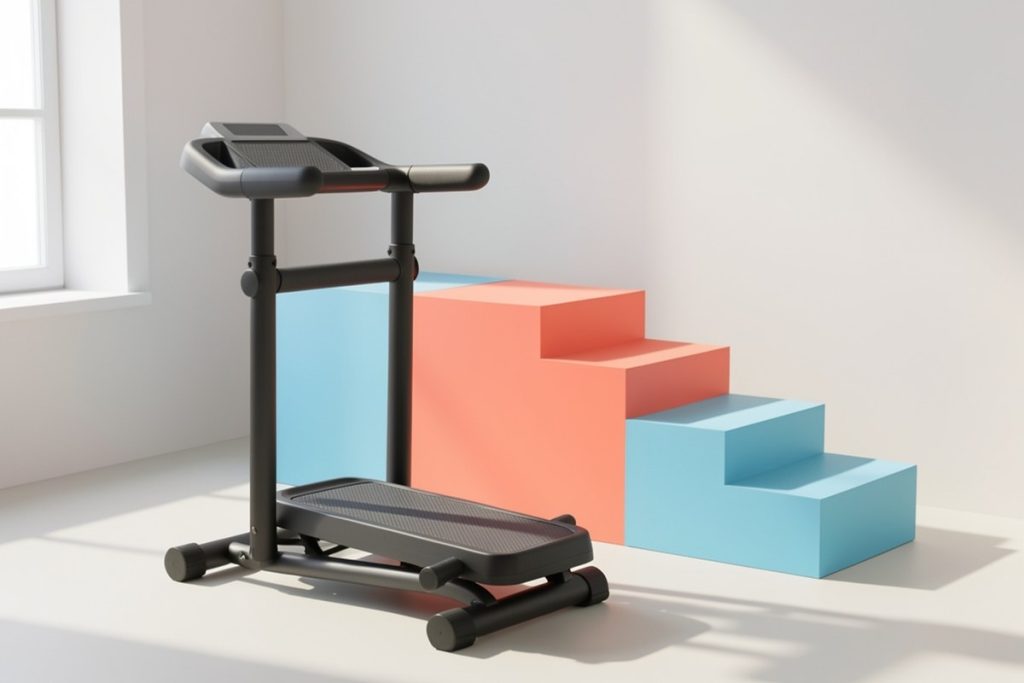
A stepper makes sense when your main obstacle is limited space, poor weather, or the need for a quick indoor routine. The Sunny Health & Fitness Stair Stepper & Climber Exercise Equipment is one compact cardio option to compare for that use case.
Keep the recommendation in perspective. A compact stepper will not give you the same continuous walking surface as a treadmill, and it may not suit someone who prefers seated cardio. Repeated stepping can also feel uncomfortable for some people with existing knee, hip, ankle, or balance concerns. Before buying, check the product dimensions, required clearance, user-weight specifications, stability features, and return terms against your space and needs. Those details matter more than a promise of rapid results.
Quick pre-workout checklist
- Clear the floor and place the machine on a stable, level surface.
- Wear supportive shoes and keep water nearby.
- Test a few slow steps before starting the timer.
- Choose an effort you can control, not the hardest available setting.
- Stop for sharp pain, chest pressure, faintness, severe breathlessness, or symptoms that feel unusual for you.
When to get professional guidance
If you have been inactive for a long time, are managing a chronic condition, are pregnant, or have a history of joint, heart, or balance concerns, ask a qualified healthcare professional how to begin safely. They can help you choose an appropriate intensity and identify modifications.
During exercise, stop and seek urgent medical help for serious warning signs such as chest pressure, fainting, severe breathing difficulty, or symptoms that do not improve with rest. Ordinary effort should feel challenging but recognizable—not frightening or medically alarming.
Last reviewed: 2026-11-20
Sources
- Physical Activity Guidelines for Adults — Centers for Disease Control and Prevention
- Physical Activity Guidelines for Americans, 2nd edition — U.S. Department of Health and Human Services
- Exercise and Physical Activity — National Institute on Aging